Porisma

A hint to get started

Use prism geometry to choose line and plane directions

Prism ABCDEF has rectangular base ABEF. Triangles ABC, DEF are congruent and perpendicular to the base. A,C have position vectors (−1,3,−5)(−1,3,−5), (3,7,5)(3,7,5). The unit vector in the direction FE is (5,−3,2)/38(5,−3,2)/\sqrt{38} and BC has equation r=(6,2,2)+λ(−3,5,3)\mathbf r=(6,2,2)+\lambda(-3,5,3), λ real. Find:

(i) a vector equation of AB and the position vector of B; marks

(ii) an equation of plane ABC in the form r⋅n=D\mathbf r\cdot\mathbf n=D; marks

(iii) a vector equation of BE; marks

(iv) the position vector of the perpendicular foot from C onto plane ABEF. marks

Expand diagram

Use the scrollbars or arrow keys to inspect details.
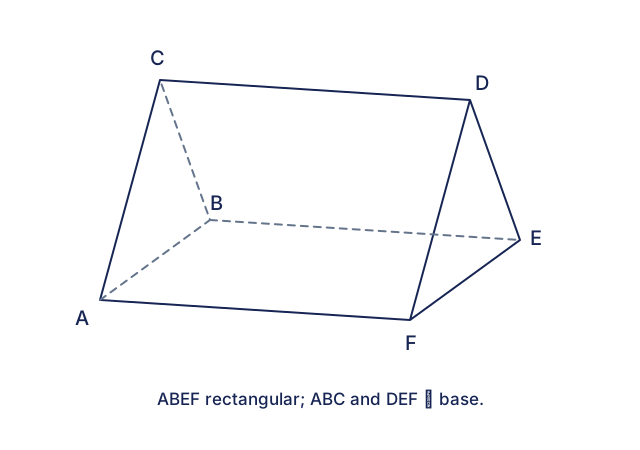
Prism ABCDEF: base ABEF is rectangular, triangles ABC and DEF are congruent and perpendicular to the base. Corresponding edges AF, BE, CD are parallel. Hidden edges AB, BC, BE are dashed. This is a perspective schematic retaining all source vertex labels and incidences, not a projection of the supplied coordinates.

[2010/MJC/Promo/12]

CJC · Review problems · Question 2

Use the rectangular base as well as the perpendicular end face to identify BE as a normal.

Read the worked solution