Porisma

Worked solution

Find a line-plane angle and reflect a point

Plane Π has equation r⋅(1,2,−3)=5\mathbf r\cdot(1,2,-3)=5. Line l passes through P with position vector (7,4,−6)(7,4,−6) and is parallel to (7,3,−5)(7,3,−5).

(i) Find the perpendicular distance from the origin to Π. marks

(ii) Find the acute angle between l and Π. marks

(iii) Find the position vector of the perpendicular foot from P to Π. Hence find the position vector of P’s reflection in Π. marks

[2007/IJC/I/10(modified)]

CJC · Review problems · Question 3

Answer

Distance 514/145\sqrt{14}/14; angle 0.964rad or 55.2°; OF=(5,0,0)OF=(5,0,0); OP′=(3,−4,6)OP′=(3,-4,6).

(i) Project to a plane normal

Choose A=(5,0,0) on Π. Its normal has magnitude√14. The distance is h=∣OA⋅(1,2,−3)/14∣=5/14=514/14h=|OA\cdot(1,2,-3)/\sqrt{14}|=5/\sqrt{14}=5\sqrt{14}/14 units.

How did this part go?

(ii) Take the complement of the normal angle

If α is the acute angle between l and the normal, α=cos⁡−1[28/(1483)]=0.60693\alpha=\cos^{-1}[28/(\sqrt{14}\sqrt{83})]=0.60693 rad(5s.f.), or 34.775°(5s.f.). The line-plane angle is π/2−α=0.964\pi/2-\alpha=0.964 rad(3s.f.), or 55.2°(1d.p.).

How did this part go?

(iii) Intersect a normal through P with Π

ln:r=(7,4,−6)+α(1,2,−3)l_n:\mathbf r=(7,4,-6)+\alpha(1,2,-3). At its foot F, (7+α,4+2α,−6−3α)⋅(1,2,−3)=5(7+\alpha,4+2\alpha,-6-3\alpha)\cdot(1,2,-3)=5. Thus 7+α+8+4α+18+9α=57+\alpha+8+4\alpha+18+9\alpha=5, so α=−2 and OF=(5,0,0)OF=(5,0,0).

How did this part go?

(iii) Use the foot as a midpoint

For reflected point P′, OF=(OP+OP′)/2OF=(OP+OP′)/2. Hence OP′=2OF−OP=2(5,0,0)−(7,4,−6)=(3,−4,6)OP′=2OF-OP=2(5,0,0)-(7,4,-6)=(3,-4,6).

How did this part go?

Compare your sketch

Expand diagram

Use the scrollbars or arrow keys to inspect details.
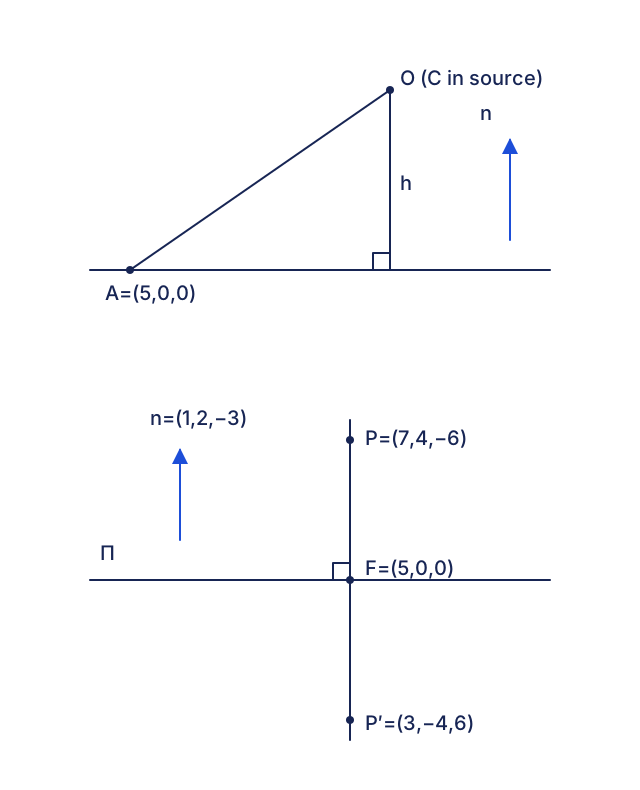
Upper source construction: A is on the plane, the origin (labelled C in the source sketch) is off it, and the perpendicular height h is its distance to the plane; normal n=(1,2,−3) shown. Lower: P,F,P′ lie on a normal line, F lies on the plane and is the midpoint of PP′. Both are independent planar schematics.

Common mistakes

Reflect through the perpendicular foot, not through an arbitrary point on the plane.

Solution notes

All source calculation stages, both angle units/roundings and both diagrams retained. The upper source sketch labels its off-plane vertex C, though the ask is the origin; the explanatory reconstruction identifies that role explicitly.

Read the hint