Worked solution
Reflect a light ray using the plane normal
A=(4,1,0), and line l1 is .
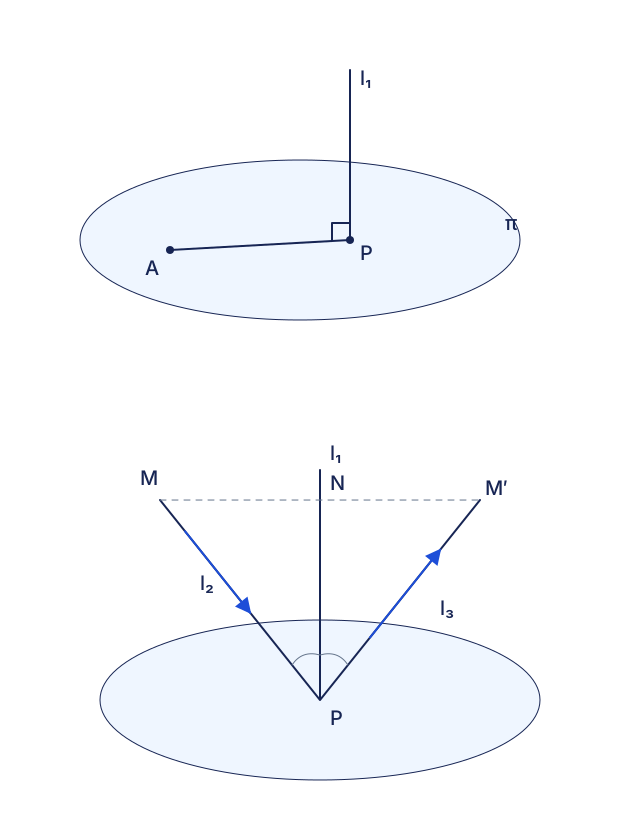
(i) Find plane π containing A and perpendicular to l1, in scalar-product form. marks
(ii) Find P on l1 with AP perpendicular to l1. marks
A ray travels along l2 from (0,−9,1) to P and reflects in π along l3, in the same plane as l1,l2, with equal angles between l1,l2 and l1,l3. Find l3. marks
[2016/SAJC/Promo/11]
CJC · Review problems · Question 12
Answer
π:; P=(2,1,1); reflected line .
(i) Use the line direction as the plane normal
. Hence π:.
(ii) Find the normal-plane intersection
P lies on l1 and π. Substitute : , giving λ=−1. Thus P=(2,1,1).
Reflection: find a foot from M to the normal line
Let M=(0,−9,1). Put . Then ; requiring gives , so 6t=2, t=1/3 and .
Reflection: mirror M across the normal axis
With M′ the reflection of M about l1,. The source reflects the source point about the normal line, producing the outgoing reflected ray through P.
Reflection: parameterise the outgoing line
. Thus , μ real for the supporting line, μ≥0 for the outgoing ray.
Compare your sketch
Expand diagramFit diagram to page
Use the scrollbars or arrow keys to inspect details.
Common mistakes
A supporting line uses any real parameter; the outgoing ray uses the nonnegative orientation shown here.
Solution notes
All printed asks, foot/midpoint reflection working and both source sketches retained. Ray orientation clarified without changing the supporting-line answer.