Porisma

Worked solution

Reflect a light ray using the plane normal

A=(4,1,0), and line l1 is x−3=−y=(z−3)/2x-3=-y=(z-3)/2.

(i) Find plane π containing A and perpendicular to l1, in scalar-product form. marks

(ii) Find P on l1 with AP perpendicular to l1. marks

A ray travels along l2 from (0,−9,1) to P and reflects in π along l3, in the same plane as l1,l2, with equal angles between l1,l2 and l1,l3. Find l3. marks

[2016/SAJC/Promo/11]

CJC · Review problems · Question 12

Answer

π:r⋅(1,−1,2)=3r\cdot(1,-1,2)=3; P=(2,1,1); reflected line r=(2,1,1)+μ(7,11,8)r=(2,1,1)+\mu(7,11,8).

(i) Use the line direction as the plane normal

l1:r=(3,0,3)+λ(1,−1,2)l_1:\mathbf r=(3,0,3)+\lambda(1,-1,2). Hence π:r⋅(1,−1,2)=(4,1,0)⋅(1,−1,2)=3\mathbf r\cdot(1,-1,2)=(4,1,0)\cdot(1,-1,2)=3.

How did this part go?

(ii) Find the normal-plane intersection

P lies on l1 and π. Substitute [(3,0,3)+λ(1,−1,2)]⋅(1,−1,2)=3[(3,0,3)+\lambda(1,-1,2)]\cdot(1,-1,2)=3: 3+λ+λ+6+4λ=33+\lambda+\lambda+6+4\lambda=3, giving λ=−1. Thus P=(2,1,1).

How did this part go?

Reflection: find a foot from M to the normal line

Let M=(0,−9,1). Put ON=(3,0,3)+t(1,−1,2)ON=(3,0,3)+t(1,-1,2). Then MN=(3+t,9−t,2+2t)MN=(3+t,9-t,2+2t); requiring MN⋅(1,−1,2)=0MN\cdot(1,-1,2)=0 gives 3+t−9+t+4+4t=03+t-9+t+4+4t=0, so 6t=2, t=1/3 and ON=(10/3,−1/3,11/3)ON=(10/3,-1/3,11/3).

How did this part go?

Reflection: mirror M across the normal axis

With M′ the reflection of M about l1,OM′=2ON−OM=2(10/3,−1/3,11/3)−(0,−9,1)=(20/3,25/3,19/3)OM′=2ON-OM=2(10/3,-1/3,11/3)-(0,-9,1)=(20/3,25/3,19/3). The source reflects the source point about the normal line, producing the outgoing reflected ray through P.

How did this part go?

Reflection: parameterise the outgoing line

PM′=(20/3,25/3,19/3)−(2,1,1)=(14/3,22/3,16/3)=23(7,11,8)PM′=(20/3,25/3,19/3)-(2,1,1)=(14/3,22/3,16/3)=\frac23(7,11,8). Thus l3:r=(2,1,1)+μ(7,11,8)l_3:\mathbf r=(2,1,1)+\mu(7,11,8), μ real for the supporting line, μ≥0 for the outgoing ray.

How did this part go?

Compare your sketch

Expand diagram

Use the scrollbars or arrow keys to inspect details.
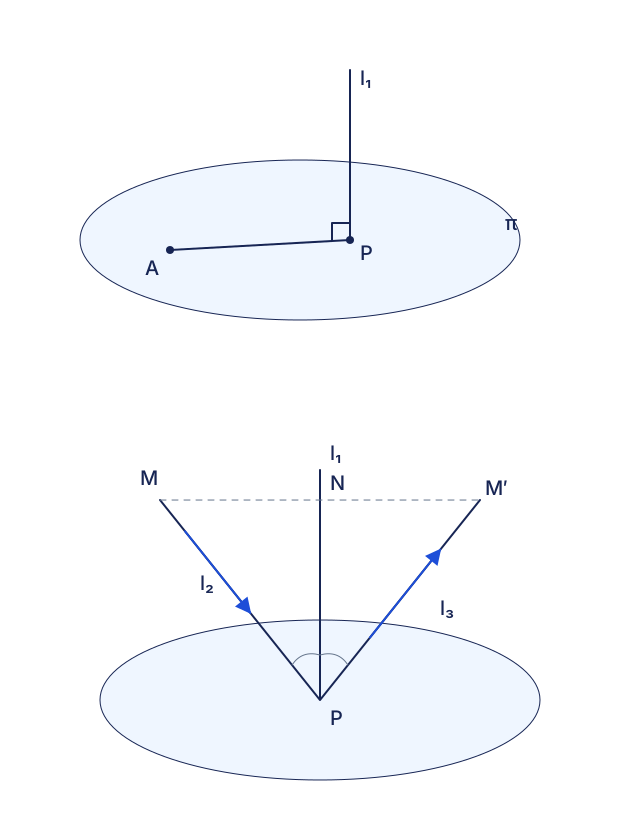
Upper: A and P lie in plane pi, AP is perpendicular to the normal line l1 through P. Lower: incoming ray from M meets P, and outgoing ray goes from P to M′, the reflection of M about the normal line l1; the two lines make equal acute angles with l1. N is the midpoint of MM′ on l1. Both printed sketches independently reconstructed as planar schematics.

Common mistakes

A supporting line uses any real parameter; the outgoing ray uses the nonnegative orientation shown here.

Solution notes

All printed asks, foot/midpoint reflection working and both source sketches retained. Ray orientation clarified without changing the supporting-line answer.

Read the hint