Worked solution
Rotations on an Argand diagram
The point represents a fixed complex number where . The complex numbers and are represented by the points and respectively.
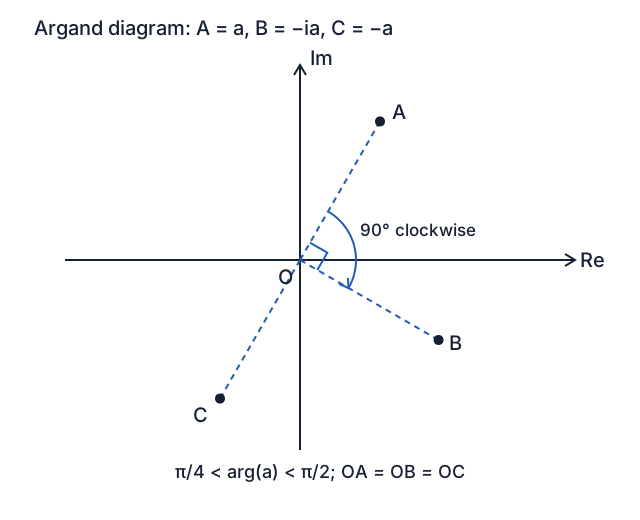
On a single clearly labelled Argand diagram, mark the points , and .
Describe the geometrical relationship between
(a) and , and
(b) and .
[2023/TJC_NYJC_VJC/FM/I/6(modified)]
CJC · Discussion · Question 9
Answer
B: 90° clockwise rotation of A about O. C: 180° rotation of A about O. All three have equal modulus.
Argand diagram
Put A in the first quadrant with argument strictly between and . B lies in the fourth quadrant at the same distance from O, obtained by multiplying a by −i. C is opposite A in the third quadrant, also at the same distance from O. A, O and C are collinear, and OA is perpendicular to OB.
(a)
B is obtained by rotating A 90° clockwise about the origin O.
(b)
C is obtained by rotating A 180° about the origin O.
Compare your sketch
Expand diagramFit diagram to page
Use the scrollbars or arrow keys to inspect details.
Common mistakes
The inequalities for arg(a) are strict; neither boundary ray is permitted.