Porisma

Worked solution

Sketch a derivative from a maximum and asymptotes

The diagram shows the graph of y=f(x)y=f(x). It has a maximum point (4a,3a)(4a,3a) and asymptotes x=2ax=2a and y=ay=a. The drawing also shows the curve passing through the origin and (3a,0)(3a,0).

Sketch the graph of y=f′(x)y=f^{\prime}(x), where f′f^{\prime} is the gradient function of ff, showing the relevant features of the graph.

Expand diagram

Use the scrollbars or arrow keys to inspect details.
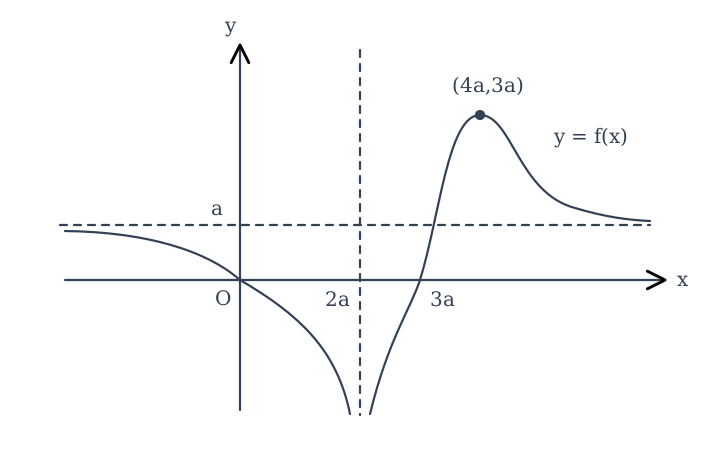
Given f: horizontal asymptote y=a and vertical asymptote x=2a. The decreasing left branch crosses the origin and tends to negative infinity at 2a from the left. The right branch rises from negative infinity, crosses at 3a, reaches the maximum (4a,3a), then decreases towards y=a from above.

[2007/MJC/I/9]

CJC · Discussion · Question 2

Answer

f′f^{\prime} is negative for x<2ax<2a and x>4ax>4a, positive for 2a<x<4a2a<x<4a, and zero at 4a4a. The source sketch has asymptotes x=2ax=2a and y=0y=0.

Read the slope on each branch

The given curve decreases for x<2ax<2a, increases for 2a<x<4a2a<x<4a, and decreases for x>4ax>4a. Hence f′(x)<0f^{\prime}(x)<0, f′(x)>0f^{\prime}(x)>0, and f′(x)<0f^{\prime}(x)<0 on those respective intervals. At the maximum, f′(4a)=0f^{\prime}(4a)=0, with a change from positive to negative.

How did this part go?

Draw the source gradient sketch

The printed solution has vertical asymptote x=2ax=2a and horizontal asymptote y=0y=0. Its left branch lies below the axis and falls to −∞-\infty as x→2a−x\to2a^-; its right branch starts at +∞+\infty as x→2a+x\to2a^+, crosses at (4a,0)(4a,0), reaches an unlabelled minimum below the axis, then approaches 00 from below.

These are the smooth qualitative branches in the supplied sketch. No numerical position or depth is specified for the derivative’s minimum. The original curve’s intercepts at 00 and 3a3a do not become zeros of its derivative.

How did this part go?

Compare your sketch

Expand diagram

Use the scrollbars or arrow keys to inspect details.
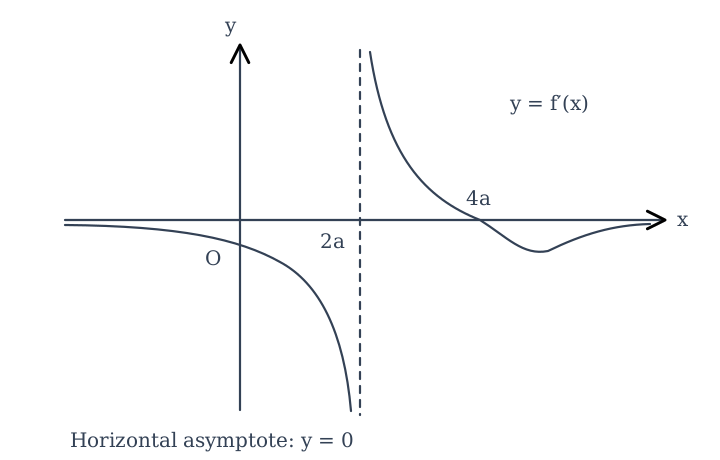
Derivative sketch: vertical asymptote x=2a and horizontal asymptote y=0. The left branch is negative. The right branch is positive before crossing the x-axis at 4a, then negative, reaching an unlabelled minimum and approaching zero from below.

Common mistakes

An x-intercept of the function does not imply zero derivative.

Read the hint