Porisma

Worked solution

Recover a decreasing function from its modulus

The diagram shows the graph of y=∣h(x)∣y=|h(x)|. Given that h′(x)<0h^{\prime}(x)<0 for x∈Rx\in\mathbb{R}, x≠0x\ne0, sketch the graph of y=h(x)y=h(x).

The supplied modulus graph has vertical asymptote x=0x=0, horizontal asymptote y=ay=a, and a zero at x=b>0x=b>0.

Expand diagram

Use the scrollbars or arrow keys to inspect details.
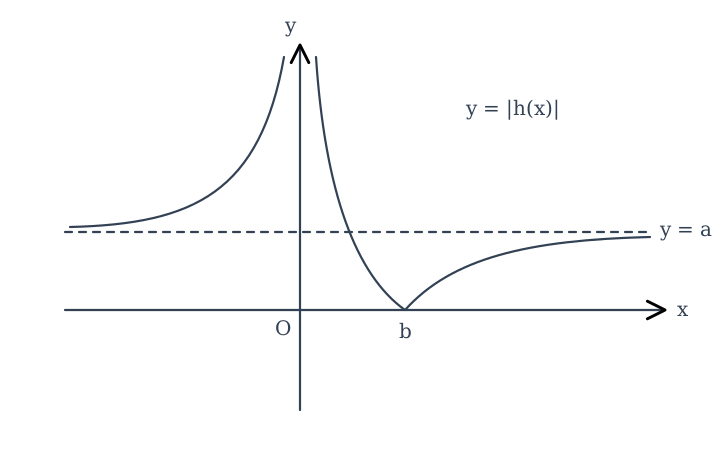
Given modulus graph |h(x)|: a positive left branch increases from horizontal asymptote y=a towards infinity at x=0. On the right, the graph falls from infinity to zero at x=b, then rises towards y=a from below. The point b is positive.

[2010/IJC/Promo/6b]

CJC · Discussion · Question 4

Answer

Reflect the x<0x<0 and x>bx>b portions of ∣h∣|h| below the x-axis; keep 0<x<b0<x<b above it. The asymptotes of hh are x=0x=0 and y=−ay=-a.

Choose the sign to the left of zero

For x<0x<0, the given ∣h(x)∣|h(x)| increases towards +∞+\infty. Since hh must decrease, this branch must be reflected below the x-axis: h(x)=−∣h(x)∣h(x)=-|h(x)|. It approaches y=−ay=-a from below as x→−∞x\to-\infty, and tends to −∞-\infty as x→0−x\to0^-.

How did this part go?

Choose the signs around the zero at b

On 0<x<b0<x<b, the modulus graph decreases from +∞+\infty to zero, so keep this branch above the axis: h(x)=∣h(x)∣h(x)=|h(x)|. After bb, the modulus graph increases, so reflect that portion below the axis: h(x)=−∣h(x)∣h(x)=-|h(x)| for x>bx>b. The reconstructed hh decreases through (b,0)(b,0) and approaches y=−ay=-a from above as x→+∞x\to+\infty.

How did this part go?

State the complete sketch

The result has vertical asymptote x=0x=0 and horizontal asymptote y=−ay=-a. Its left branch is negative, while the right branch starts positive, crosses at (b,0)(b,0), then becomes negative. The derivative condition excludes x=0x=0; do not join the branches across the vertical asymptote.

How did this part go?

Compare your sketch

Expand diagram

Use the scrollbars or arrow keys to inspect details.
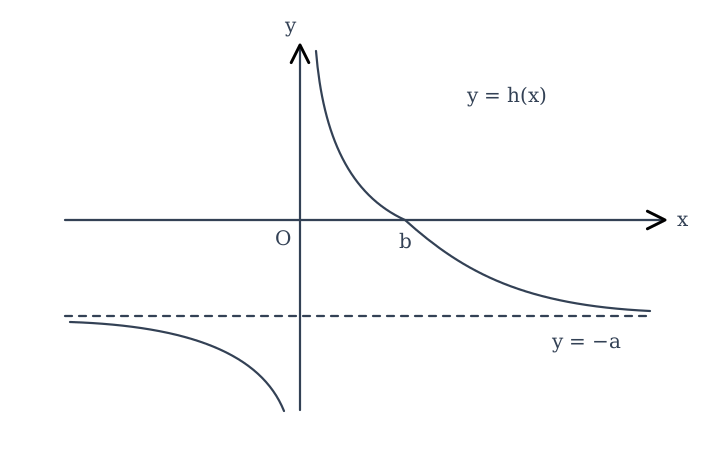
Reconstructed h: the left branch decreases below y=−a towards negative infinity at x=0. The right branch decreases from positive infinity at x=0, crosses the axis at b and tends to y=−a from above. Both branches are strictly decreasing.

Common mistakes

The bars mean absolute value. Copying the entire given graph would leave increasing portions.

Read the hint