Worked solution
Read stationary points and concavity from a gradient graph
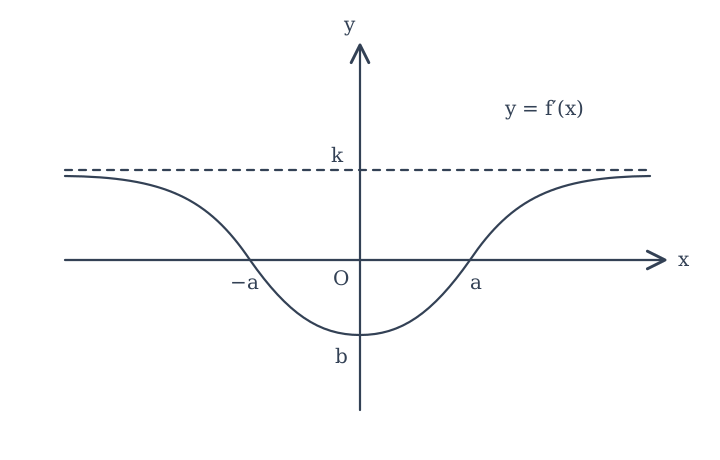
The diagram shows . The curve cuts the x-axis at and , has a stationary point at , and has asymptote .
(i) State the x-coordinates of the stationary points of and determine the nature of each.
(ii) State the ranges of for which is (a) strictly increasing, (b) concave downwards.
Expand diagramFit diagram to page
Use the scrollbars or arrow keys to inspect details.
[2008/IJC/Promo/6]
CJC · Discussion · Question 5
Answer
Maximum at , minimum at ; strictly increasing for or ; concave downwards for .
(i) Locate and classify the stationary points
Stationary points of occur where , so .
| Location | Sign of f′ just before | Sign at the point | Sign just after | Nature of f |
|---|---|---|---|---|
| −a | + | 0 | − | Maximum |
| a | − | 0 | + | Minimum |
The source sign charts show rising–horizontal–falling at and falling–horizontal–rising at .
(ii)(a) Read positive gradients
for or . These are the printed open ranges of strict increase.
(ii)(b) Read decreasing gradients
Concavity downwards requires , meaning that the graph of decreases. This occurs for , not simply wherever is negative.
Common mistakes
A negative derivative means decreasing; it does not alone mean concave downwards.