Porisma

Worked solution

Combine a leaking cone with trapezium optimisation

(a) A factory produces disposable cups in the shape of inverted right cones of radius 44 cm and height 88 cm. For a quality check, the supervisor fills one cup completely with water. Water leaks from its vertex at a constant 1.5 cm3 s−11.5\text{ cm}^3\text{ s}^{-1}. Find the exact rate at which the water level is decreasing when its depth is 22 cm. marks

The volume of a cone of base radius rr and height hh is 13πr2h\tfrac13\pi r^2h.

(b) Trapezium ABCDABCD has height 55 cm and DA+AB+BC=20DA+AB+BC=20 cm. Points M,NM,N are the feet of the perpendiculars from A,BA,B to DCDC. Given ∠DAM=∠CBN=θ\angle DAM=\angle CBN=\theta, where 0<θ<π/20<\theta<\pi/2:

(i) Show that its area is A=100−50sec⁡θ+25tan⁡θ cm2A=100-50\sec\theta+25\tan\theta\text{ cm}^2. marks

(ii) Hence use differentiation to find its maximum area in exact form. You do not need to verify that it is a maximum. marks

Expand diagram

Use the scrollbars or arrow keys to inspect details.
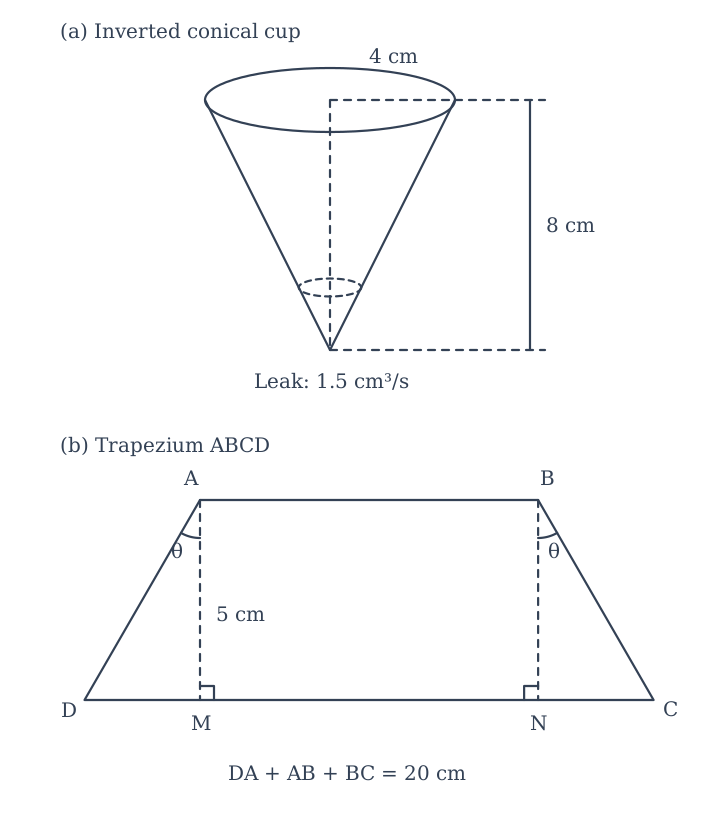
Two given diagrams. (a) An inverted conical cup with top radius 4 cm and vertical height 8 cm, with a smaller water cone inside and leakage at its bottom vertex. (b) Trapezium ABCD with top AB, longer base DC and perpendiculars AM and BN of length 5 cm. The equal angles theta lie between AD and AM at A, and between BC and BN at B. The sum DA+AB+BC is 20 cm.

[2022/TMJC/I/6]

CJC · Discussion · Question 13

Answer

(a) Decreases at 3/(2π) cm s−13/(2\pi)\text{ cm s}^{-1}. (b) A=100−50sec⁡θ+25tan⁡θA=100-50\sec\theta+25\tan\theta; maximum 100−253 cm2100-25\sqrt3\text{ cm}^2 at θ=π/6\theta=\pi/6.

(a) Relate radius, depth and volume

For the smaller cone of water, similar triangles give r/h=4/8=1/2r/h=4/8=1/2, so r=h/2r=h/2 and V=13π(h/2)2h=πh3/12V=\tfrac13\pi(h/2)^2h=\pi h^3/12. Hence dV/dh=πh2/4dV/dh=\pi h^2/4.

How did this part go?

(a) Apply the signed rate and report a decrease

The loss gives dV/dt=−1.5=−3/2 cm3 s−1dV/dt=-1.5=-3/2\text{ cm}^3\text{ s}^{-1}. At h=2h=2,

dVdt=dVdhdhdt,−32=π4(2)2dhdt,dhdt=−32π cm s−1.\frac{dV}{dt}=\frac{dV}{dh}\frac{dh}{dt},\qquad-\frac32=\frac{\pi}{4}(2)^2\frac{dh}{dt},\qquad\frac{dh}{dt}=-\frac{3}{2\pi}\text{ cm s}^{-1}.

Thus the rate at which the water level is decreasing is the positive magnitude 3/(2π) cm s−13/(2\pi)\text{ cm s}^{-1}.

How did this part go?

(b)(i) Use the height and three-side constraint

From the two end right triangles, DM=NC=5tan⁡θDM=NC=5\tan\theta and AD=BC=5sec⁡θAD=BC=5\sec\theta. Therefore AB=20−10sec⁡θAB=20-10\sec\theta, and DC=AB+10tan⁡θDC=AB+10\tan\theta. The area is

A=52(AB+DC)=52[2(20−10sec⁡θ)+10tan⁡θ]=100−50sec⁡θ+25tan⁡θ.\begin{aligned}&A\\ & =\frac52(AB+DC)\\ & =\frac52\left[2(20-10\sec\theta)+10\tan\theta\right]\\ & =100-50\sec\theta+25\tan\theta.\end{aligned}

For an actual nondegenerate trapezium, AB>0AB>0 further requires 0<θ<π/30<\theta<\pi/3 within the stated angle range. This does not change the printed optimiser below.

How did this part go?

(b)(ii) Differentiate and evaluate the admissible angle

Set

dAdθ=−50sec⁡θtan⁡θ+25sec⁡2θ=25sec⁡θ(−2tan⁡θ+sec⁡θ)=0.\begin{aligned}&\frac{dA}{d\theta}\\ & =-50\sec\theta\tan\theta+25\sec^2\theta\\ & =25\sec\theta(-2\tan\theta+\sec\theta)\\ & =0.\end{aligned}

The factor sec⁡θ\sec\theta cannot be zero. Thus 2tan⁡θ=sec⁡θ2\tan\theta=\sec\theta, giving sin⁡θ=1/2\sin\theta=1/2 and θ=π/6\theta=\pi/6. This lies in the feasible geometric range. Substitute sec⁡(π/6)=2/3\sec(\pi/6)=2/\sqrt3 and tan⁡(π/6)=1/3\tan(\pi/6)=1/\sqrt3:

Amax⁡=100−5023+2513=100−753=100−253 cm2.\begin{aligned}&A_{\max}\\ & =100-50\frac2{\sqrt3}+25\frac1{\sqrt3}\\ & =100-\frac{75}{\sqrt3}\\ & =100-25\sqrt3\text{ cm}^2.\end{aligned}

The question explicitly does not require a separate maximum test.

How did this part go?

Common mistakes

The angle is measured from the vertical perpendicular, so the sloping side is 5 sec(theta), not 5 cosec(theta).

Read the hint