Worked solution
Combine a leaking cone with trapezium optimisation
(a) A factory produces disposable cups in the shape of inverted right cones of radius cm and height cm. For a quality check, the supervisor fills one cup completely with water. Water leaks from its vertex at a constant . Find the exact rate at which the water level is decreasing when its depth is cm. marks
The volume of a cone of base radius and height is .
(b) Trapezium has height cm and cm. Points are the feet of the perpendiculars from to . Given , where :
(i) Show that its area is . marks
(ii) Hence use differentiation to find its maximum area in exact form. You do not need to verify that it is a maximum. marks
Expand diagramFit diagram to page
Use the scrollbars or arrow keys to inspect details.
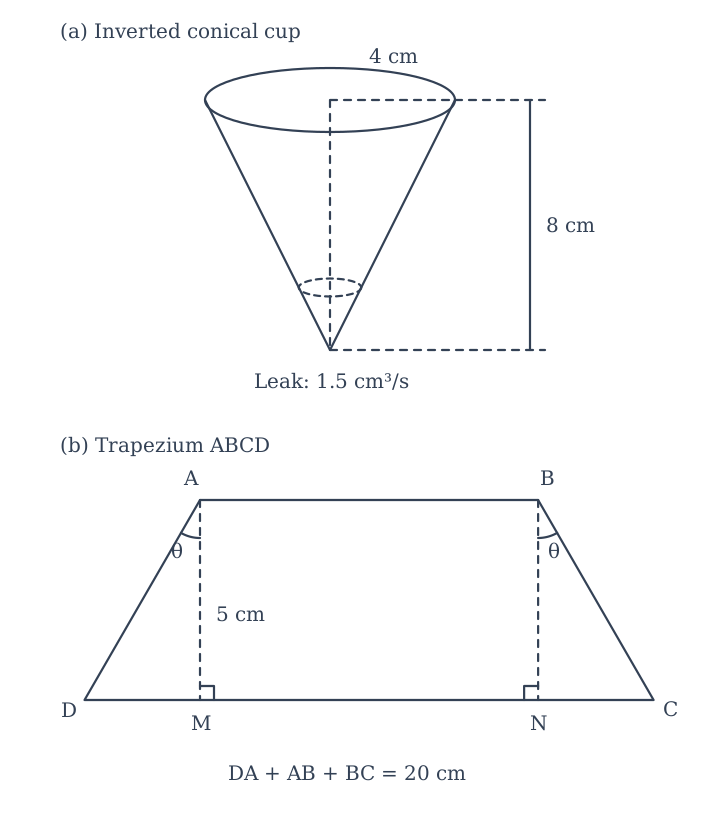
[2022/TMJC/I/6]
CJC · Discussion · Question 13
Answer
(a) Decreases at . (b) ; maximum at .
(a) Relate radius, depth and volume
For the smaller cone of water, similar triangles give , so and . Hence .
(a) Apply the signed rate and report a decrease
The loss gives . At ,
Thus the rate at which the water level is decreasing is the positive magnitude .
(b)(i) Use the height and three-side constraint
From the two end right triangles, and . Therefore , and . The area is
For an actual nondegenerate trapezium, further requires within the stated angle range. This does not change the printed optimiser below.
(b)(ii) Differentiate and evaluate the admissible angle
Set
The factor cannot be zero. Thus , giving and . This lies in the feasible geometric range. Substitute and :
The question explicitly does not require a separate maximum test.
Common mistakes
The angle is measured from the vertical perpendicular, so the sloping side is 5 sec(theta), not 5 cosec(theta).