Worked solution
Link the discriminant interval to the missing horizontal levels
C has equation .
(i) Find its asymptotes.
(ii) Find, in exact form, all k for which has no real roots.
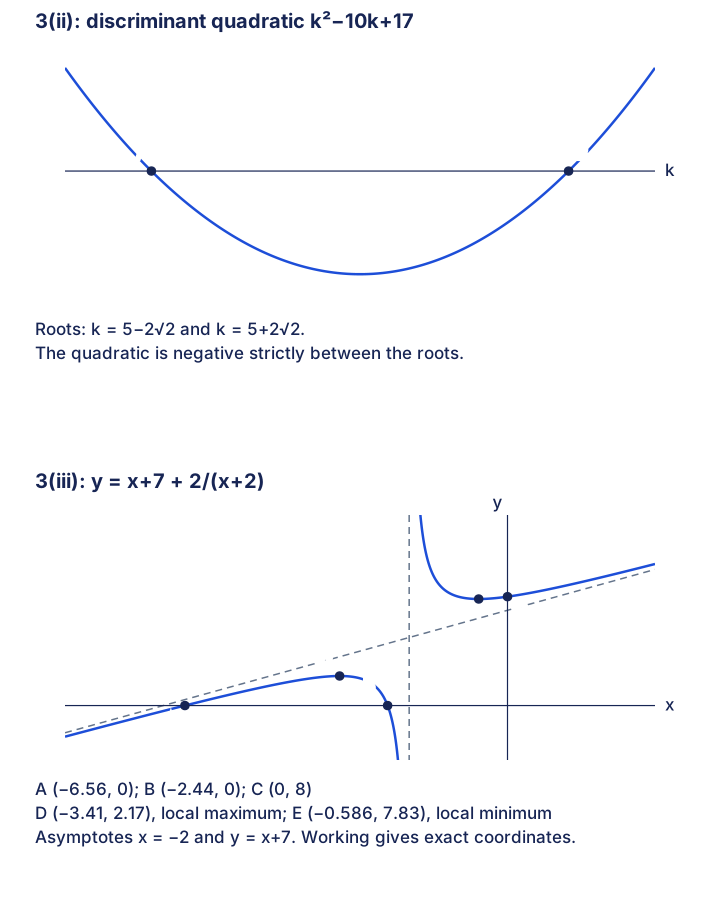
(iii) Sketch C with asymptotes, stationary points and x-/y-axis intersections labelled.
[2009/IJC/II/1]
CJC · Discussion · Question 3
Answer
Asymptotes x=−2,y=x+7; no roots for ; all intercepts/turns shown.
(i) Perform the full division
Subtract from the numerator to leave 7 x+16. Subtract to leave 2. Hence , with asymptotes y=x+7 and x=−2.
(ii) Form a quadratic in x
For x≠−2, , hence . Its discriminant must be negative: , so , or . The excluded x=−2 cannot be a spurious quadratic root because substitution gives 2, not 0.
(ii) Solve the boundary quadratic exactly
. The upward-opening quadratic is negative between these roots. Therefore , as in the source number-line sketch.
(iii) Find intercepts and stationary points
The y-intercept is (0,8); x-intercepts are , approximately (−6.56,0),(−2.44,0). Since , stationary points are , local maximum≈(−3.41,2.17), and , local minimum≈(−0.586,7.83). Both asymptotes and both branches are retained. The exact coordinates supplement the source’s rounded graph labels.
Compare your sketch
Expand diagramFit diagram to page
Use the scrollbars or arrow keys to inspect details.
Common mistakes
Keep both discriminant endpoints excluded: at an endpoint the horizontal line touches a stationary point.
Solution notes
The missing horizontal levels lie strictly between the two stationary output values.
Exact intercept and stationary coordinates are given in the working alongside the rounded graph labels.