Worked solution
Recover the coefficients from a vertical and an oblique asymptote
has equation .
(i) It has vertical asymptote x=2 and an oblique asymptote through (0,10) and (−2,0). Find a,b,c.
(ii) Hence sketch , clearly stating all asymptotes and stationary points.
[2014/NJC/MYE/7(part)]
CJC · Discussion · Question 4
Answer
a=5,b=0,c=−2; asymptotes x=2,y=5 x+10; stationary points(0,0) and (4,40).
(i) Determine the denominator shift
The vertical asymptote gives x=−c=2, so c=−2.
(i) Find the quotient and remainder
. Subtract to leave . Thus , with oblique asymptote y=ax+b+2 a.
(i) Substitute the two given points
At (0,10), b+2 a=10. At (−2,0), −2 a+b+2 a=0, so b=0. Hence a=5 and c=−2.
(ii) Identify the curve and both stationary points
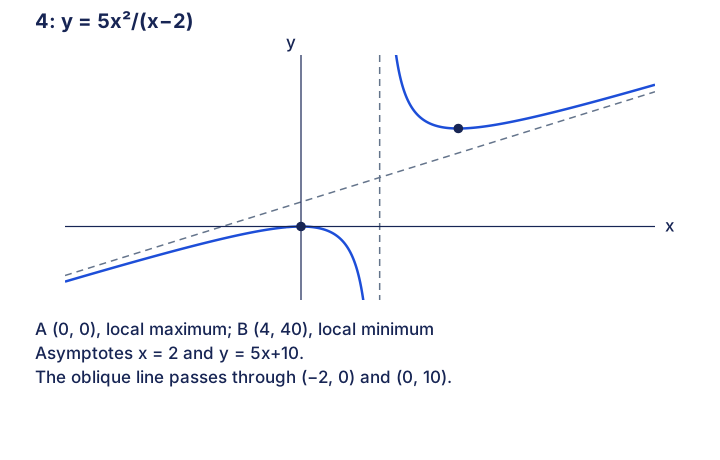
Now . The asymptotes are x=2 and y=5 x+10. The source sketch labels (0,0) and (4,40); differentiation gives , confirming a local maximum (0,0) and local minimum (4,40). The oblique line’s axis crossings (−2,0),(0,10)are shown separately from the curve intercept (0,0).
Compare your sketch
Expand diagramFit diagram to page
Use the scrollbars or arrow keys to inspect details.
Common mistakes
Points supplied on an asymptote are not necessarily points on the curve.
Solution notes
Use the two given points on the oblique asymptote to recover its slope and intercept.
The curve’s stationary points are (0,0) and (4,40); the asymptote’s crossings are different points.