Worked solution
Use missing output levels and a circle comparison to count roots
C has equation , with vertical asymptote x=−1 and a stationary point at x=2.
(i) Find a and b.
(ii) Find the other asymptote.
(iii) Without a calculator, find the set of values y cannot take.
(iv) Sketch C, showing axial intercepts, asymptotes and stationary points.
(v) Deduce the number of real roots of .
[2007/HCI/I/13(modified)]
CJC · Discussion · Question 5
Answer
a=−4,b=1; other asymptote y=x−5; missing outputs −12<y<0; turns (−4,−12),(2,0); final equation has 2 distinct real roots.
(i) Recover b and differentiate before substituting
The vertical asymptote gives b=1. The quotient rule yields . At the stationary point x=2, , hence a=−4.
(ii) Divide to expose the oblique asymptote
. Therefore the other asymptote is y=x−5.
(iii) Form a quadratic with the output y as parameter
gives , hence . For no real x, . Thus , so , or y(y+12)<0. The unattainable set is exactly −12<y<0. The excluded x=−1 never solves this quadratic, since substitution gives 9.
(iv) Label the complete curve
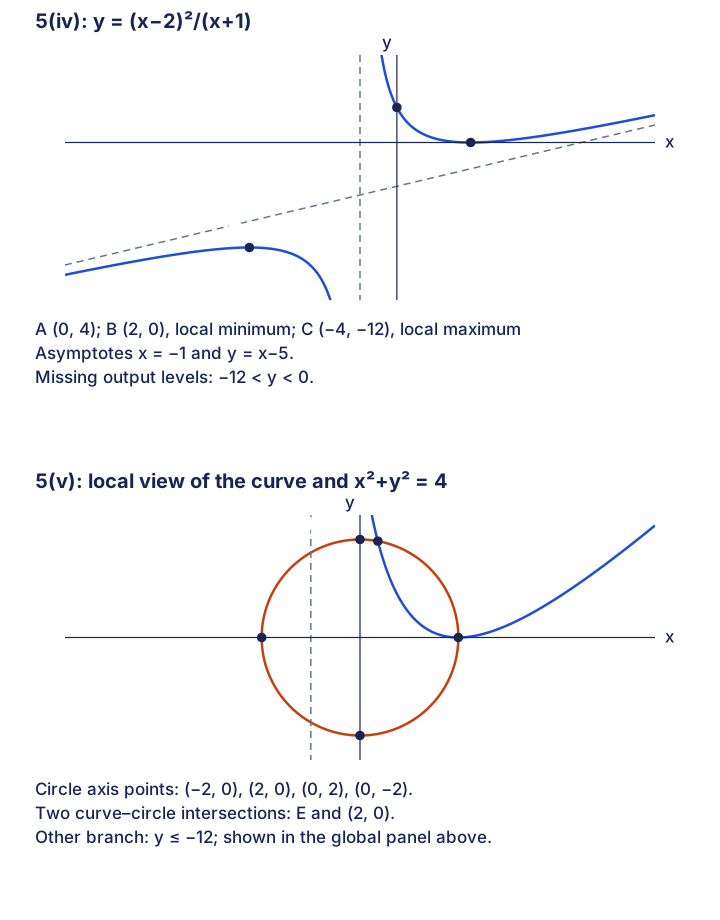
Asymptotes are x=−1 and y=x−5. Intercepts are (0,4) and (2,0), with the latter a local minimum. The other stationary point is a local maximum (−4,−12), as shown in the source. In fact . Boundary outputs −12 and 0 are attained, explaining why they are not in the missing-output interval.
(v) Compare the curve with a circle
For x≠−1, divide the equation by (x+1)²to obtain . With y equal to the curve, this is , or : the circle x²+y²=4. The source circle sketch labels (−2,0),(2,0),(0,2),(0,−2) and shows two intersections with C. Hence the original equation has two distinct real roots. x=−1 is not a lost root: the original sides there are 0 and 81.
(v) Confirm the graphical count algebraically
As a supplementary check, bring all terms to one side and factor to get , up to an overall nonzero sign. The cubic derivative is positive for all real x, so it has exactly one real root; its values at 0 and 1 have opposite signs. That root is distinct from x=2. This confirms the source’s two-intersection deduction without replacing it.
Compare your sketch
Expand diagramFit diagram to page
Use the scrollbars or arrow keys to inspect details.
Common mistakes
Keep both semicircles when rewriting y²=4−x², and check the excluded denominator input before dividing.
Solution notes
The output levels −12 and 0 are attained, so only the open interval between them is excluded.
Both semicircles are needed for the circle comparison. The local view complements the global curve, whose left branch cannot meet the circle.