Worked solution
Respect the vertical-asymptote condition at the derivative boundary
· Techniques of Differentiation
C has equation , where a,b are nonzero constants. x=2 is an asymptote.
(i) State b.
(ii) By differentiation, find the range of a for which C has no stationary points.
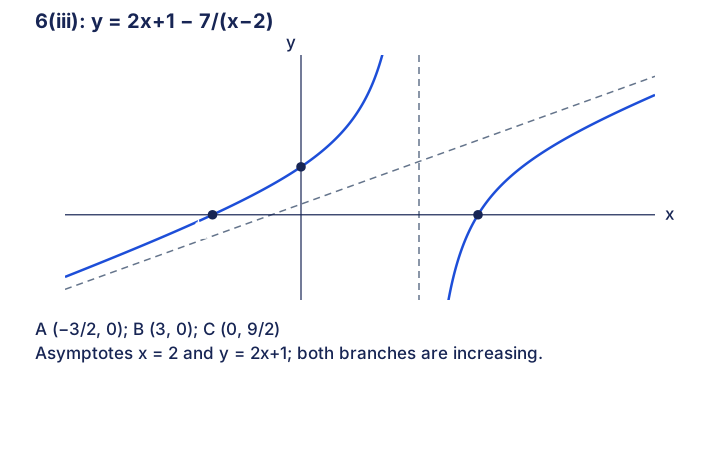
(iii) Given a=−3, sketch C with all asymptotes and axis intersections.
[2009/RJC/I/10]
CJC · Discussion · Question 6
Answer
b=−2; a<−8/5; at a=−3, asymptotes x=2,y=2 x+1 and intercepts (−3/2,0),(3,0),(0,9/2).
(i) Locate the denominator zero
The vertical asymptote gives b=−2.
(ii) Differentiate using the quotient rule
. The source excludes real zeros of the derivative numerator by requiring the discriminant of to be negative: , hence 8+5 a<0, giving a<−8/5.
(ii) Check the excluded boundary against the original assumption
At a=−8/5 the derivative numerator’s only zero is x=2, which is outside the domain. However, the original function then cancels to a line with a hole at x=2, so x=2 is no longer a vertical asymptote. This boundary violates the given condition and is excluded. Thus the source’s strict a<−8/5 range is correct within the stated problem.
(iii) Divide and identify each intercept
At a=−3, . Asymptotes are x=2 and y=2 x+1. The numerator factors as(2 x+3)(x−3), giving intercepts (−3/2,0),(3,0), and the y-intercept is (0,9/2). Both branches increase; for this a the derivative is .
Compare your sketch
Expand diagramFit diagram to page
Use the scrollbars or arrow keys to inspect details.
Common mistakes
A derivative numerator zero at an excluded input is not a stationary point; cancellation may also invalidate the given vertical asymptote.
Solution notes
The boundary a=−8/5 would replace the vertical asymptote by a removable hole, contradicting the given condition.
For a=−3 the derivative is positive on both domain intervals; no stationary points occur.