Maclaurin series and approximation
Practice section 5 of 7
Questions 25–30 in this collection
Practice questions
Discussion practice · 1 of 6
Transform an exponential series without differentiating again
Let . Show that . Hence find its Maclaurin expansion through , and deduce the expansion of through .
[2007/HCI/I/8]
CJC · Discussion · Question 10
Solution
Discussion practice · 2 of 6
Match trigonometric and exponential series
Let for real distinct positive constants .
(i) Show that .
(ii) Hence find the first three nonzero Maclaurin terms in terms of .
(iii) These terms agree with the first three terms of for small . Using MF27, find the exact values of .
[2022/RVHS/II/4(modified)]
CJC · Discussion · Question 11
Solution
Discussion practice · 3 of 6
Approximate a triangle side using radians
In triangle , , radians and radians (see diagram).
(i) Show that .
(ii) For sufficiently small , show that , determining .
Expand diagramFit diagram to page
Use the scrollbars or arrow keys to inspect details.
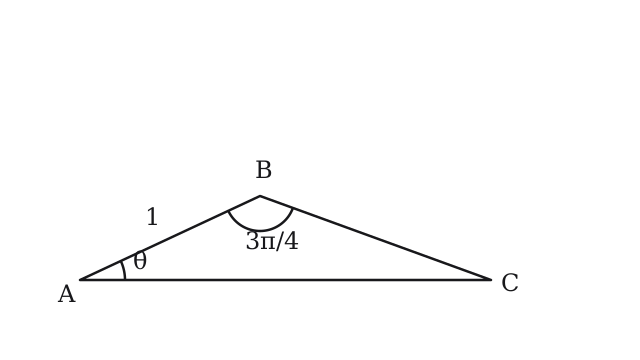
[N2012/I/4]
CJC · Discussion · Question 12
Solution
Review practice · 4 of 6
Partial fractions before a local expansion
Express in partial fractions and hence obtain as a series expansion in ascending powers of up to and including the term in . [5]
Find the range of values of for which the expansion is valid. [1]
[2009/HCI/I/7(modified)]
CJC · Review problems · Question 1
Solution
Review practice · 5 of 6
Extract a constant term from a Laurent product
Expand in ascending powers of through , and state its range of validity. Find if the term independent of in is . [6]
[2007/NYJC/I/1]
CJC · Review problems · Question 2
Solution
Review practice · 6 of 6
Choose a valid substitution for a square-root estimate
Expand through . [4]
(i) A student substitutes to estimate . Explain why this is wrong. [1]
(ii) Put in the expansion to show , and find the positive integer . [2]
[2001/RJC/I/16(a)]
CJC · Review problems · Question 3