Porisma

A hint to get started

Start from the actual given graph f(x)+3

The supplied graph is y=f(x)+3y=f(x)+3, with maximum (−1,5), y-intercept 3 and a right-hand horizontal asymptote y=1.

Sketch on separate diagrams:

(i) y=f(x)y=f(x);

(ii) y=−f(x)+3y=-f(x)+3;

(iii) y=f(−x+3)y=f(-x+3);

(iv) y=f(2x+1)y=f(2x+1).

Clearly indicate asymptotes, turning points and intercepts where possible.

Expand diagram

Use the scrollbars or arrow keys to inspect details.
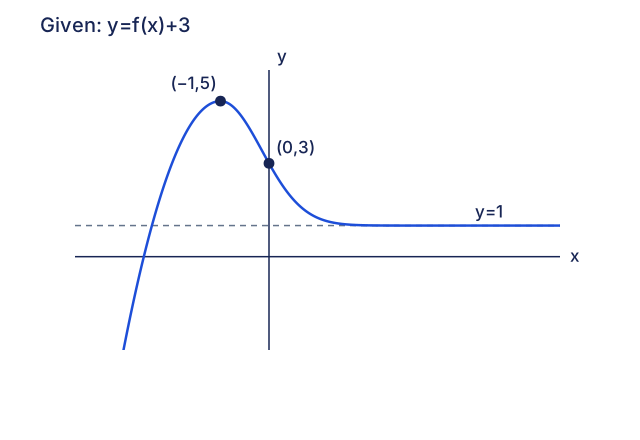
Independent qualitative reconstruction of the supplied graph y=f(x)+3: maximum (-1,5),y intercept (0,3), right-hand horizontal asymptote y=1. Unlabelled crossings and interpolation are schematic; no exact f formula or additional intercept coordinate is inferred.

CJC · Discussion · Question 2

First recover f itself; the given picture already includes a vertical shift of 3.

Read the worked solution