Porisma
All chapter practice

Graph transformations

Practice section 7 of 9

Questions 37–42 in this collection

Practice questions

Discussion practice · 1 of 6

Start from the actual given graph f(x)+3

The supplied graph is y=f(x)+3y=f(x)+3, with maximum (−1,5), y-intercept 3 and a right-hand horizontal asymptote y=1.

Sketch on separate diagrams:

(i) y=f(x)y=f(x);

(ii) y=−f(x)+3y=-f(x)+3;

(iii) y=f(−x+3)y=f(-x+3);

(iv) y=f(2x+1)y=f(2x+1).

Clearly indicate asymptotes, turning points and intercepts where possible.

Expand diagram

Use the scrollbars or arrow keys to inspect details.
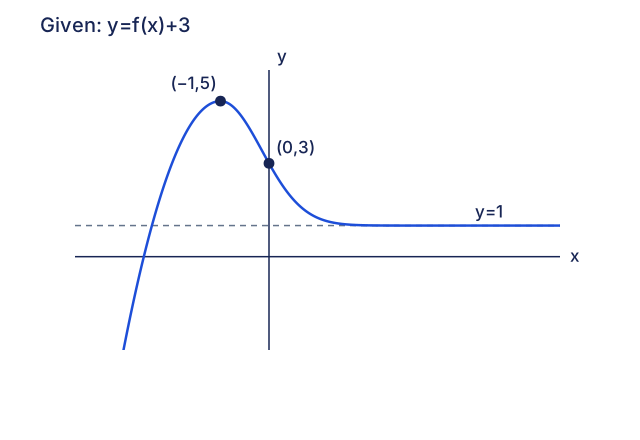
Independent qualitative reconstruction of the supplied graph y=f(x)+3: maximum (-1,5),y intercept (0,3), right-hand horizontal asymptote y=1. Unlabelled crossings and interpolation are schematic; no exact f formula or additional intercept coordinate is inferred.

CJC · Discussion · Question 2

Solution

Discussion practice · 2 of 6

Transform symbolic coordinates without choosing k

The given graph y=f(x)y=f(x) shows A=(k,1), B=(2k,−2), C=(3k,1), with k>0 as noted in the solution.

Sketch y=f(x/2+k)−1y=f(x/2+k)-1, indicating the coordinates corresponding to A, B, C.

Expand diagram

Use the scrollbars or arrow keys to inspect details.
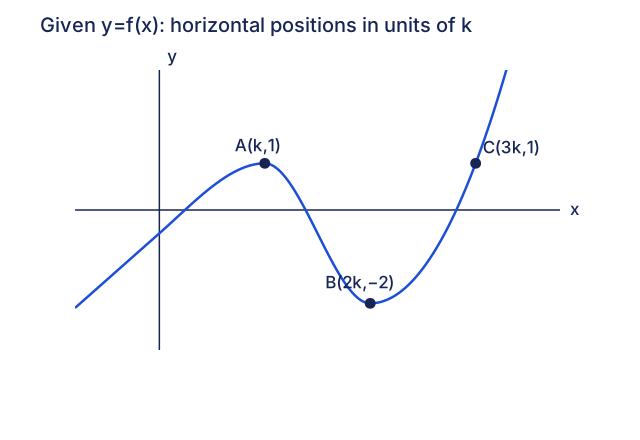
Source qualitative curve with A(k,1),B(2k,-2),C(3k,1), where k>0. Horizontal positions are normalised multiples of the unspecified positive k; no numerical k or extra intercept coordinate is assigned.

[2011/MJC/Promo/6(a)]

CJC · Discussion · Question 3

Solution

Discussion practice · 3 of 6

Reverse a horizontal stretch, reflection and translation

The original y=f(x)y=f(x) undergoes, in order:

A:translation 4 units in the positive x-direction;

B:reflection in the y-axis;

C:stretch parallel to x by 2.

The resulting equation is y=(x−1)/(x+1)y=(x-1)/(x+1). Obtain the original equation.

[2011/SAJC/II/1(b)]

CJC · Discussion · Question 4

Solution

Discussion practice · 4 of 6

Sketch an exact rational function and two different modulus graphs

Given F(x)=(2x−x2)/(x2−2x−3)F(x)=(2x-x^2)/(x^2-2x-3), find:

(i) the asymptotes;

(ii) where the curve cuts the axes;

(iii) the stationary point.

Hence sketch F and use it to obtain separate graphs of y=∣F(x)∣y=|F(x)| and y=(2∣x∣−x2)/(x2−2∣x∣−3)=F(∣x∣)y=(2|x|-x^2)/(x^2-2|x|-3)=F(|x|).

CJC · Discussion · Question 5

Solution

Discussion practice · 5 of 6

Use zeros, poles and turning values to sketch three reciprocals

Given the three supplied graphs of y=f(x)y=f(x), sketch y=1/f(x)y=1/f(x) on separate diagrams.

(a) Zeros x=1,2, y-intercept 2, minimum (3/2,−1/4).

(b) Vertical asymptote x=−1, horizontal asymptote y=−1, y-intercept 1, zero x=1.

(c) Vertical asymptote x=−1, zeros x=±5/2, y-intercept 2, and the oblique guide shown through (0,1), (2,0).

Expand diagram

Use the scrollbars or arrow keys to inspect details.
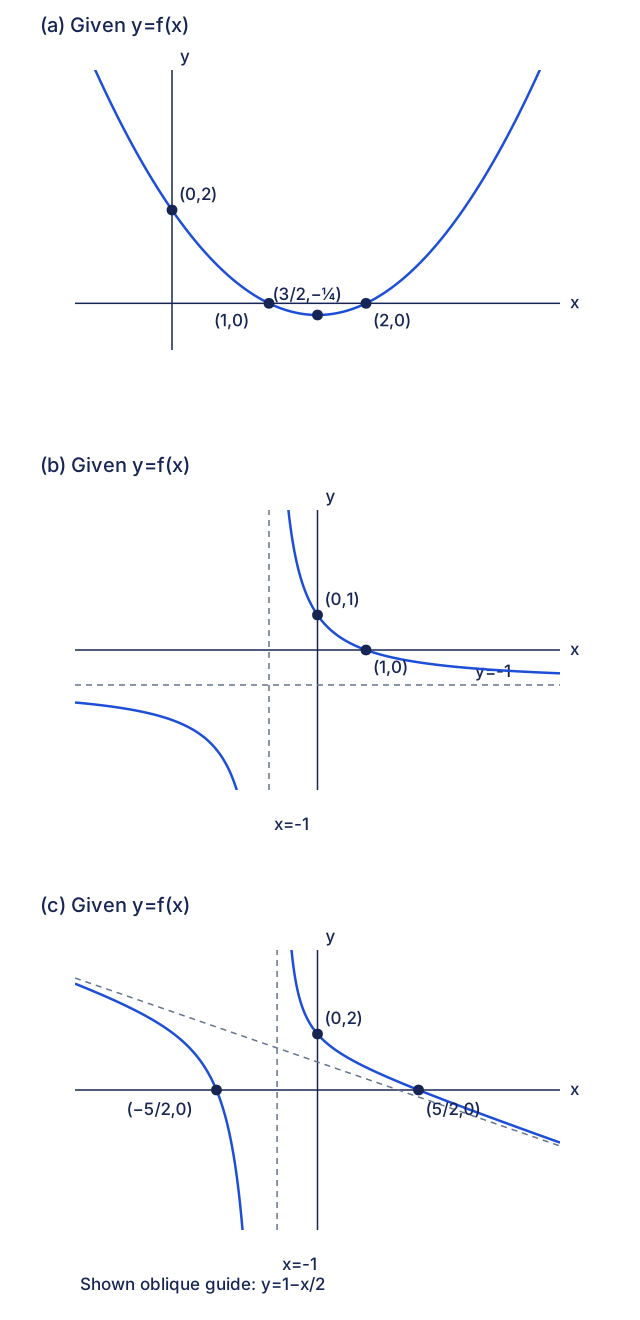
Three qualitative source graph reconstructions, not asserted exact source formulas. (a) zeros 1,2,y intercept 2, minimum (3/2,-1/4). (b) pole -1, horizontal -1,y intercept 1, zero 1. (c)[2009/VJC/I/7] pole -1, zeros ±5/2,y intercept 2, and the shown oblique guide through (0,1),(2,0). All labelled source features are retained.

Part (c): [2009/VJC/I/7]

CJC · Discussion · Question 6

Solution

Discussion practice · 6 of 6

Use partial fractions before sketching an absolute reciprocal

Curve C is f(x)=(x−9)2/[(x−3)(x+3)]f(x)=(x-9)^2/[(x-3)(x+3)].

(i) Express it as P+Q/(x−3)+R/(x+3)P+Q/(x-3)+R/(x+3).

(ii) State all asymptotes and axial intercepts.

(iii) Sketch separately (a) y=f(x)y=f(x) and (b) y=∣1/f(x)∣y=|1/f(x)|, making the main features clear.

[2007/CJC/I/12]

CJC · Discussion · Question 7

Solution

Back to all practice questions