Worked solution
Sketch an exact rational function and two different modulus graphs
Given , find:
(i) the asymptotes;
(ii) where the curve cuts the axes;
(iii) the stationary point.
Hence sketch F and use it to obtain separate graphs of and .
CJC · Discussion · Question 5
Answer
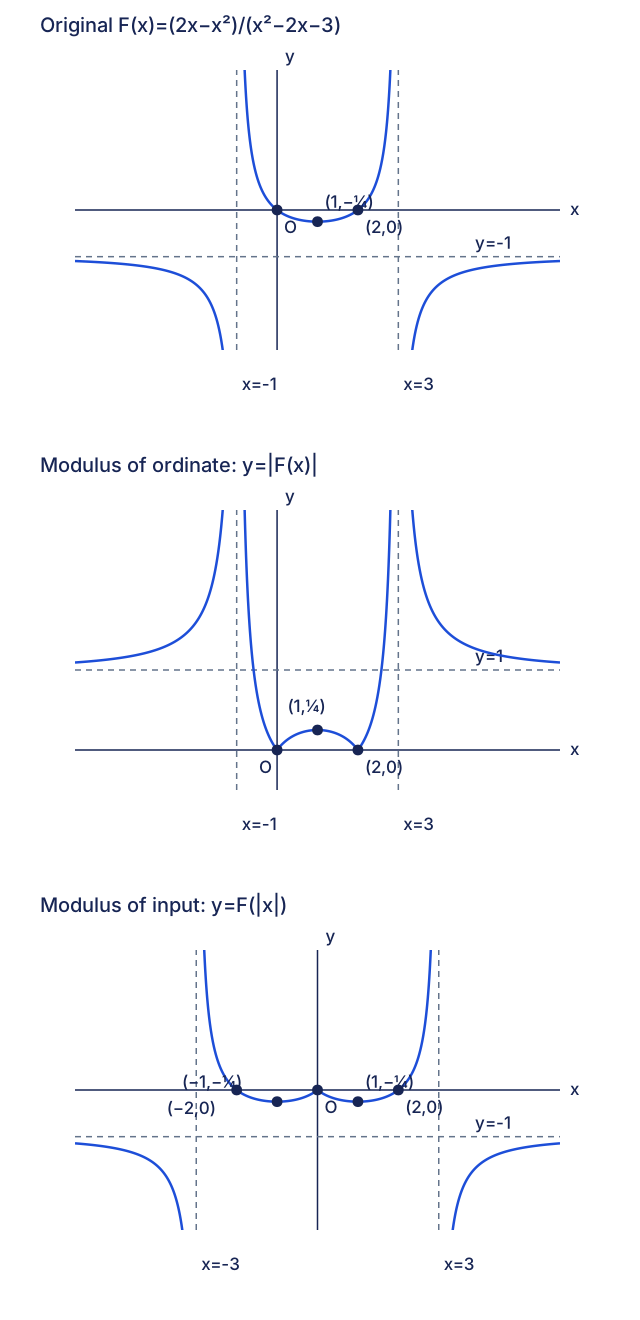
F:asymptotes y=−1, x=−1,3; intercepts (0,0), (2,0); minimum (1,−1/4). |F|: horizontal 1, maximum (1,1/4). F(|x|): poles ±3, zeros −2,0,2, minima(±1,−1/4), horizontal −1.
(i) Separate the constant and denominator factors
. Thus horizontal asymptote y=−1 and vertical asymptotes x=−1,3.
(ii) Find intercepts without cancelling excluded inputs
At x=0, y=0. Setting the numerator gives x=0,2. Both are allowed, so the axial intercepts are (0,0), (2,0).
(iii) Differentiate and classify
The denominator is positive on the domain. F′=0 at x=1, where F=−1/4; the sign changes from negative to positive, so this is a minimum (1,−1/4).
First modulus: reflect negative ordinates
keeps the zeros 0,2 and poles −1,3. Its horizontal asymptote is y=1. The negative minimum becomes a positive local maximum (1,1/4), and the zero crossings become sharp minima.
Second modulus: use only nonnegative inputs, then reflect horizontally
is even. Retain the x≥0 branch and reflect it in the y-axis. Its poles are x=±3, not x=−1; zeros are −2,0,2; minima are (±1,−1/4); horizontal asymptote is y=−1. The origin is a sharp local maximum, not an additional stationary point of the original differentiable F.
Compare your sketch
Expand diagramFit diagram to page
Use the scrollbars or arrow keys to inspect details.
Common mistakes
Do not retain the negative-input pole −1 when forming F(|x|).
Solution notes
Every printed ask, algebraic rewrite, derivative and all 3 source graphs retained. Modulus bars absent from extraction restored from the PDF image. These panels plot the exact supplied expression, not a qualitative inferred formula.