Porisma

A hint to get started

Use zeros, poles and turning values to sketch three reciprocals

Given the three supplied graphs of y=f(x)y=f(x), sketch y=1/f(x)y=1/f(x) on separate diagrams.

(a) Zeros x=1,2, y-intercept 2, minimum (3/2,−1/4).

(b) Vertical asymptote x=−1, horizontal asymptote y=−1, y-intercept 1, zero x=1.

(c) Vertical asymptote x=−1, zeros x=±5/2, y-intercept 2, and the oblique guide shown through (0,1), (2,0).

Expand diagram

Use the scrollbars or arrow keys to inspect details.
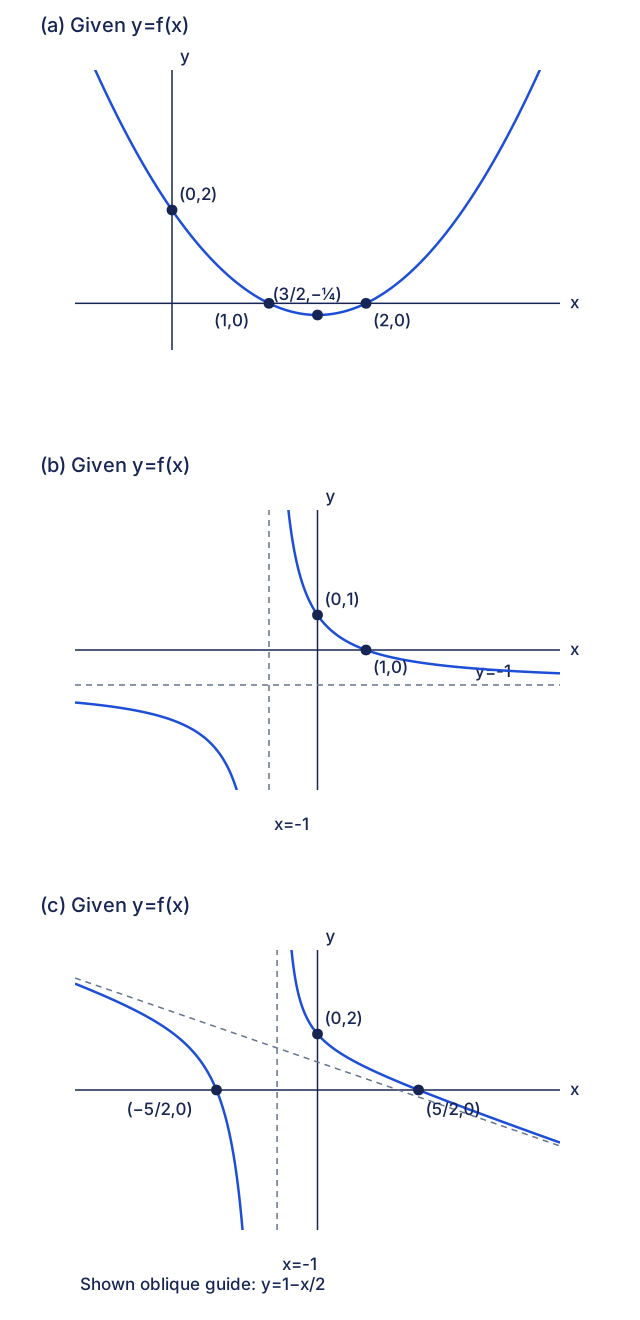
Three qualitative source graph reconstructions, not asserted exact source formulas. (a) zeros 1,2,y intercept 2, minimum (3/2,-1/4). (b) pole -1, horizontal -1,y intercept 1, zero 1. (c)[2009/VJC/I/7] pole -1, zeros ±5/2,y intercept 2, and the shown oblique guide through (0,1),(2,0). All labelled source features are retained.

Part (c): [2009/VJC/I/7]

CJC · Discussion · Question 6

Zeros create reciprocal poles; an original pole input stays outside the reciprocal domain.

Read the worked solution