Worked solution
Use partial fractions before sketching an absolute reciprocal
Curve C is .
(i) Express it as .
(ii) State all asymptotes and axial intercepts.
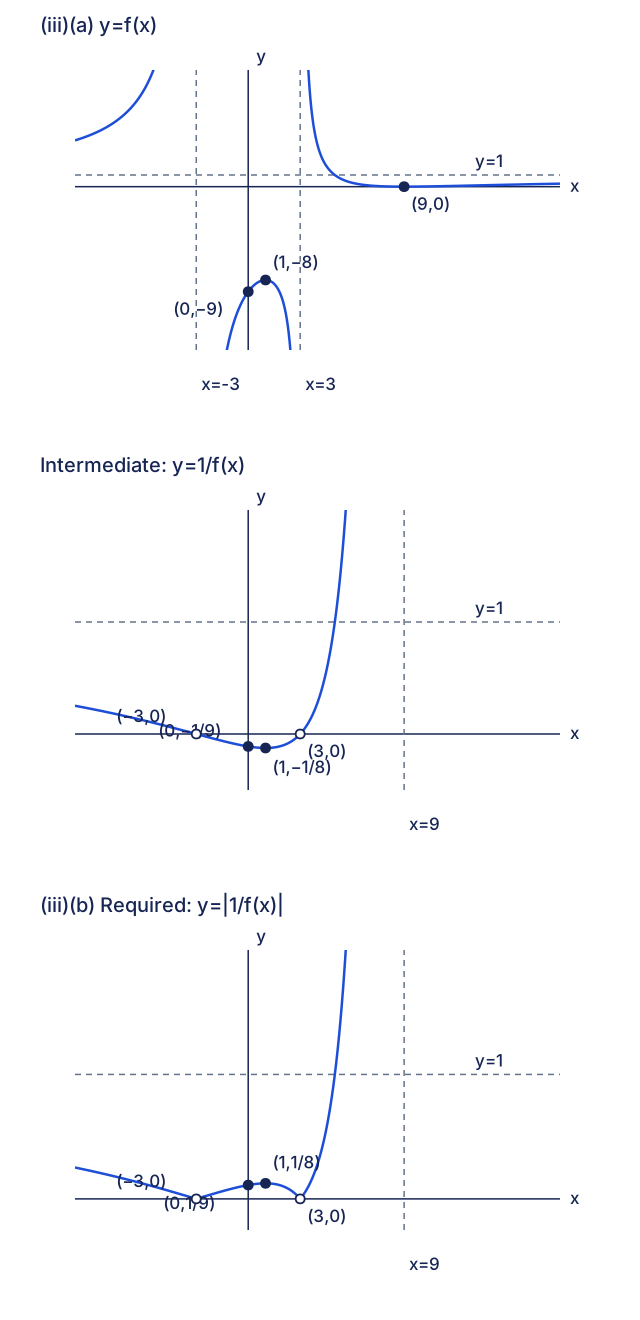
(iii) Sketch separately (a) and (b) , making the main features clear.
[2007/CJC/I/12]
CJC · Discussion · Question 7
Answer
. Original asymptotes y=1, x=±3; intercepts (0,−9), (9,0). Required |1/f|: pole 9, horizontal 1, y-intercept 1/9, maximum (1,1/8), open points (±3,0).
(i) Divide and resolve the remainder
. Write the remainder as . Then . At x=3, A=6; at x=−3, B=−24. Hence , so P=1, Q=6, R=−24.
(ii) State the source features
Asymptotes are y=1, x=±3. Intercepts are (0,−9), (9,0). The squared numerator means the curve touches, rather than crosses, the x-axis at 9.
(iii)(a) Retain the printed turning-point labels
The source sketch marks maximum (1,−8) on the negative branch and minimum (9,0) on the right branch. These are consistent with . The exact plot preserves both poles and horizontal asymptote 1.
(iii)(b) Source intermediate: the signed reciprocal
The source first sketches 1/f: vertical asymptote x=9, horizontal y=1, y-intercept −1/9, and minimum (1,−1/8). Inputs ±3 remain excluded from its domain, even though the algebraic reciprocal has zero limits there. Mark open points (±3,0), not the source filled intercepts.
(iii)(b) Take the absolute value required by the actual ask
Reflect the negative reciprocal middle branch upwards. The required has y-intercept 1/9, local maximum (1,1/8), vertical asymptote x=9 and horizontal y=1. The open zero-limit points at ±3 remain holes, so there are no actual x-intercepts. Its domain excludes −3,3,9.
Compare your sketch
Expand diagramFit diagram to page
Use the scrollbars or arrow keys to inspect details.
Common mistakes
Algebraic inversion does not restore original excluded inputs ±3. The printed filled zeros in both reciprocal sketches need open-point qualifications.
Solution notes
All asks, partial-fraction equations and all 3 source sketches retained. Absolute-value bars on the actual(b)ask restored from the source image. The signed reciprocal intermediate is retained but clearly distinguished from the required absolute reciprocal. Exact expression plots and explicit domain holes preserve the mathematical content.