Porisma

A hint to get started

Recover f from a transformed input graph before reciprocating

The given graph is G(x)=f(3−x/2)G(x)=f(3-x/2), with stationary points (8,−2), (14,2) and x-intercepts 6,10,18. The source diagram shows a vertical asymptote x=0 and left horizontal asymptote y=−4.

Sketch separately:

(a) y=1/f(3−x/2)=1/G(x)y=1/f(3-x/2)=1/G(x);

(b) y=f(x)y=f(x).

Clearly show asymptotes, stationary points and axial intercepts.

Expand diagram

Use the scrollbars or arrow keys to inspect details.
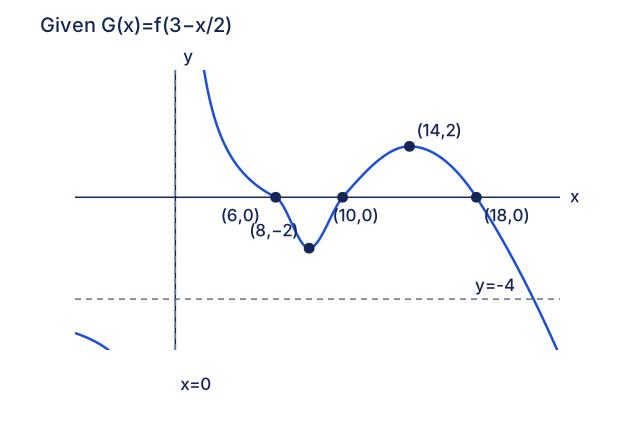
Source qualitative graph G(x)=f(3-x/2), with pole x=0, min (8,-2), max(14,2), zeros 6,10,18, left horizontal asymptote y=-4 and unbounded decreasing right tail. No exact G formula is supplied; interpolation is schematic.

[2009/AJC/I/11]

CJC · Discussion · Question 8

The supplied graph is G(x)=f(3−x/2), not f itself. Solve for the original input.

Read the worked solution