Porisma

Worked solution

Reflect the origin across an equal-radius chord

The points AA and BB have position vectors a\mathbf a and b\mathbf b respectively, relative to the origin OO such that ∣a∣=∣b∣|\mathbf a|=|\mathbf b|. The point PP with position vector p\mathbf p lies on ABAB such that b⋅p=a⋅p\mathbf b\cdot\mathbf p=\mathbf a\cdot\mathbf p.

(i) Show that AB→\overrightarrow{AB} is perpendicular to OP→\overrightarrow{OP}.

(ii) Determine the position vector of the point DD in terms of a\mathbf a and b\mathbf b, where DD is the reflection of OO about the line ABAB.

(iii) Give the geometrical meaning of ∣a×b∣|\mathbf a\times\mathbf b|.

[2010/NJC/I/3]

CJC · Discussion · Question 10

Answer

AB⋅OP=0AB\cdot OP=0; OD→=a+b\overrightarrow{OD}=\mathbf a+\mathbf b; ∣a×b∣|\mathbf a\times\mathbf b| is the area of rhombus OADB.

(i) Direct displacement-vector proof

AB→⋅OP→=(b−a)⋅p=b⋅p−a⋅p=0\overrightarrow{AB}\cdot\overrightarrow{OP}=(\mathbf b-\mathbf a)\cdot\mathbf p=\mathbf b\cdot\mathbf p-\mathbf a\cdot\mathbf p=0. Thus AB and OP are perpendicular in the stated geometric configuration.

How did this part go?

(i) Source alternative proof

Start instead with the given equality: b⋅p−a⋅p=0\mathbf b\cdot\mathbf p-\mathbf a\cdot\mathbf p=0. Factor it as (b−a)⋅p=0(\mathbf b-\mathbf a)\cdot\mathbf p=0, which is the same perpendicularity condition.

How did this part go?

(ii) Locate the reflection

Because ∣a∣=∣b∣|\mathbf a|=|\mathbf b|, triangle OAB is isosceles. Its perpendicular from O to AB meets the midpoint P, so OP→=12(a+b)\overrightarrow{OP}=\frac 12(\mathbf a+\mathbf b). Reflection places P halfway from O to D; hence

OD→=2OP→=a+b.\overrightarrow{OD}=2\overrightarrow{OP}=\mathbf a+\mathbf b.

The source reflection schematic is reconstructed with the associated rhombus completed.

How did this part go?

(iii) Interpret the cross-product magnitude

The magnitude ∣a×b∣|\mathbf a\times\mathbf b| is the area of the parallelogram with adjacent side vectors a and b. Here it is the area of rhombus OADB: the two adjacent side lengths are equal because ∣a∣=∣b∣|\mathbf a|=|\mathbf b|. It is twice the area of triangle OAB.

How did this part go?

Compare your sketch

Expand diagram

Use the scrollbars or arrow keys to inspect details.
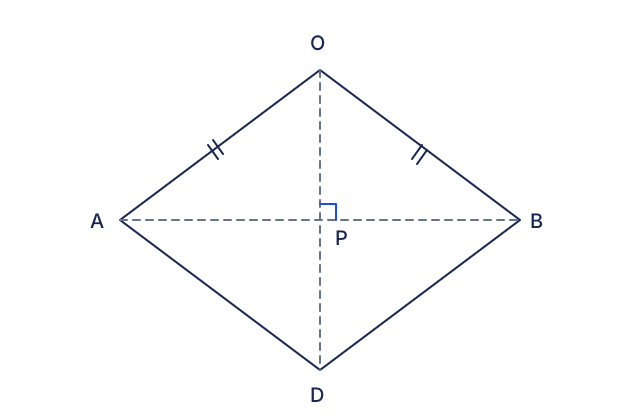
O is above midpoint P of AB, with OA=OB. D is the reflection of O below P. OP and PD have equal lengths and OP is perpendicular to AB. The completed outline O-A-D-B is a rhombus; it completes the source reflection schematic to illustrate the area interpretation.

Common mistakes

The parallelogram area is the full cross-product magnitude; triangle area has an extra factor½.

Solution notes

Magnitude bars in the equal-radius condition and in(iii) are visibly printed and are restored. Both source perpendicularity proofs retained. Diagram completes the rhombus sides for the area interpretation and is labelled as an independent reconstruction.

Read the hint