Worked solution
Project a pyramid shadow under two different lighting models
A right opaque pyramid has square base ABCD at ground level, centre O and vertex V. Perpendicular unit vectors point along AB, AD, OV, respectively. AB has length 8 and OV has length 2h. A point light source is at . A screen of height 35 has its base on the ground and lies in , where , as shown.
(i) Find a vector equation for the line depicting the light ray from P to V, in terms of h. marks
(ii) Find an inequality between so the pyramid’s shadow does not exceed the screen height. marks
The point light is now replaced by parallel light rays perpendicular to the screen; also .
(iii) Find the exact length of the shadow cast by edge VB on the screen. marks
A mirror is placed on plane VBC.
(iv) Find a vector equation of plane VBC and hence the mirror’s inclination to the ground. marks
Expand diagramFit diagram to page
Use the scrollbars or arrow keys to inspect details.
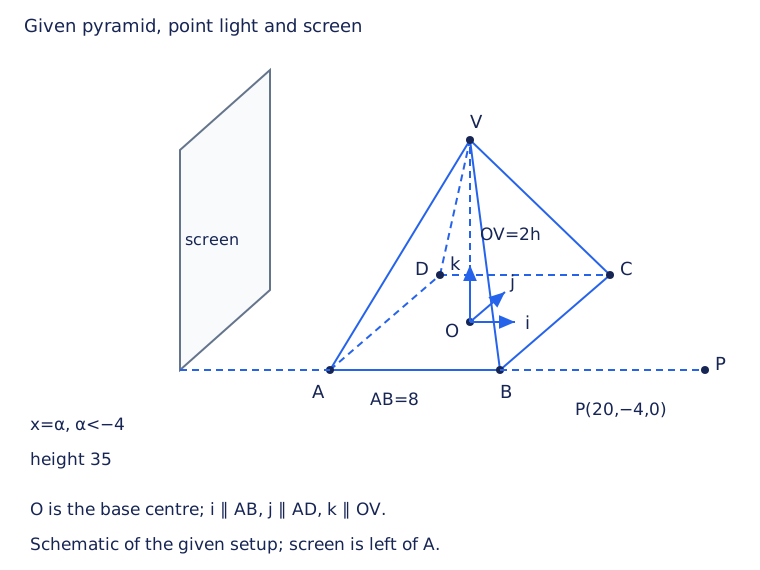
[2017/RI/I/11]
CJC · Discussion · Question 10
Answer
(i) ; (ii) ; (iii) ; (iv) , inclination .
(i) Join the point source to the vertex
With origin O, and . Thus and the line is , . The physical forward ray uses , and passes V at .
(ii) Intersect the ray with the screen
The screen has , so and . The vertex shadow height is . Since , , so the height bound is (with the physical pyramid height ). This uses point-source rays; it is not the later parallel projection.
(iii) Switch to parallel orthogonal projection
Now , and . Rays parallel to the unit screen normal remove the x-component: the shadow displacement is . Equivalently, the source uses . Both describe the same projected length.
(iv) Construct the mirror plane and compare normals
gives , and . Crossing and gives . Therefore the plane is , or . The ground normal is , so the inclination is (1 d.p.).
Common mistakes
Part (iii) changes the light source; do not reuse the point-source enlargement factor.