Porisma
Back to reading

Conic sections

Conic sections · Diagrams · Complete reading

Choose another diagram

Four plane cuts of a double cone

Expand diagram

Use the scrollbars or arrow keys to inspect details.
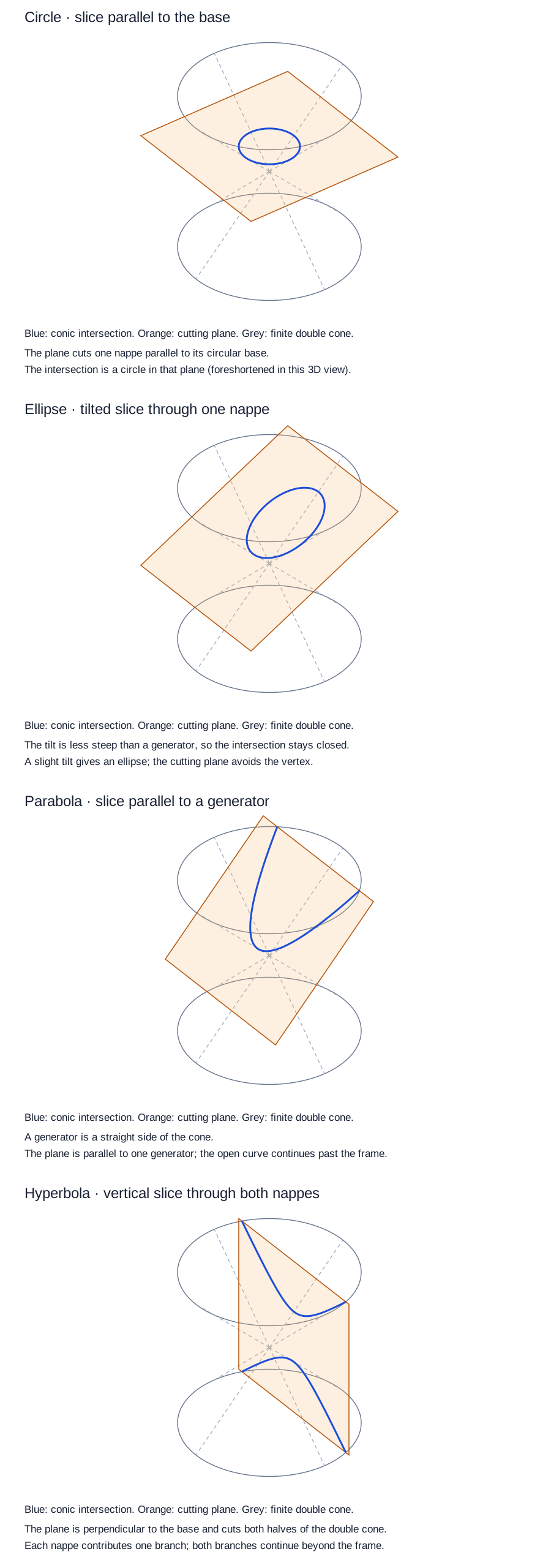
Four 3D schematics: a plane parallel to the base gives a circle; a tilted plane through one nappe gives an ellipse; a plane parallel to a generator gives a parabola; a vertical plane through both nappes gives two hyperbola branches. Blue marks each intersection and orange its cutting plane. The finite cones truncate open curves; circles appear foreshortened in the 3D projection.
Open original diagram (new tab)

Vertical parabola sign cases

Expand diagram

Use the scrollbars or arrow keys to inspect details.
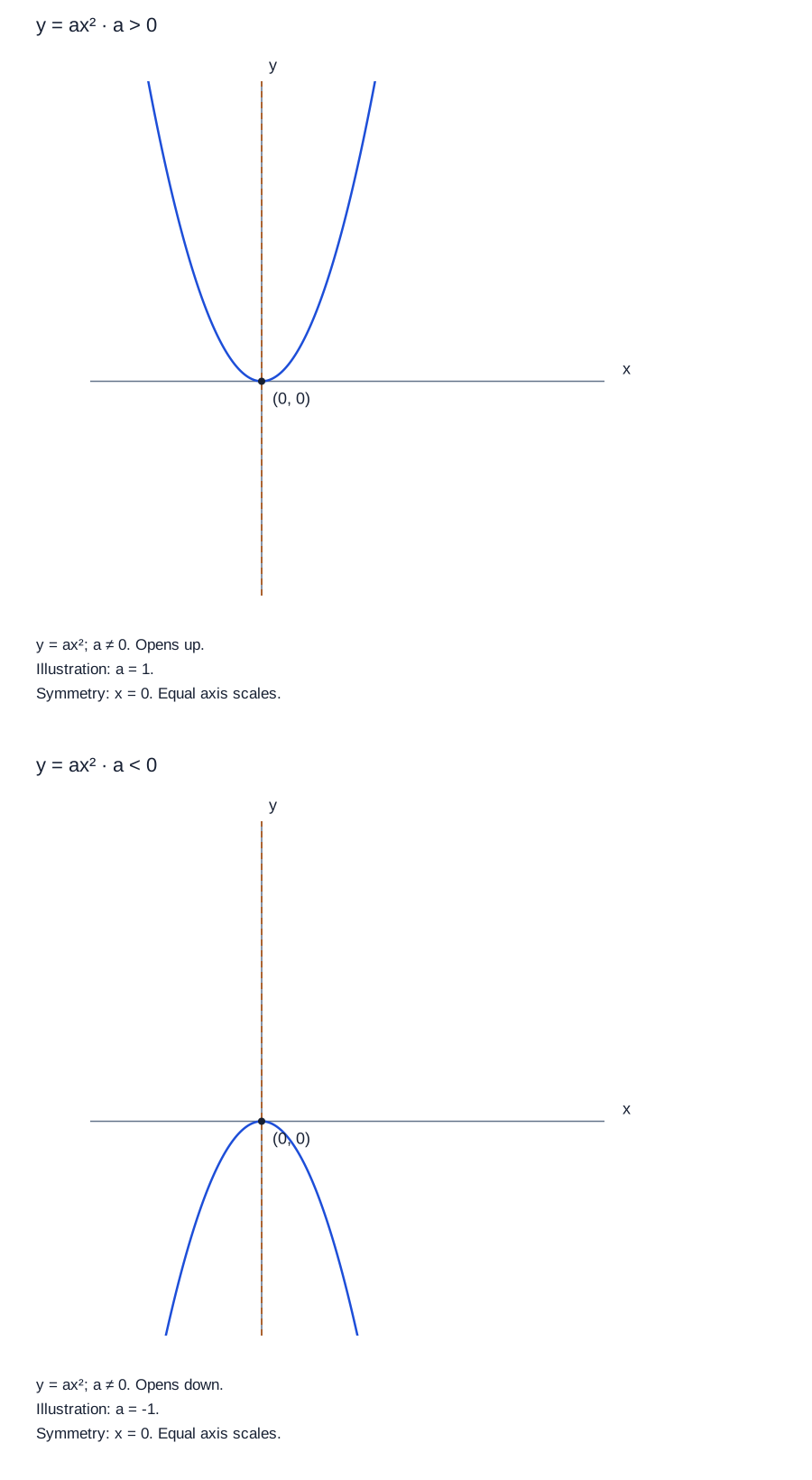
Vertical parabolas in both sign cases: positive a opens up, negative a opens down. Basic vertex (0,0), symmetry x=0.
Open original diagram (new tab)

Vertical parabola translations

Expand diagram

Use the scrollbars or arrow keys to inspect details.
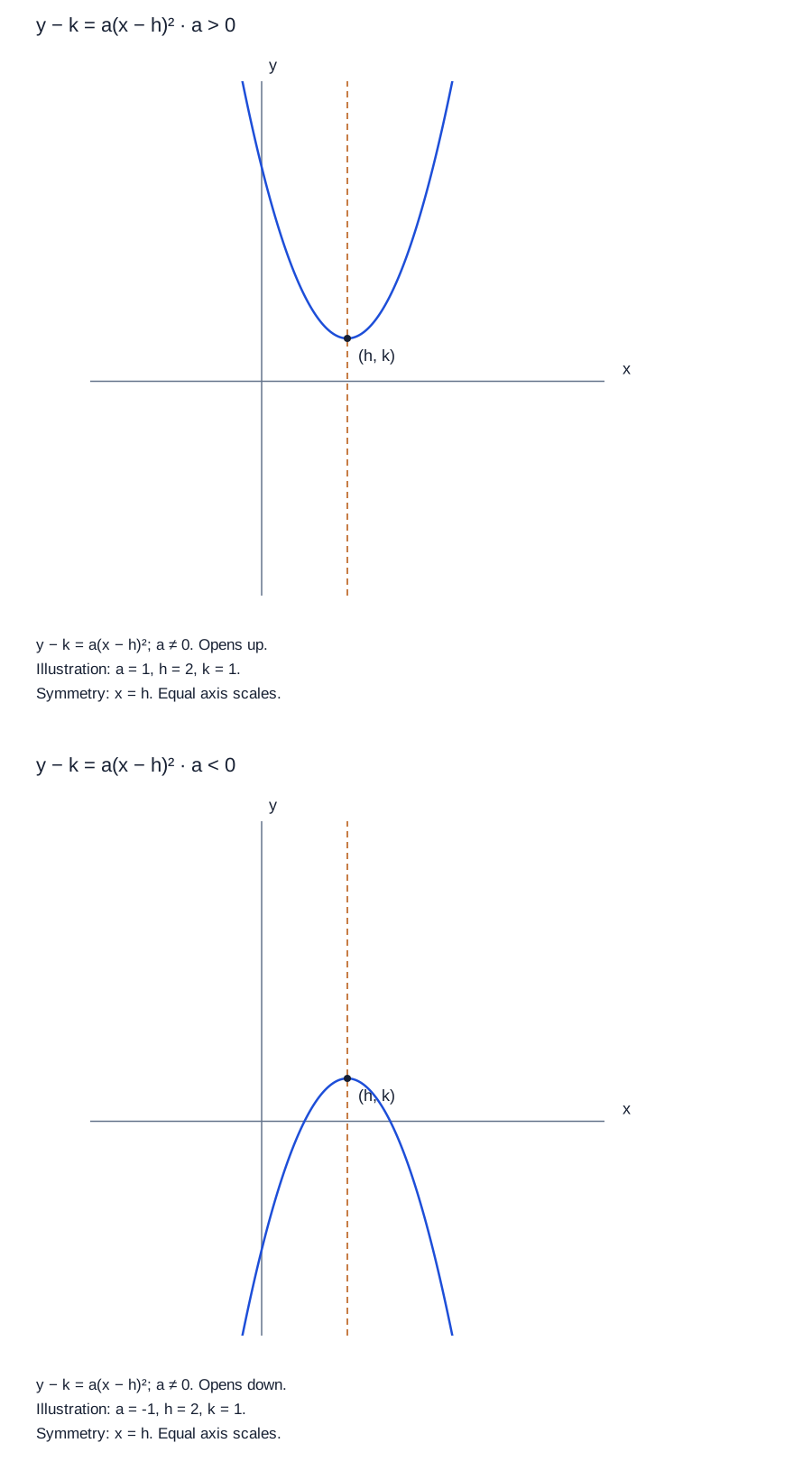
Vertical parabolas in both sign cases: positive a opens up, negative a opens down. Translated vertex (h,k), symmetry x=h. Illustration h=2,k=1.
Open original diagram (new tab)

Horizontal parabola sign cases

Expand diagram

Use the scrollbars or arrow keys to inspect details.
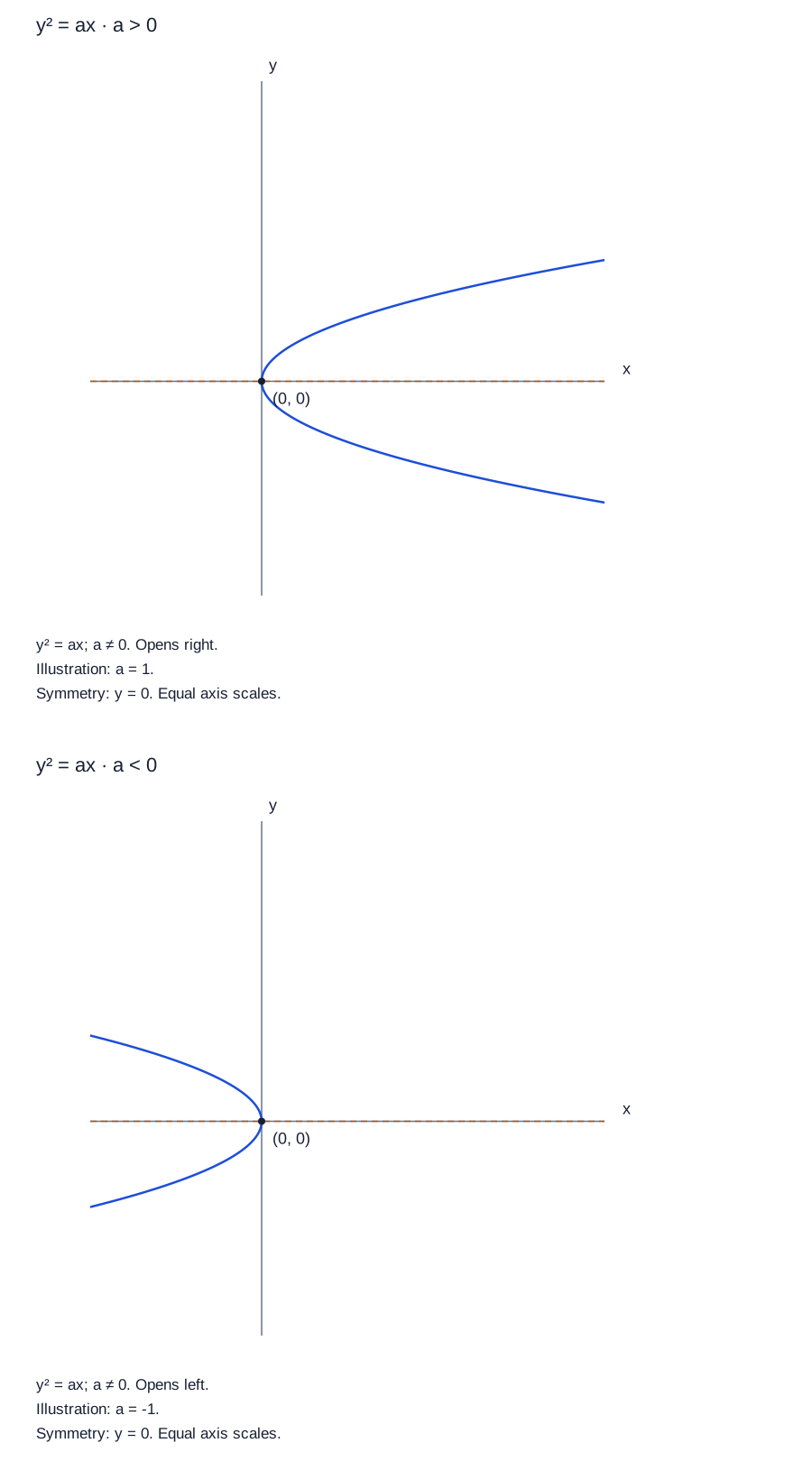
Horizontal parabolas in both sign cases: positive a opens right, negative a opens left. Basic vertex (0,0), symmetry y=0.
Open original diagram (new tab)

Horizontal parabola translations

Expand diagram

Use the scrollbars or arrow keys to inspect details.
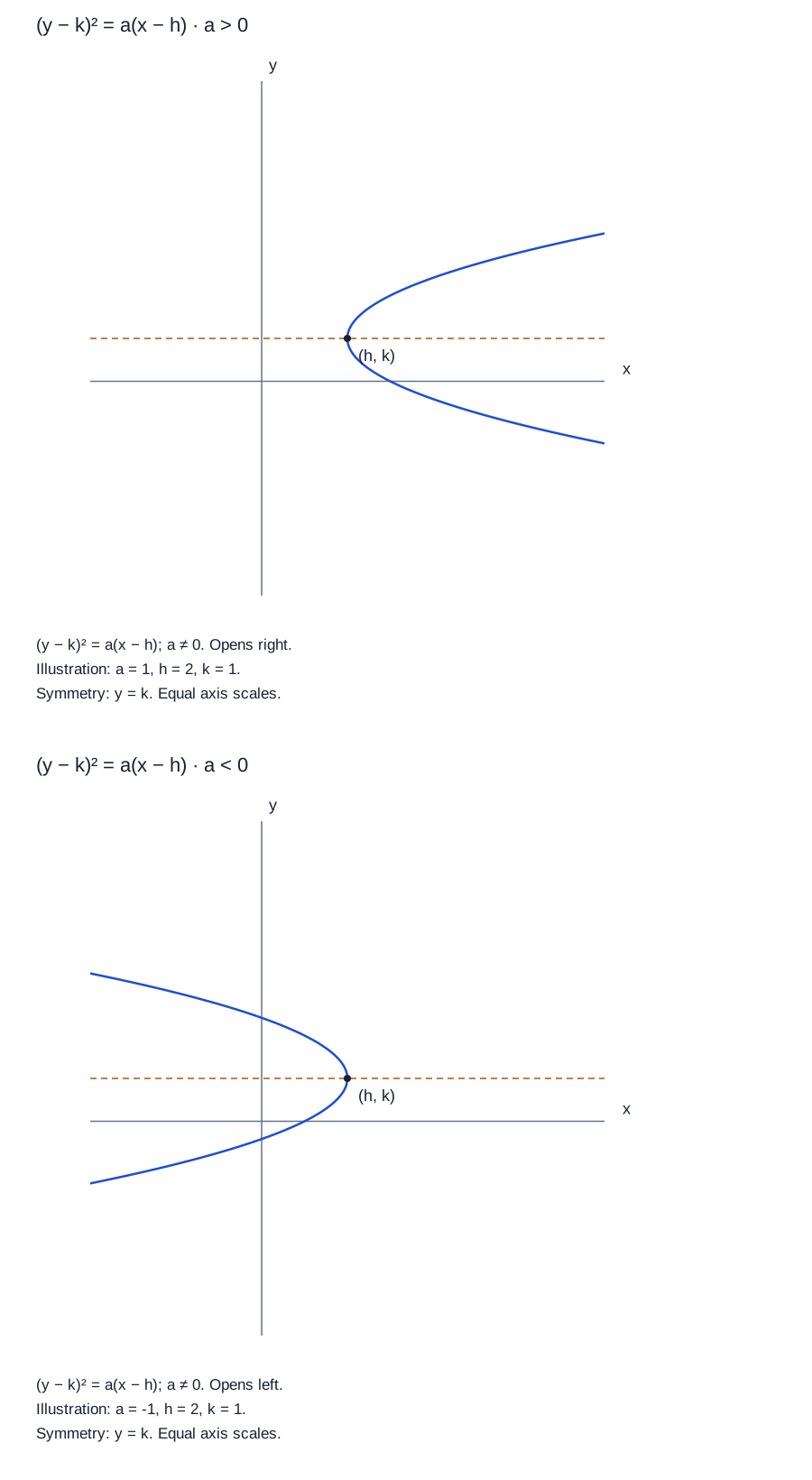
Horizontal parabolas in both sign cases: positive a opens right, negative a opens left. Translated vertex (h,k), symmetry y=k. Illustration h=2,k=1.
Open original diagram (new tab)

From a unit circle to an ellipse

Expand diagram

Use the scrollbars or arrow keys to inspect details.
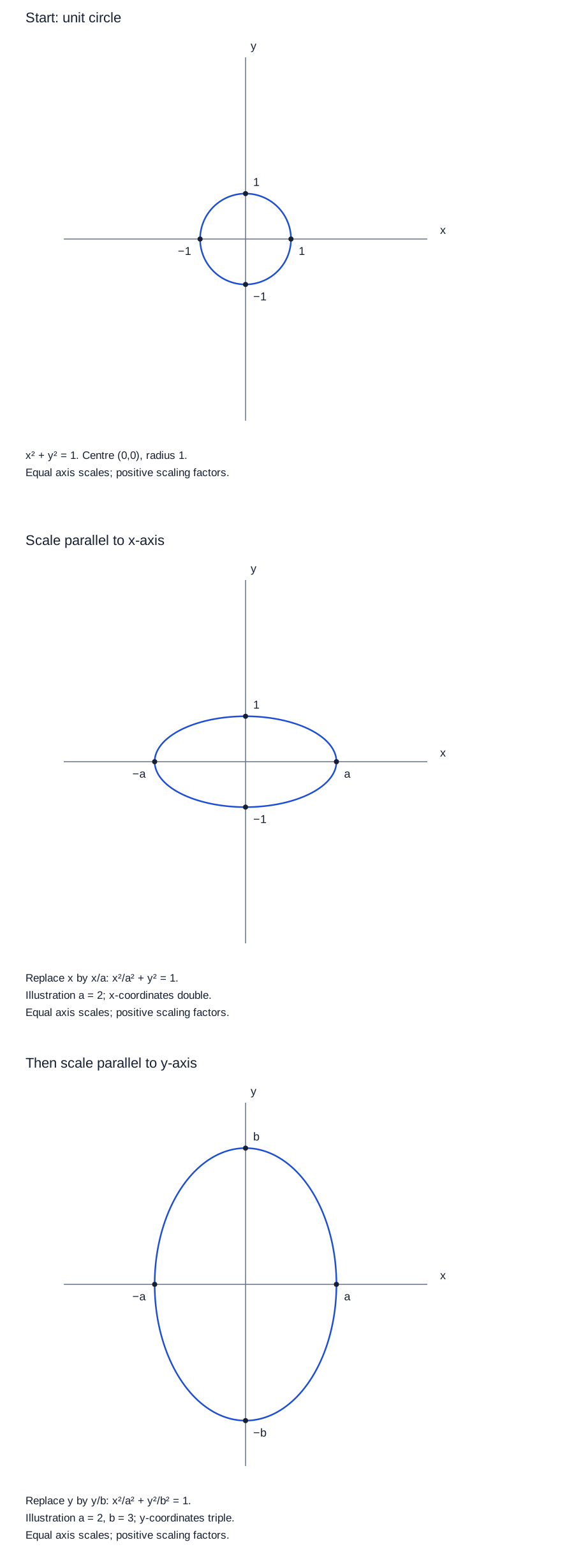
Three stages: unit circle, horizontal stretch by positive a replacing x with x/a, then vertical stretch by positive b replacing y with y/b. Result x²/a²+y²/b²=1. Example factors a=2,b=3; equal axis scales.
Open original diagram (new tab)

Ellipse axes and translation

Expand diagram

Use the scrollbars or arrow keys to inspect details.
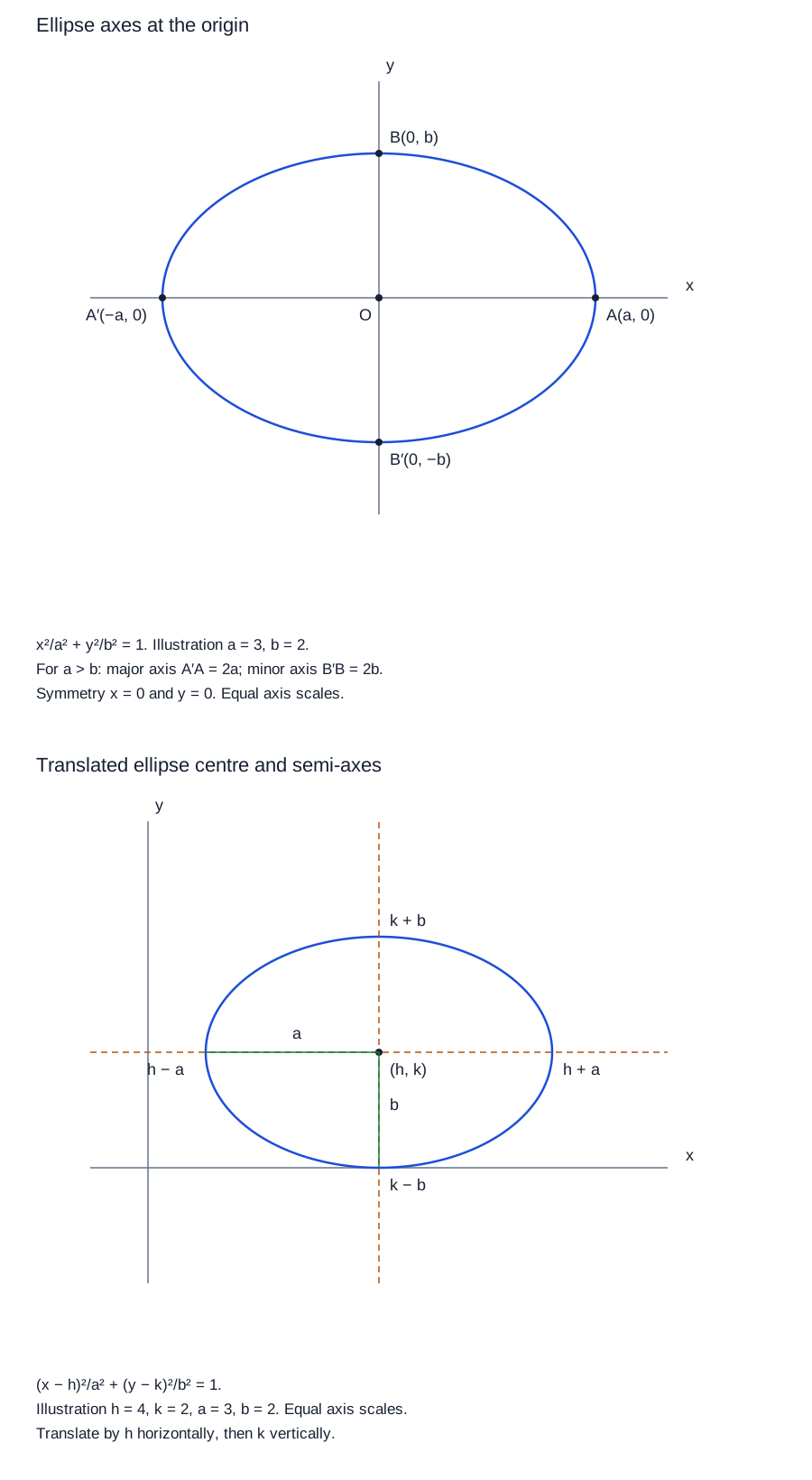
Two panels: origin-centred ellipse with A(a,0), A′(−a,0), B(0,b), B′(0,−b); lengths 2a,2b when a>b. Translated ellipse centred at (h,k), symmetry x=h,y=k, endpoints h±a,k±b and semi-axes a,b. Numerical examples explicitly labelled.
Open original diagram (new tab)

Horizontal hyperbola and translation

Expand diagram

Use the scrollbars or arrow keys to inspect details.
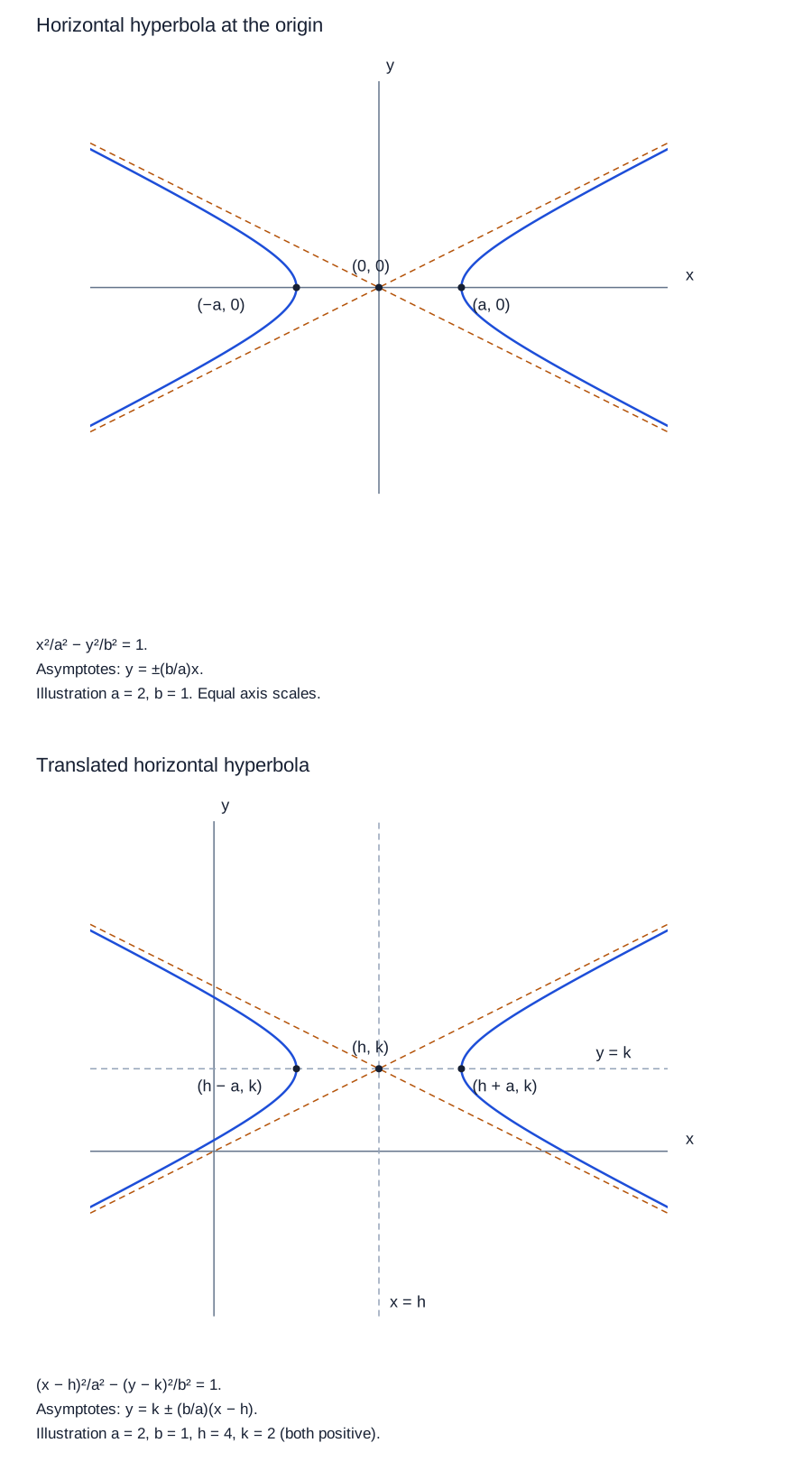
Two panels: x²/a²−y²/b²=1 has centre(0,0), vertices (±a,0), symmetry x=0,y=0 and asymptotes y=±(b/a)x. Translation by h,k gives centre(h,k), vertices (h±a,k), symmetry x=h,y=k and asymptotes y=k±(b/a)(x−h). Source illustration assumes h>0,k>0; figures explicitly use a=2,b=1,h=4,k=2.
Open original diagram (new tab)

Vertical hyperbola and translation

Expand diagram

Use the scrollbars or arrow keys to inspect details.
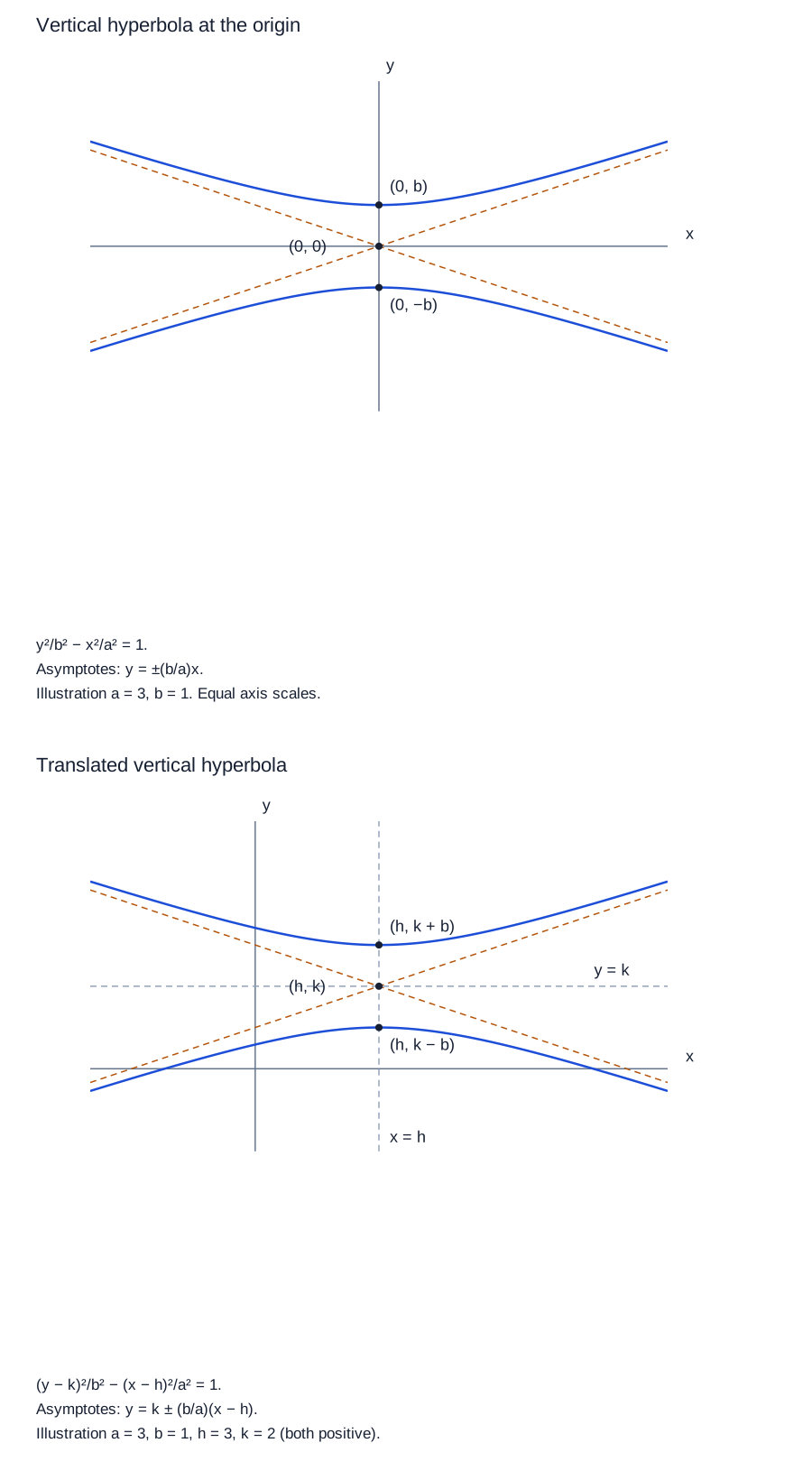
Basic vertical hyperbola y²/b²−x²/a²=1 has centre(0,0), vertices (0,±b), symmetry x=0,y=0, asymptotes y=±(b/a)x. Translated form has centre(h,k), vertices (h,k±b), symmetry x=h,y=k and asymptotes y=k±(b/a)(x−h). Illustrations use a=3,b=1 and, in the translated case, positive h=3,k=2.
Open original diagram (new tab)

Reciprocal model for the appendix

Expand diagram

Use the scrollbars or arrow keys to inspect details.
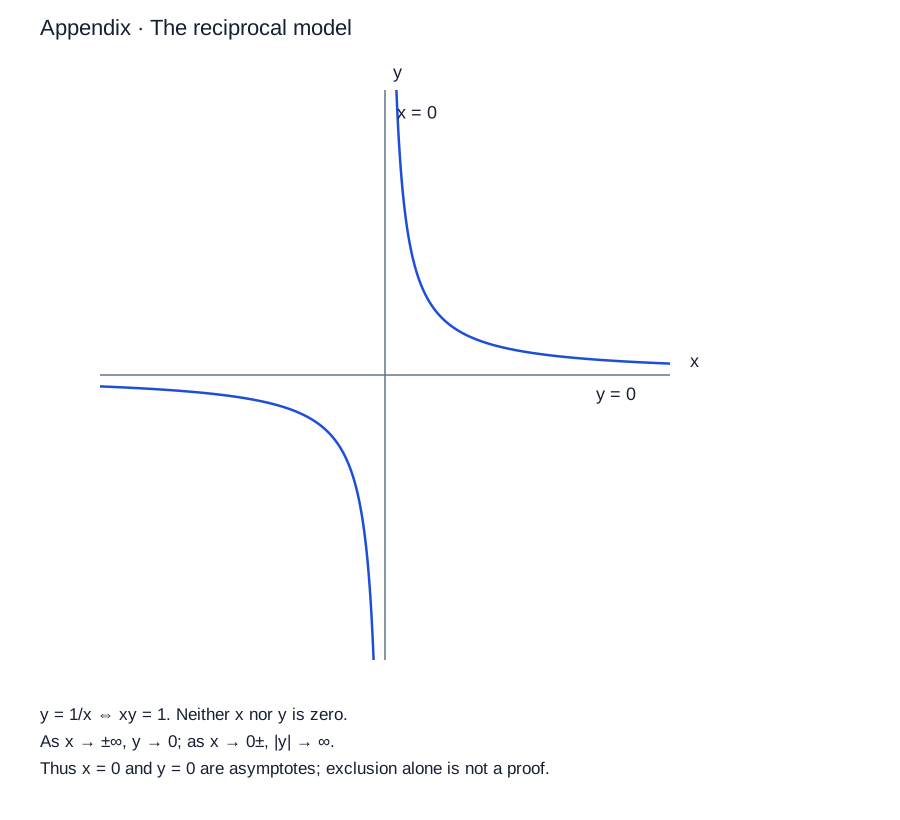
The rectangular hyperbola y=1/x, equivalently xy=1, has branches in quadrants I and III and asymptotes x=0,y=0. These asymptotes are approached in limits; they contain no curve points.
Open original diagram (new tab)
Back to reading