Applications of differentiation · Read curve shape and derivative graphs
Read slope as derivative height
Keep the same input. Transfer the original curve's slope to the derivative's height, then inspect both sides of each stationary input. Crossings and touches carry different information.
Keep the input; change the height
Work where the original function is differentiable. Its height and its slope are different quantities; the derivative graph records the slope.
- Positive original slopeDerivative above the axis
Where , the derivative graph has positive height. This does not require the original graph itself to be above the axis.
- Zero original slopeDerivative on the axis
A stationary original point gives the derivative point . The original height does not carry across.
- Negative original slopeDerivative below the axis
Where , the derivative graph has negative height. Read the original curve’s direction, not its position relative to the axis.
A corner or another input where the derivative does not exist is not automatically a derivative zero. The full sketch also needs the function’s domain and justified boundary/asymptote information; this companion covers the local slope transfers.
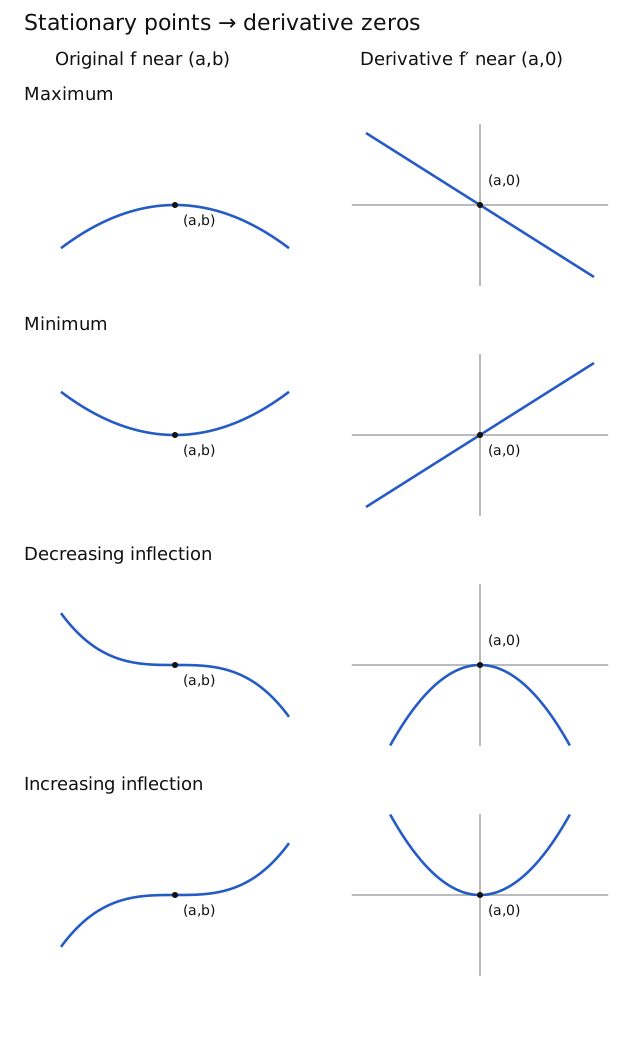
A turning point gives a crossing in these cases
Use signs that hold on intervals on either side of the stationary input, not two sampled slopes. The source's local maximum and minimum configurations have opposite signs across the point.
- Positive → zero → negativeOriginal maximum; derivative crosses down
The original rises into the point and falls away. The derivative is above the axis on the left and below it on the right, passing through .
- Negative → zero → positiveOriginal minimum; derivative crosses up
The original falls into the point and rises away. The derivative changes from negative to positive through .
These are the sign-changing local configurations shown in the source. A derivative zero by itself does not establish a turning point.
Same signs give a touch at zero
Here the derivative is zero at the stationary input and has one strict sign throughout each neighbouring interval. The original keeps its direction through the point.
Expand diagramFit diagram to page
Use the scrollbars or arrow keys to inspect details. The text explanation follows.
- Positive → zero → positiveDerivative minimum at zero
The derivative is positive nearby and zero at the point: it touches from above. The source’s rising stationary-inflection configuration has this pattern.
- Negative → zero → negativeDerivative maximum at zero
The derivative is negative nearby and zero at the point: it touches from below. The source’s falling stationary-inflection configuration has this pattern.
Same-sign first derivatives show no original turning point. Confirm a change of the original curve’s concavity before calling it an inflection; the sign pattern alone is insufficient. The worked cubics below establish that extra condition.
Try a worked example
Read a case, make a prediction, then reveal the reasoning. The examples keep their stated values.
A maximum above the axis
Consider this illustrative function:
At input zero, predict the derivative’s height and crossing direction. Does the original height 2 carry across?
Show reasoning
1. Transfer the slope, keeping the input
The original point is (0, 2). Its slope is zero, so the derivative point is (0, 0).
2. Read both intervals
For every , ; for every , . The derivative crosses down through zero. The original curve has a strict local maximum at .
A minimum below the axis
Consider this illustrative function:
At input zero, predict where the derivative meets the axis. Does an original point below the axis force a negative derivative?
Show reasoning
1. Differentiate independently of the height
The original point is (0, -2), while its horizontal tangent gives derivative point (0, 0).
2. Read the upward crossing
For every , ; for every , . The derivative crosses from below to above. The original curve has a strict local minimum at . At , the original height is but the derivative height is : the original is below the axis while its derivative is above.
Rising on both sides
Consider this illustrative function:
At input zero, predict whether the derivative crosses or touches the axis. Then check whether the original has an inflection.
Show reasoning
1. Locate the derivative's minimum
The squared term is positive at every nonzero input, while the derivative is zero at input zero. The derivative touches zero from above and has a strict minimum there. The original point is , not .
2. Check the original concavity separately
The second derivative is negative to the left of zero and positive to the right. This change of concavity establishes the original stationary inflection. Positive first derivatives on both sides alone would not prove that change.
Falling on both sides
Consider this illustrative function:
Near input zero, predict which side of the axis contains the derivative. Is its zero a maximum or a minimum of the derivative?
Show reasoning
1. Locate the derivative's maximum
The negative squared term is negative at every nonzero input, while the derivative is zero at input zero. The derivative touches zero from below and has a strict maximum there. The original point is .
2. Confirm the original inflection
The second derivative is positive to the left of zero and negative to the right. Concavity changes, so the original point is a stationary inflection. The curve keeps falling through it; it is not an original turning point.
Compare with the paired source sketches
Expand diagramFit diagram to page
Use the scrollbars or arrow keys to inspect details.