Systems of linear equations
← Back to lesson · Complete chapter reading and print view
By the end, you can
- Translate constraints into simultaneous equations
- Solve by elimination and verify the result
- Distinguish unique, inconsistent and dependent systems
about 15 minutes for the lesson · practise at your own pace.
The central idea
A linear equation has the form , with constant coefficients (not all zero) and first powers of the chosen unknowns.
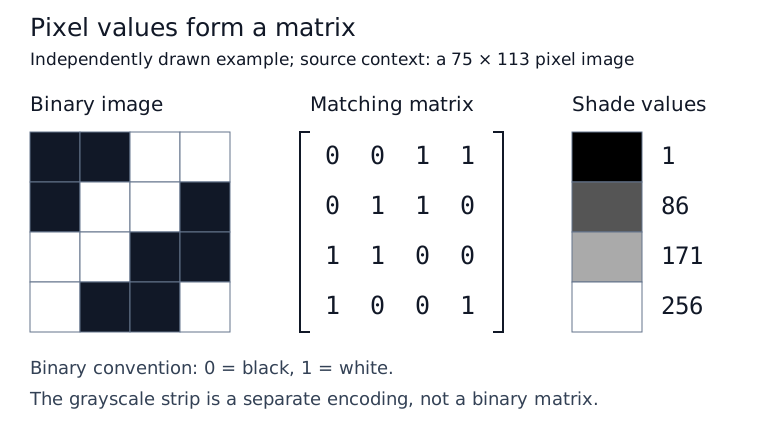
The source motivates linear algebra through digital images: pixels form a matrix; its Mona Lisa illustration compares a full image with a 75-by-113 pixel representation, describes 0/1 as black/white and mentions 256 shades.
The original portrait illustration is retained in the source review evidence; the independent grid below illustrates how arrays represent image data. Binary values and a 256-level encoding are different conventions, not simultaneous requirements.
Linearity depends on the chosen unknowns:
| Equation | Linear in ? |
|---|---|
| Yes | |
| Yes | |
| Yes: all coefficients are constants | |
| No; linear in instead, with | |
| No; linear in instead |
A system has equations in common unknowns. Write row as . In matrix form, , where is , and . The augmented matrix retains the right-hand column.
The printed example is , , :
Pixel values form a matrix: an independent example
Expand diagramFit diagram to page
Use the scrollbars or arrow keys to inspect details.
Explore
In Example 3, replace the second equation’s right-hand side by . Doubling the first still forces , so the changed second equation contradicts it. The original has infinitely many solutions; the changed system has none. Keep all equations when interpreting a dependent row.
Related interactive example
Explore this related example, then return to the prediction task above.
Worked example
Solve and . Adding gives , so . Substitution gives . Both original equations hold.
A calculator solution still needs interpretation in the context, especially when a quantity must be nonnegative or integral.
Check your understanding
A club sells 20 tickets, at 3 dollars for children and 5 dollars for adults, for total revenue 76 dollars. Define the unknowns, formulate and solve a system, and verify the answer. State two assumptions needed for the model.
Let be the child and adult ticket counts. Then and . Subtracting gives , so . Both counts are nonnegative integers; and . The model assumes every ticket is in one of these categories and that all are sold at the stated prices, with no discounts or other revenue.
Mastery learning objectives
At the end of this chapter, I should be able to:
Choose a practice question
The printed skill map (printed page172 in both copies) groups the chapter into the following question types. Its final row combines two printed bullets with shared references.
| Common question types | Lecture examples, as printed | Review problems (follow up), as printed |
|---|---|---|
| Contextual problem (Direct) | 5 | 1, 2, 3, 4, 5 |
| Non-contextual problem (may involve Calculus and/or other topics) | 6, 7 | 6, 7, 8 |
| Contextual problem (Indirect); interpretation of a system’s solution in context | 8, 9 | 9, 10 |
Numbering qualification: the map calls the banking example “5,” but both lecture copies actually label it as a second “Example4,” immediately after the no-solution Example4. No separate Example5 is printed. Use the banking link below for the map’s direct-context example.
- Banking: second printed Example4
- Circle coefficients: Example6
- Cubic and stationary points: Example7
- Donor counts: Example8
- Library fines: Example9
- Review1–5: direct contextual models
- Review6–8: non-contextual models
- Review9–10: interpretation and discrete restrictions
The two source checkpoints are after self-study and after tutorial, preserved by the checkboxes above. The repeated Review1–10 asks and answer key on lecture PDF13–15 point to the existing reviewed questions; no duplicate questions are added. The cinema answer key’s “<65” category is a source typo: its prompt/table say under16. The reviewed answer uses under16 at $7.65. The shoe-budget interpretation remains qualified in Review10.
Practice questions
Practice section 1 · Questions 1–6
Substitution, elimination and a graphical check · Enter a system and interpret a unique calculator solution · +4 more
Practice section 2 · Questions 7–12
Use both coordinates and gradients at stationary points · Restrict a free parameter to feasible donor counts · +4 more
Practice section 3 · Questions 13–18
Juice mixtures: conserve volume and each ingredient · Basketball: distinguish attempts, successes and points · +4 more
- Juice mixtures: conserve volume and each ingredient
- Basketball: distinguish attempts, successes and points
- Recover a rational curve from points and a gradient
- A cubic determined by two points and two stationary inputs
- Use a remainder and a stationary point as constraints
- Brick orders: distinguish a fixed-profit system from cost minimisation
Practice section 4 · Question 19
Shoe production: full expenditure and a budget cap
More practice
Apply the lecture methods and contextual checks in the linked interactive questions.
Ready to try this on your own?
For “Systems of linear equations”, try a question without the working and explain your method. This records your confidence, saved in this browser only.