Porisma
Back to reading

Systems of linear equations

Systems of linear equations · Diagrams

Pixel values form a matrix: an independent example

Expand diagram

Use the scrollbars or arrow keys to inspect details.
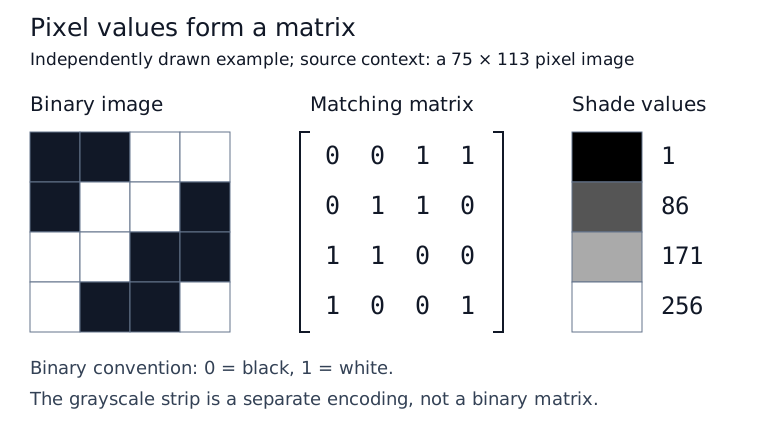
An independent 4-by-4 binary grid has rows 0 0 1 1; 0 1 1 0; 1 1 0 0; 1 0 0 1, alongside the matching numeric matrix. Zero is black and one is white. A separate grayscale strip illustrates the source’s 1-to-256 convention: 1 is black, 86 dark gray, 171 light gray and 256 white. The original source uses a 75-by-113 pixel Mona Lisa; this grid explains its matrix idea without reproducing that portrait.
Open original diagram (new tab)
Back to reading