Solving inequalities
← Back to lesson · Complete chapter reading and print view · Open reference notes separately
By the end, you can
- Solve rational inequalities with a sign diagram
- Distinguish zeros from excluded denominator values
- Interpret absolute values as distances
about 15 minutes for the lesson · practise at your own pace.
The central idea
An inequality asks for a set of inputs. Factor a rational expression, mark every numerator zero and denominator zero, and test the intervals between them. For , means , while selects the two outside intervals.
Critical values and repeated roots
Factor the polynomial, mark every real zero and test signs between them. For , the roots are and interval signs are . Thus gives , where the upward-opening parabola is below the axis.
For , signs on are . The double root does not change the sign. The positive inequality gives or or ; the nonpositive inequality gives or .
Example 1’s test-point paragraph prints : that is a typo. Test the original , consistent with the source roots and final answer.
Nine rules for preserving an inequality
Before cancelling a factor, check its sign. When applying a function to both sides, check whether it increases or decreases.
- Transitivity: and imply . For example, gives .
- Add the same number: implies . Starting with , adding gives ; adding gives .
- Multiply by a positive number: if and , then . From , multiplication by gives .
- Multiply by a negative number: if and , then . Multiplying by gives . Check this sign before multiplying by an expression involving .
- Square positive inputs: implies . For example, gives . Do not drop the positivity condition.
- A positive product: means both factors are positive or both are negative. For example, and .
- A negative product: means the factors have opposite signs. For example, and .
- Apply an increasing function: implies when is strictly increasing. The examples are on positive inputs and : and .
- Apply a decreasing function: implies when is strictly decreasing. For , this gives .
Algebraic and graphical methods describe the same solution set. Check critical values individually for non-strict inequalities; an even repeated root need not change the sign. When asked for the set of values, present set notation. A range may be written with inequalities, interval notation or set notation.
Choose one of three methods
One graph: make the right side zero, for example . Sketch the difference; find its x-intercepts and vertical asymptotes, then read the required intervals.
Two graphs: sketch and . Find intersection inputs and vertical asymptotes of either graph, then compare which graph lies higher.
Analytical: make the right side zero, combine the left side into one rational expression and factor numerator and denominator as far as possible. Complete the square when a quadratic does not factor over the reals. Mark critical values and test every interval.
For other expressions a graph is often useful. Always inspect domain endpoints and vertical asymptotes as well as crossings. When squaring a radical comparison, first check that its radicand is nonnegative and that the two quantities being compared have the required signs.
Modulus: a nonnegative magnitude
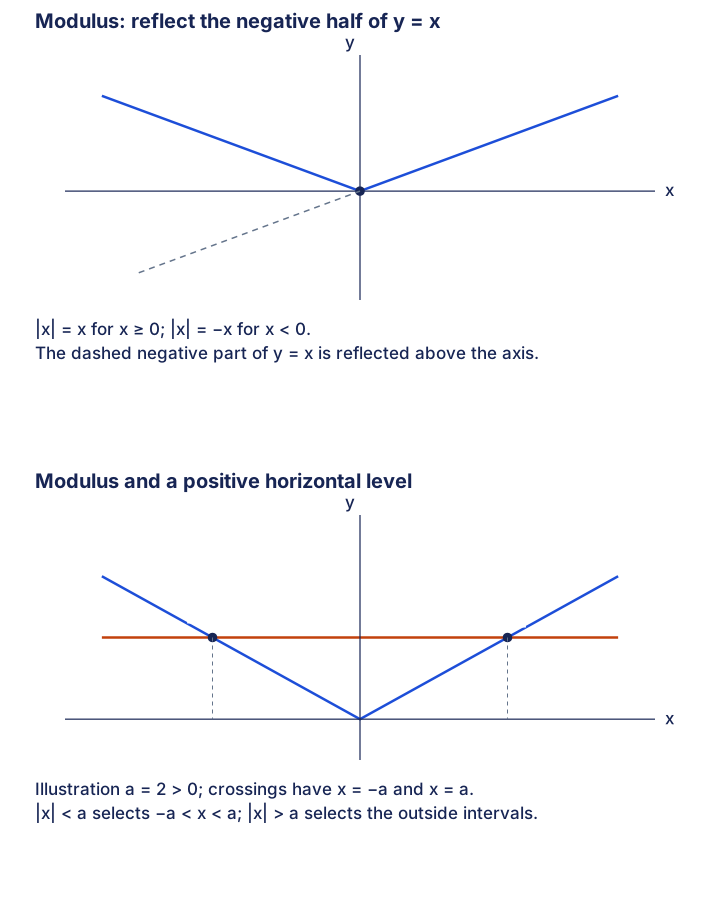
By definition, for and for . Its graph reflects the negative half of above the axis.
- for every real .
- .
- , which need not equal when .
- For a positive constant , means .
- For a positive constant , means or .
Compare the V graph with to see the inside and outside intervals. Simple modulus inequalities can use these properties directly; more complicated ones can use graph comparisons. The positivity condition matters: has no solution, whereas holds for every real .
Recognise a hence substitution
Match the complete expression to a form already solved. Every occurrence of the old input must be replaced, including powers, denominators and modulus bars. Common replacements in these notes are , , , and .
Then intersect the resulting condition with the replacement’s range and domain: , , requires , and . Keep denominator exclusions after substitution. Examples 10 and 11 show why the algebraic answer alone is not the last step.
Compare the modulus graphs
Expand diagramFit diagram to page
Use the scrollbars or arrow keys to inspect details.
Explore
Use the worked example below, then change one input or assumption. Predict which part of the answer must change before calculating.
Related interactive example
Explore this related example, then return to the prediction task above.
Worked example
Solve . Critical inputs are and . The expression is positive when both factors have the same sign: or . The denominator zero is excluded, and the strict inequality excludes the numerator zero.
Multiplying through by a denominator of unknown sign can reverse the answer on only part of the domain.
Check your understanding
Solve .
, hence . Both endpoints are included.
Mastery learning objectives
At the end of this chapter, I should be able to:
Choose a practice question
Use the examples to learn a method, then attempt the linked questions before opening their working. The skill routes below retain the source’s part references.
| Skill | Lecture examples | Discussion | Review follow-up |
|---|---|---|---|
| Analytical: rational functions | 4 | 1(a)(c)(d), 4, 8 first part | 1 first part, 2 first two parts, 3(i), 4 first part |
| Analytical: completing the square | 5, 6, 10 first part | 1(b), 7 | 5, 6, 7 first part, 8(a), 9 first part |
| Analytical: modulus | 8 | 2 | — |
| Graphical methods | 6, 7, 9, 10 first part | 3 first part | 10, 11, 12, 13, 14(i) |
| Hence: modulus replacement | 10 hence | 4(ii) | 1 hence, 7 hence |
| Hence: logarithmic or exponential replacement | 11 hence | 3 hence, 4(i) | 3(ii), 4 hence, 14(ii) |
| Hence: trigonometric replacement | — | 8 hence | — |
| Hence: algebraic replacement | — | — | 2 deduce, 8(b), 9 deduce |
| Prior topic: graphing techniques | — | 5, 6 | 15 |
The printed logarithm row names Example 10 (hence), but that example uses modulus. Example 11 is the logarithm example, so its link is used here. The graphical row also lists Example 10’s first part: its printed working uses a sign test; you can practise a graph of the same expression as an alternative.
Practice questions
Practice section 1 · Questions 1–6
Read the same interval from a parabola and a sign line · Check a repeated root and include isolated equality solutions · +4 more
- Read the same interval from a parabola and a sign line
- Check a repeated root and include isolated equality solutions
- Use a difference graph, two graphs or a factored sign line
- Discard an always-positive factor safely
- Keep a denominator zero separate from allowed endpoints
- Keep the sign of x when solving a rational inequality
Practice section 2 · Questions 7–12
Prove a quadratic is positive before removing it · Use either a difference graph or a denominator sign test · +4 more
- Prove a quadratic is positive before removing it
- Use either a difference graph or a denominator sign test
- Check the radical domain before reading or squaring the inequality
- Keep both radical endpoints strict in self-practice
- Choose inside or outside intervals for a modulus comparison
- Keep the parameter when translating a modulus interval
Practice section 3 · Questions 13–18
Compare two moduli using a difference or two graphs · Recognise the same rational inequality after a substitution · +4 more
Practice section 4 · Questions 19–24
Rational inequalities with transformed inputs · Find a range using the discriminant · +4 more
Practice section 5 · Questions 25–30
A rational identity and a scaled input · Transfer a rational inequality to logarithmic inputs · +4 more
Practice section 6 · Questions 31–36
Use a nonpositive squared input · Compare squared and reflected inputs · +4 more
Practice section 7 · Questions 37–38
A parameter hyperbola and a logarithmic input · Use two distinct real roots to restrict a parameter
More practice
Ready to try this on your own?
For “Solving inequalities”, try a question without the working and explain your method. This records your confidence, saved in this browser only.