Vectors: magnitude, direction and products
Compare parallel and perpendicular lengths · Diagrams
Dot and cross products as right-triangle lengths
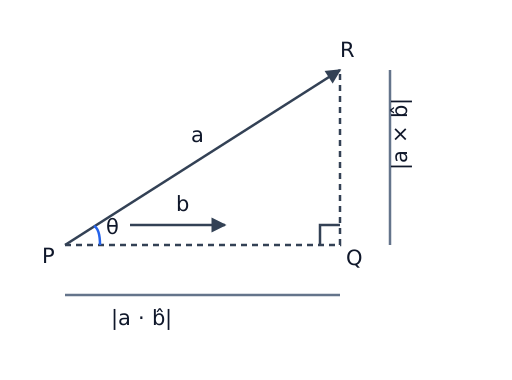
Compare parallel and perpendicular lengths using a unit target direction. Both lengths are nonnegative, even when the scalar component is negative.
Illustration: |a| = 3 units and b̂ points right. Change θ to compare signs and lengths. Values are rounded to four significant figures.
Acute angle
The projection follows the target direction; its signed component is positive.
- Signed scalar s
- 2.121
- Parallel length PQ
- 2.121 units
- Perpendicular length QR
- 2.121 units
PR represents a, PQ its parallel vector and QR its perpendicular residual. The angle θ is measured from b̂ to a.
The cross-product vector is normal to this plane. Its magnitude equals QR; it is a different vector from the in-plane residual.
Keep the scalar component's sign
Use the unit direction , with . A negative component means the projection points opposite to this direction.
Take a magnitude for the parallel length
PQ is a nonnegative length. The same absolute-value formula covers acute and obtuse angles.
Read the cross-product magnitude as a height
The cross-product vector is normal to the plane. Its magnitude equals QR; it is a different vector from the in-plane perpendicular residual.
Check the two lengths together
The parallel and perpendicular components form the two legs. At a parallel boundary the height is zero, and at a right angle the parallel component is zero.
The target vector b must be nonzero to form b̂. If a is zero, both lengths are zero and its angle has no defined direction.
Compare with the source length construction
Expand diagramFit diagram to page
Use the scrollbars or arrow keys to inspect details.