Vectors: lines and perpendicular feet
Two ways to find a foot on a line
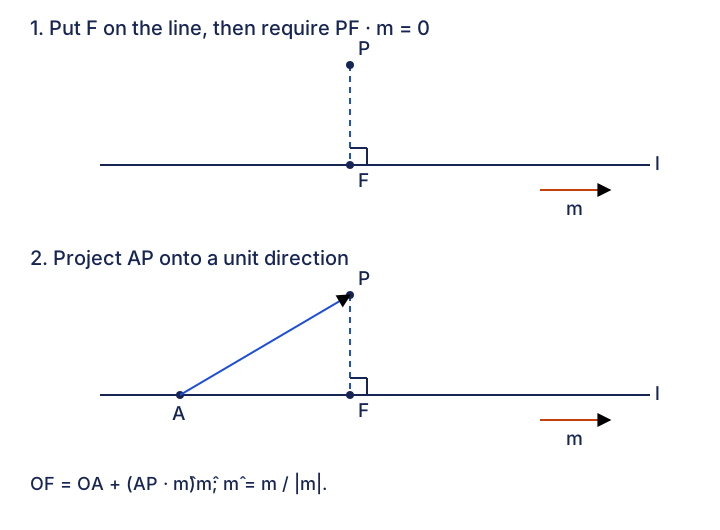
Choose either method for the same foot F. A is a known point on the line, p is P's position vector, and m is a nonzero line direction. The foot must lie on the line and have a perpendicular displacement from P.
Put the foot on the line
Use this route when a line parameter is convenient. Write a candidate foot on the line before imposing perpendicularity.
- Parameter routeSolve one scalar equation
Put . Then
Hence
Substitute back into to find F.
Check both line membership and perpendicularity. The parameter can be negative; its sign is not a distance.
Project from a known line point
Use the vector projection of AP onto the line direction. Keep its sign when locating the foot.
- Projection routeAdd the projection vector to OA
First find
Then . A negative component puts F opposite to the chosen direction from A. Taking an absolute value here would put F on the wrong side.
Use a unit direction, or divide by m·m as in the parameter formula. If P is on the line, F=P and the distance is zero.
Try a worked example
Read a case, make a prediction, then reveal the reasoning. The examples keep their stated values.
The foot is behind the line point
For and , predict which side of contains the foot F. Compare the two methods on the same geometry.
Show reasoning
1. Put F on the line
Use the same parameter in all three coordinates, then require the displacement from P to F to be perpendicular to the line direction.
2. Check by signed projection
AP has dot product −6 with m, while m·m=6. Keep the negative sign: AF points opposite to m, so F is behind A. A schematic’s left-to-right order cannot override the coordinates.
3. Verify both conditions
F lies on the line at λ=−1 and PF has zero dot product with its nonzero direction. A negative parameter is allowed on an infinite line; it is not a negative distance.
Illustration: P already lies on the line
Boundary-case illustration: keep but choose . Predict the foot and distance. Use this extra comparison to check the zero-distance boundary.
Show reasoning
1. Check membership
At λ=2 the line already reaches P. Its foot is P itself.
2. Accept the zero displacement
The perpendicular-displacement equation still holds when PF=0. The point-to-line distance is zero; do not require a nonzero displacement to accept this boundary.
Compare the geometric constructions
Expand diagramFit diagram to page
Use the scrollbars or arrow keys to inspect details.