Vectors: lines and perpendicular feet
Choose a point-to-line distance method
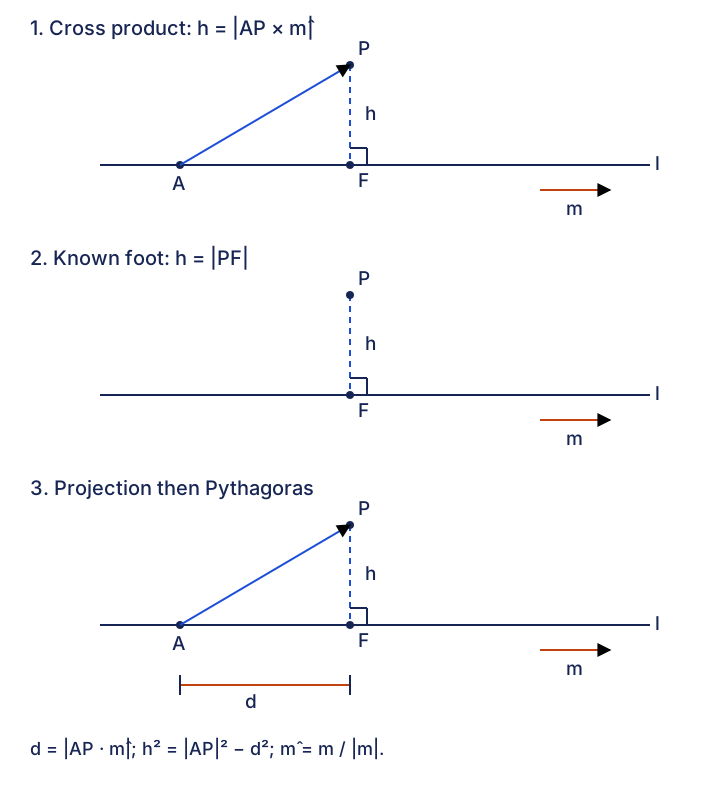
These are alternative routes to the same nonnegative perpendicular distance. Choose a known point A on the infinite line and a nonzero direction m. Reuse a foot or projection length when the question has already supplied it.
A verified foot is already available
If F has already been found, reuse it. Confirm that F lies on the line and PF is perpendicular to its direction.
- Known footTake the displacement's magnitude
A line parameter is not this length. When P lies on the line, F=P and h=0.
Use the companion foot method if F has not been established. A point merely lying on the line is not necessarily the perpendicular foot.
A direction and line point are available
Find AP and normalise the line direction. This route gives the height directly without first finding F.
- Cross productUse area divided by base
-
An unnormalised cross product gives an area, not the perpendicular distance.
Reversing or rescaling a nonzero direction leaves the distance unchanged after normalisation.
A projection length is available
Resolve AP along the line, then use Pythagoras for the perpendicular component. A signed component and a length are different quantities.
- Projection and PythagorasSubtract squared lengths
The signed component s can be negative; d and h are nonnegative. Keep exact values until the final calculation.
All three routes give distance to the infinite line. A foot outside a specified segment or ray requires a separate restriction check.
Try a worked example
Read a case, make a prediction, then reveal the reasoning. The examples keep their stated values.
Reuse a foot already found
The existing foot calculation gives for . How can you deduce the shortest distance without another projection?
Show reasoning
1. Take the perpendicular displacement's magnitude
The foot has already been verified. The requested distance is a nonnegative length, not the line parameter −1.
Use the cross product with the right scale
Use , and . Predict why alone is not the distance to the line AB.
Show reasoning
1. Find the displacements
AB is a nonzero direction, but its length is √6 rather than 1.
2. Expand the cross product
Compute all three signed cross-product components before taking the magnitude. The middle component is negative.
3. Divide by the direction's length
The cross product’s magnitude is the parallelogram area. Dividing by the base length gives its perpendicular height.
A negative component gives a positive length
For the same , and , compare signed projection with projection length. Must the perpendicular foot lie between A and B?
Show reasoning
1. Keep direction and length distinct
The component is negative, so AF points opposite to AB. Its magnitude gives the projection length.
2. Use the right triangle
AP²=17 and d²=6. The remaining perpendicular length agrees with the cross-product result.
3. Check which object the question names
F=(0,0,2) lies before A along AB, giving the order F,A,B. The source sketch is schematic. Distance to the infinite line permits this foot; distance to a segment would also need its endpoint constraints checked.
Compare the three geometric routes
Expand diagramFit diagram to page
Use the scrollbars or arrow keys to inspect details.