Original question & working
Reconstruct signs from two absolute-value sketches · source reference
2018/NJC/Prelim/I/8 · Question pp. 4 · Working pp. 11, 12
Open the interactive lessonThe working and teaching notes are included in the interactive lesson.
View source review notesFull original question, working & notes
Printed question
(a) Describe a sequence of exactly three transformations that will transform the curve with equation onto the curve with equation , where is a positive constant. [3]
Given instead that , use a non-graphical method to determine the range of values of where the graph of is concave upwards. [2]
(b) The diagrams below show the graphs of and , where the equations of the asymptotes and the coordinates of the turning points are given. The gradient of the graph with equation at the origin is .
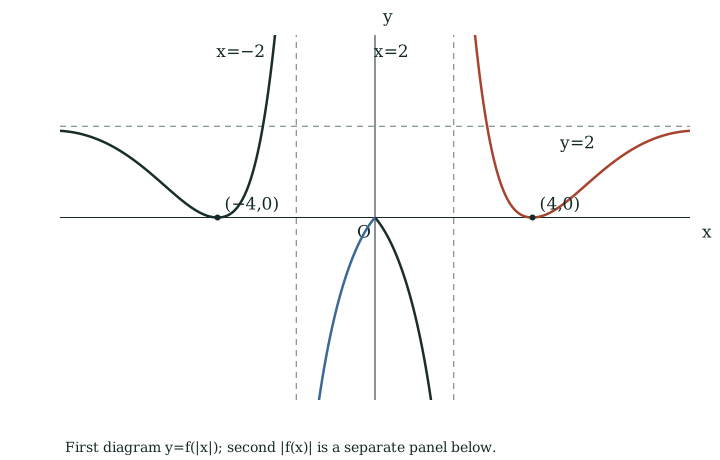
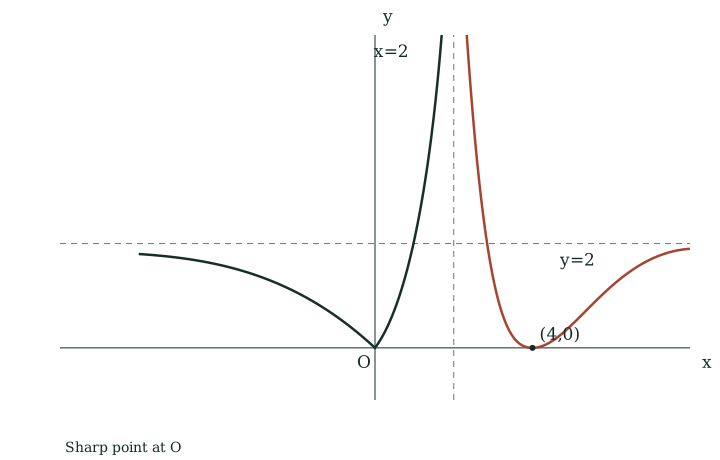
On separate diagrams, sketch the graph of including the coordinates of the points where the graphs cross the - and -axes and the equations of the asymptotes, if any. [2]
[2018/NJC/Prelim/I/8]
Printed working
(a) .
- Reflect graph about the -axis.
- Scale graph parallel to the -axis by factor of .
- Translate graph in the negative -direction by 2 units.
.
.
.
.
Where the graph is concave upwards, .
Since . Therefore, .
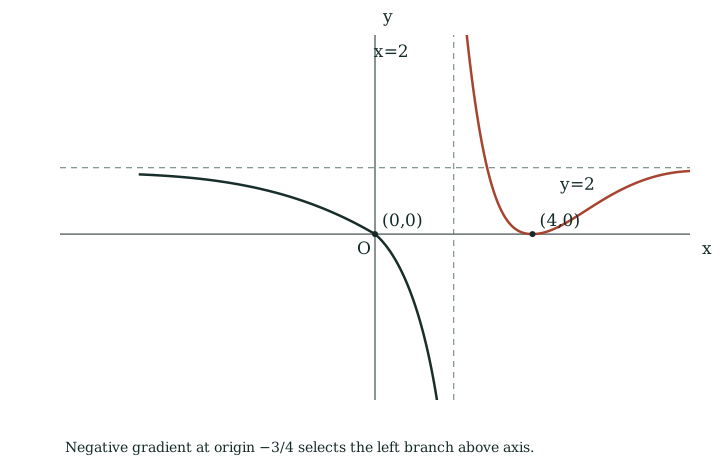
(b) Native graph below preserves the printed shape and labels.
Teacher notes
(b) 1. For , this part of the graph of is the same as the graph of .
- For , since the gradient of curve at the origin is negative, this part of the graph of is the same as the graph of .
Printed answer key
(a) 1. Reflect graph about x-axis. 2. Scale parallel to y-axis by factor (6+a). 3. Translate negative y-direction by 2 units; x>3. (b) The native graph above.
Source provenance
2025 TJC H2 Math (9758) JC2 MSM: GRAPHS AND CURVE SKETCHING. Question/answer booklet printed pages 1–14; solutions printed pages 1–28. Running metadata and repeated headings are transcribed in the topic metadata article.