Original question & working
Count roots on either side of a pole · source reference
2011/NJC/Prelim/I/12b · Question pp. 6 · Working pp. 19, 20
Open the interactive lessonThe working and teaching notes are included in the interactive lesson.
Source solution PDF p.20 labels A=(−1.186,0) in one sentence, although its graph and r≥1.186 conclusion use the positive root. Authored working keeps the exact positive threshold separately.
Full original question, working & notes
Printed question
The curve has equation , where is a constant.
(i) Find in terms of , and deduce the range of values of if has two distinct stationary points. [4]
(ii) Given that the asymptotes of intersect at the point , show that . [2]
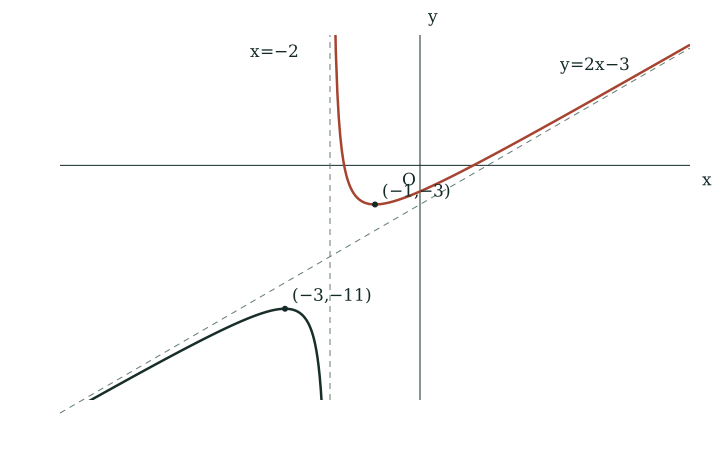
(iii) Sketch , indicating clearly the asymptotes and stationary points. [2]
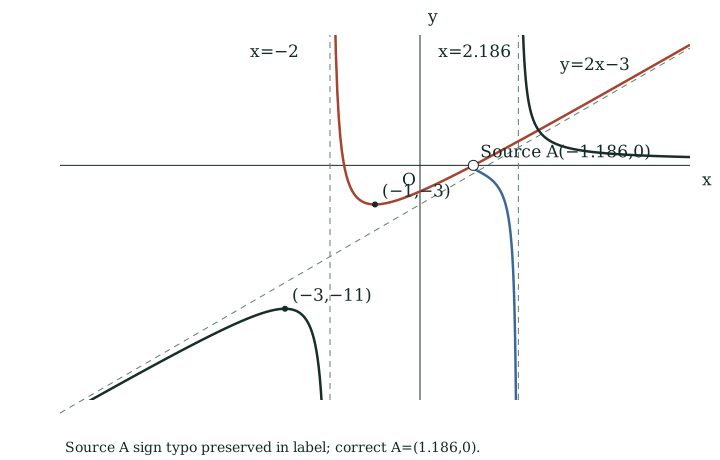
(iv) For , find the range of values of , correct to 3 decimal places, such that the equation has exactly one real root. [2]
[2011/NJC/Prelim/I/12b]
Printed working
(i) The curve has equation , where is a constant.
.
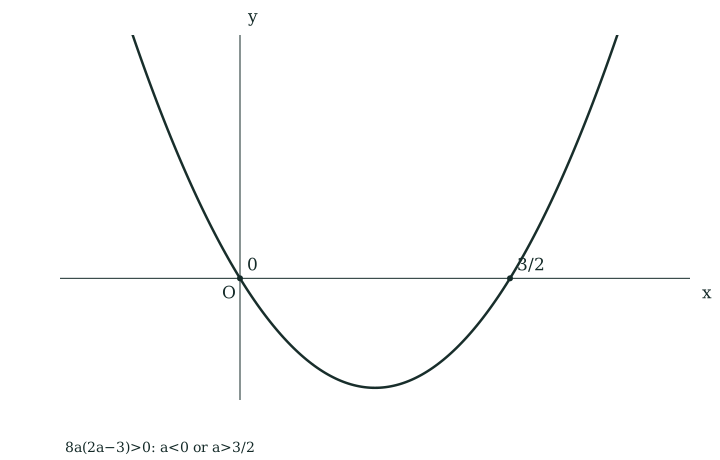
If has two distinct stationary points, then has 2 distinct real roots.
has two distinct roots.
Discriminant .
.
.
or .
(ii) (by long division).
Vertical Asymptote: .
Oblique Asymptote: .
At , .
(iii) , stationary points .
(iv) — (*).
Note: It would be advisable to get graph of from the graph of .
From GC, the curve cuts the -axis at (to 3 d.p.).
For exactly 1 real root, i.e., exactly 1 point of intersection, (3 d.p.).
Teacher notes
Curve excludes the pt and has a vertical asymptote at .
For eqn (*) to have 1 real root, the pt must be the pt () or to the right of pt ().
Printed answer key
(i) ; or . (iii) Native graph above. (iv) (3 d.p.). The short key omits (ii).
Editorial qualification
The source states A(-1.186,0), but the relevant positive zero is A(1.186,0): (−1+√33)/4≈1.186. The original negative sign is preserved as a printed error; the final r bound uses the positive value. At the excluded original pole x=-2 an algebraic derivative root must not be retained.
Source provenance
2025 TJC H2 Math (9758) JC2 MSM: GRAPHS AND CURVE SKETCHING. Question/answer booklet printed pages 1–14; solutions printed pages 1–28. Running metadata and repeated headings are transcribed in the topic metadata article.