Original question & working
Compare a rational branch to the upper hyperbola · source reference
2018/AJC/Prelim/II/3 · Question pp. 6 · Working pp. 21, 22
Open the interactive lessonThe working and teaching notes are included in the interactive lesson.
Squaring without first requiring the rational side to be nonnegative would incorrectly include 2<x≤5/2.
Full original question, working & notes
Printed question
The curve has equation , where are real constants such that .
(i) By using differentiation, find the range of values of in terms of such that has no stationary points. [4]
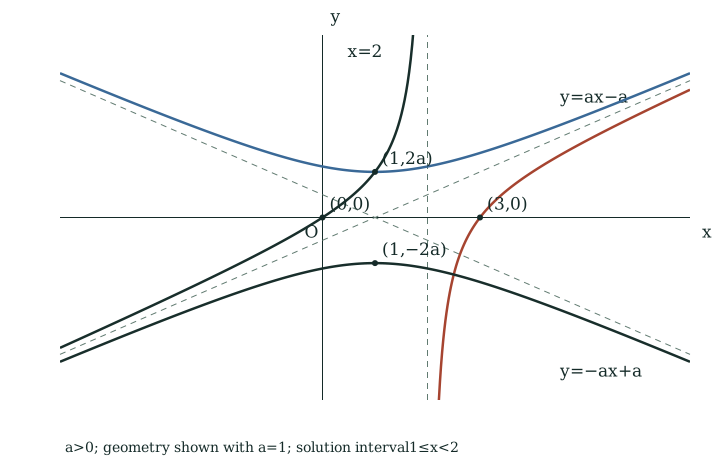
(ii) Given that , sketch , stating the equations of any asymptotes and the coordinates of the points where crosses the axes. [3]
(iii) On the same diagram as , sketch the graph of , showing clearly the equations of the asymptotes and turning points. Hence solve the inequality . [4]
[2018/AJC/Prelim/II/3]
Printed working
(i) .
.
When , .
— (*).
For to have no stationary points, (since ).
.
Alternatively,
, .
.
.
For to have no stationary points,
Discriminant .
Since , .
(ii) For , .
Equations of asymptotes: , .
(iii) (Hyperbola).
Asymptotes: or .
Vertices: .
.
From the graphs of and (i.e. ), .
Teacher notes
Since for all , for to have no stationary pts, equation (*) has no real roots since , i.e. .
-
To find asymptotes: Let .
-
To find vertices: Put , .
, and where .
So range of values of for which the part of curve is on or above curve .
Printed answer key
(i) . (ii), (iii) ; native graph above.
Editorial qualification
The teacher note’s statement “(x−2)²>0 for all x∈ℝ” needs x≠2; the question already excludes 2. Its line a(x−2)²<0 is a shorthand impossibility argument, not a feasible inequality. The printed transformed reciprocal branch continues to respect x≠2.
Source provenance
2025 TJC H2 Math (9758) JC2 MSM: GRAPHS AND CURVE SKETCHING. Question/answer booklet printed pages 1–14; solutions printed pages 1–28. Running metadata and repeated headings are transcribed in the topic metadata article.