Original question & working
A discriminant reveals a forbidden output interval · source reference
2009/NYJC//Prelim/I/7 · Question pp. 7 · Working pp. 26
Open the interactive lessonThe working and teaching notes are included in the interactive lesson.
Question PDF p.7 explicitly prints a<0 under √a; real range working and solution PDF p.26 give a=2. Preserve this source contradiction.
Full original question, working & notes
Printed question
The curve has equation . It is given that has a vertical asymptote .
(i) Determine the value of . [1]
(ii) Find the equation of the other asymptote of . [2]
(iii) Prove, using an algebraic method, that cannot lie between , , where is to be determined. [3]
(iv) When , the graph of cuts the -axis at 2 distinct points where is a positive integer.
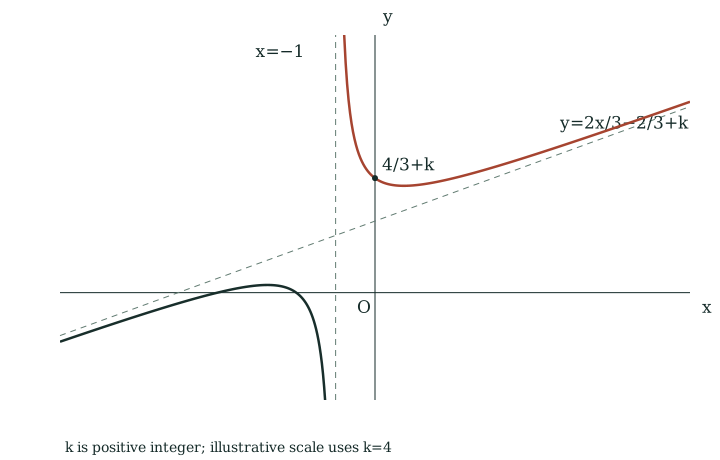
(a) Sketch the graph of when , indicating clearly all asymptotes and the coordinates of the axial intercepts. [4]
(b) Deduce the least possible integer value of . [1]
[2009/NYJC/Prelim/I/7]
Printed working
(i) Since has a vertical asymptote at , thus .
(ii) .
Oblique asymptote is .
(iii) .
.
.
The equation above has no real roots when discriminant .
.
.
.
.
.
(iv)(a) .
-intercepts are and .
(b) For the graph of to cut the -axis at 2 distinct points,
least integer value of is 4.
OR: For 2 distinct pts, has 2 distinct real roots Discriminant , i.e. .
Teacher notes
NOTE: Let , constant. Range of values of that cannot lie in (i.e. range of values that cannot take) → the values of (i.e. ) for which the line does not intersect the curve at all.
, i.e. has no real roots Discriminant .
Printed answer key
(i) . (ii) . (iv)(a) Native graph above, both x-intercepts as transcribed in working. (iv)(b) 4. The key omits (iii).
Editorial qualification
Part (iii) prints a<0 under √a, which is inconsistent over the reals. The worked solution gives a=2; retain the printed premise but correct the sign assumption to a>0 when using the answer. The abbreviated answer-key page omits part (iii).
Source provenance
2025 TJC H2 Math (9758) JC2 MSM: GRAPHS AND CURVE SKETCHING. Question/answer booklet printed pages 1–14; solutions printed pages 1–28. Running metadata and repeated headings are transcribed in the topic metadata article.