Original question & working
A positive square denominator still has a hole · source reference
[modified 2011/RI/Prelim/I/1] · Question pp. 1 · Working pp. 2
Open the interactive lessonThe working and teaching notes are included in the interactive lesson.
View source review notesFull original question, working & notes
Complete question
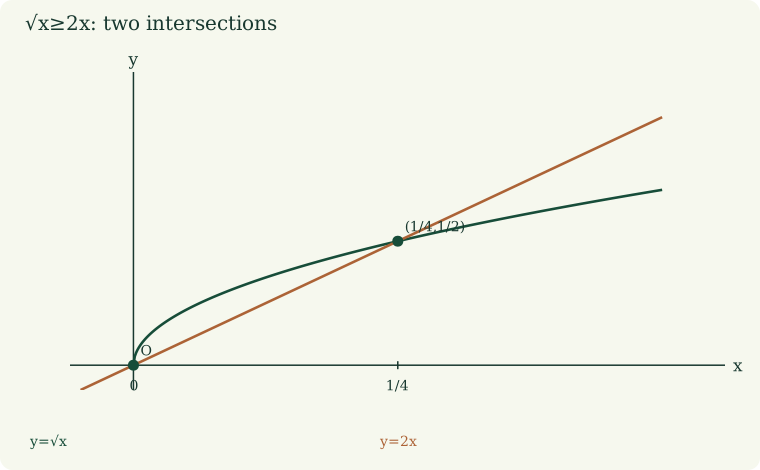
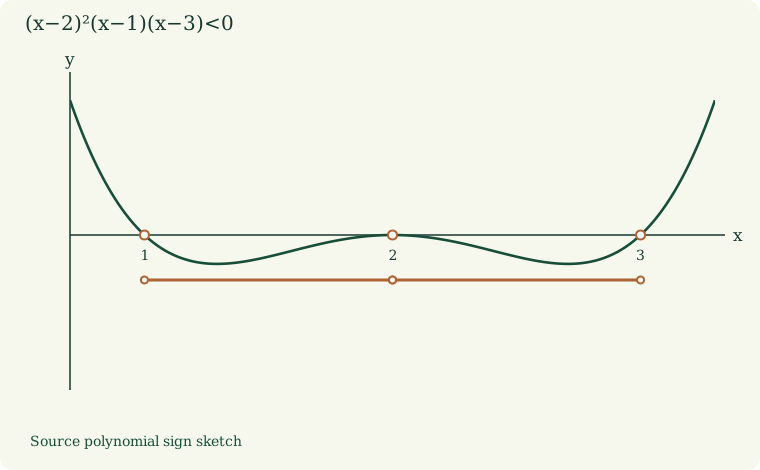
(a) Use graphs to solve . [2] (b) Solve .
[modified 2011/RI/Prelim/I/1]
Printed working
Part (a)
. From the graph, .
Part (b): Method 1
The printed quartic sketch crosses the axis at 1 and 3 and touches it at 2. The two intervals below the axis exclude the point 2. Thus or .
Part (b): Method 2
Since for all real ,
Teacher margin notes
Write down the values that cannot take. In this case, .
Source diagrams
Provenance
Question page references: 1. Solution page references: 2. The original compilation header and printed page numbers are preserved in the edition notes. Original PDFs and page images remain only in the private QA archive.