Original question & working
Replace the input by its magnitude · source reference
[2008/RJC/J1/T3 CT/9] · Question pp. 1 · Working pp. 3
Open the interactive lessonThe working and teaching notes are included in the interactive lesson.
View source review notesFull original question, working & notes
Complete question
(a) Solve exactly. [3] Hence solve . [2] (b) Prove algebraically that for all real x. Hence solve .
[2008/RJC/J1/T3 CT/9]
Printed working
Part (a)
Thus or .
Replace with to get .
The non-strict version gives
The first interval has no solution since on the domain. The second gives or .
The printed solution set is
or alternatively .
Part (b)
Since for all real values of , for all real values of . (Shown.)
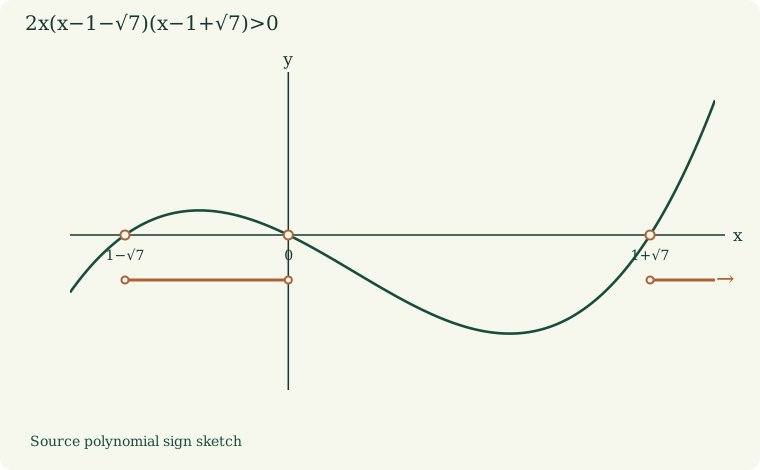
The inequality labelled (*) is
Because for all ,
Thus the solution is .
Teacher margin notes
As cannot be easily factorised: (1) use the quadratic formula to obtain the roots of , which gives the x-intercepts of the graph; OR (2) complete the square of to obtain the factors.
For , the solution is or , as the numerator can be zero in this case, unlike the first case.
Since for all , there is no sign change when both sides of inequality (*) are multiplied by .
Source diagrams
Provenance
Question page references: 1. Solution page references: 3. The original compilation header and printed page numbers are preserved in the edition notes. Original PDFs and page images remain only in the private QA archive.