Original question & working
A range proof needs degenerate cases · source reference
[2018/ACJC/Prelim/I/8] · Question pp. 1 · Working pp. 4, 5
Open the interactive lessonThe working and teaching notes are included in the interactive lesson.
Source discrepancy to review: solution PDF pp.4–5 applies the discriminant formula to all −1≤k≤1 without checking k=0 or cancelled roots at k=±1. Porisma separates those cases; the printed source remains available.
Full original question, working & notes
Complete question
(a) Without a calculator solve . [3] Hence solve . [2] (b) For with real x≠±1 and , find the range in terms of k. [4]
[2018/ACJC/Prelim/I/8]
Printed working
Part (a)
Since for all real values of , , giving or .
For , replace by in the previous result. Then (rejected) or , hence .
Part (b): Method 1 — algebraic, without GC
For values that can take, i.e. for the equation to have real roots, discriminant :
Consider :
The printed conclusion for (*) is
This is the original printed conclusion; exceptional cases are qualified below.
Part (b): Method 2 — graphical
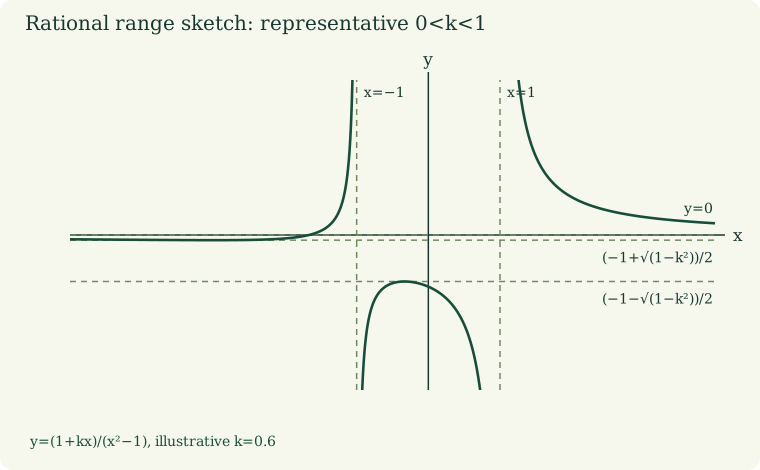
The source begins by setting and gives
The stationary points are printed as
The accompanying sketch labels the vertical lines , , horizontal asymptote , and stationary ordinate levels and . It repeats the same printed range conclusion as Method 1.
Exceptional cases — reviewed supplement
For , the printed range is correct. For , the range is . For , cancellation leaves a deleted input, so the range is . The discriminant condition alone does not enforce the non-quadratic case or the excluded inputs.
Teacher margin notes
As is a variable, and can be either negative or positive. As such, DO NOT cross-multiply.
Express the inequality in the form . Since numerator is always positive, denominator has to be positive for .
is always , i.e. for all , so there is no real solution for .
NOTE: Let , constant. The range of values that can take is the values of (i.e. ) for which the line intersects the curve: , i.e. has real roots, hence discriminant .
Source diagrams
Review qualification
Source discrepancy to review: solution PDF pp.4–5 applies the discriminant formula to all −1≤k≤1 without checking k=0 or cancelled roots at k=±1. Porisma separates those cases; the printed source remains available.
The corrected or qualified authored derivation is retained in the question article.
Provenance
Question page references: 1. Solution page references: 4, 5. The original compilation header and printed page numbers are preserved in the edition notes. Original PDFs and page images remain only in the private QA archive.