Original question & working
Strict positivity requires a strict discriminant bound · source reference
[2008/TPJC/Prelim/I/4] · Question pp. 2 · Working pp. 8
Open the interactive lessonThe working and teaching notes are included in the interactive lesson.
View source review notesFull original question, working & notes
Complete question
Show for every real x. Hence find all a such that for every real x. [6]
[2008/TPJC/Prelim/I/4]
Printed working
For the inequality to hold for all real ,
Since for all real , for all real .
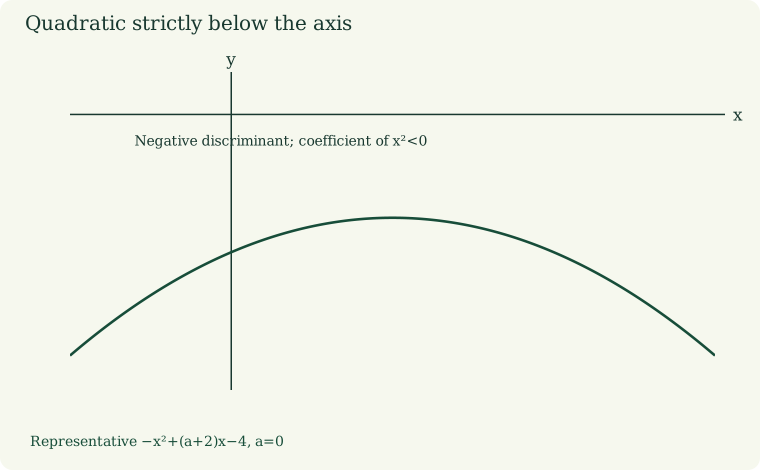
The printed curve lies entirely below the x-axis. Discriminant (note: coefficient of ):
Teacher margin notes
Show by completing the square.
Make one side of the inequality zero.
Since is “for all real x”, the quadratic curve must lie completely below the x-axis. To do so, the curve must have a maximum point. Thus two conditions must be satisfied: (1) discriminant — the curve does not cut the x-axis, so has no real roots; (2) coefficient of — the curve has a maximum point.
Source diagrams
Provenance
Question page references: 2. Solution page references: 8. The original compilation header and printed page numbers are preserved in the edition notes. Original PDFs and page images remain only in the private QA archive.