Porisma

Original question & working

A repeated factor does not disappear from a strict inequality · source reference

[modified 2008/RJC/Prelim/II/1] · Question pp. 2 · Working pp. 10, 11

Open the interactive lesson

The working and teaching notes are included in the interactive lesson.

View source review notes
Full original question, working & notes

Complete question

Show x2(x+2)2−1=(x+1)2(x+1+2)(x+1−2)x^2(x+2)^2-1=(x+1)^2(x+1+\sqrt2)(x+1-\sqrt2). [1] Hence solve 1/(x+2)2>x21/(x+2)^2>x^2 without a calculator. [3] Deduce the inputs satisfying 1/(ex+2)2>e2x1/(e^x+2)^2>e^{2x}. [2]

[modified 2008/RJC/Prelim/II/1]

Printed working

Identity

x2(x+2)2−1=(x2+2x)2−12=(x2+2x+1)(x2+2x−1)=(x+1)2[(x+1)2−(2)2]=(x+1)2(x+1+2)(x+1−2).(Shown.)\begin{aligned} x^2(x+2)^2-1&=(x^2+2x)^2-1^2\\ &=(x^2+2x+1)(x^2+2x-1)\\ &=(x+1)^2\bigl[(x+1)^2-(\sqrt2)^2\bigr]\\ &=(x+1)^2(x+1+\sqrt2)(x+1-\sqrt2).\quad\text{(Shown.)} \end{aligned}

Rational inequality — reduced quadratic

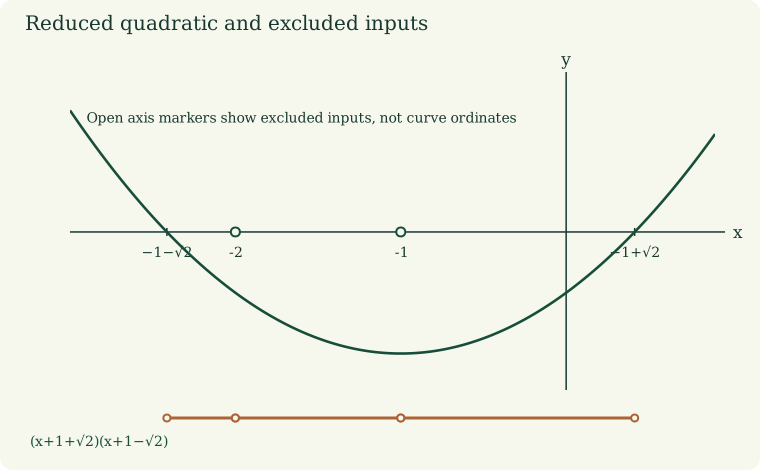
1(x+2)2>x2,x≠−2x2(x+2)2<1since (x+2)2>0(x+1)2(x+1+2)(x+1−2)<0,x≠−2(x+1+2)(x+1−2)<0since (x+1)2>0,x≠−1,−2.\begin{aligned} \frac1{(x+2)^2}&>x^2,\qquad x\ne-2\\ x^2(x+2)^2&<1\qquad\text{since }(x+2)^2>0\\ (x+1)^2(x+1+\sqrt2)(x+1-\sqrt2)&<0,\qquad x\ne-2\\ (x+1+\sqrt2)(x+1-\sqrt2)&<0\qquad\text{since }(x+1)^2>0,\quad x\ne-1,-2. \end{aligned}

Thus −1−2<x<−2-1-\sqrt2<x<-2 or −2<x<−1-2<x<-1 or −1<x<−1+2-1<x<-1+\sqrt2.

Alternatively write −1−2<x<−1+2-1-\sqrt2<x<-1+\sqrt2, x≠−2,−1x\ne-2,-1.

Alternative method — quartic sketch

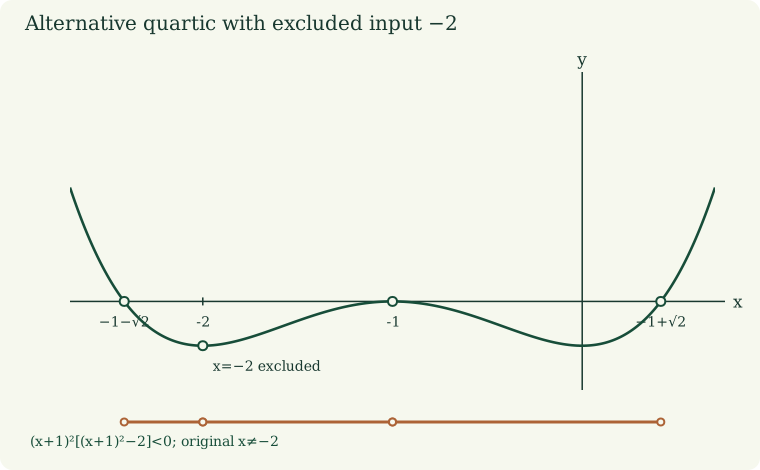
Directly solve (x+1)2(x+1+2)(x+1−2)<0(x+1)^2(x+1+\sqrt2)(x+1-\sqrt2)<0, x≠−2x\ne-2, using the printed quartic. It crosses at −1±2-1\pm\sqrt2 and touches at −1-1; the excluded input −2-2 is marked. It gives the same three intervals and the same compact answer above.

Exponential substitution

Replace xx by exe^x:

−1−2<ex<−2or−2<ex<−1or−1<ex<−1+2.-1-\sqrt2<e^x<-2\quad\text{or}\quad-2<e^x<-1\quad\text{or}\quad-1<e^x<-1+\sqrt2.

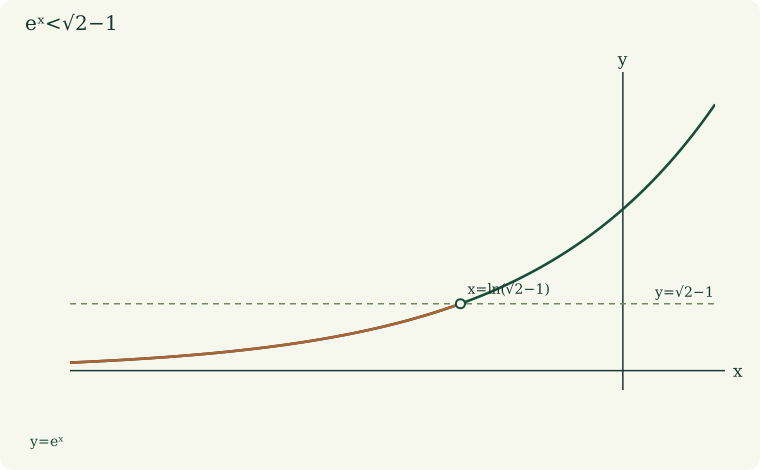
Since ex>0e^x>0, only 0<ex<−1+20<e^x<-1+\sqrt2 remains, giving x<ln⁡(2−1)x<\ln(\sqrt2-1).

Teacher margin notes

Rewrite as a2−b2=(a−b)(a+b)a^2-b^2=(a-b)(a+b).

Always state the values that xx cannot take so as to exclude these values from the solution.

Sketch the graph of y=exy=e^x and, by looking at the portion of graph between y=0y=0 and y=2−1y=\sqrt2-1, determine the range of values of xx.

Source diagrams

Reduced quadratic sign sketch: roots−1±√2 and excluded inputs−2,−1 shown as separate open number-line markers. Alternative original quartic sketch: crossing roots−1±√2, double root−1, excluded input−2; negative portions highlighted. Exponential substitution graph: y=eˣ and level√2−1, with open cutoff x=ln(√2−1) and the left interval highlighted.

Provenance

Question page references: 2. Solution page references: 10, 11. The original compilation header and printed page numbers are preserved in the edition notes. Original PDFs and page images remain only in the private QA archive.