Porisma

Original question & working

Fold the rational graph above the axis · source reference

[2020/YIJC/Prelim/I/4] · Question pp. 2 · Working pp. 13, 14

Open the interactive lesson

The working and teaching notes are included in the interactive lesson.

View source review notes
Full original question, working & notes

Complete question

(i) Find the exact roots of ∣(4x−5)/(x−2)∣=3x|(4x-5)/(x-2)|=3x. [3] (ii) Sketch that absolute-value curve and y=3x together. Hence solve ∣(5−4x)/(3x−6)∣>x|(5-4x)/(3x-6)|>x exactly. [5]

[2020/YIJC/Prelim/I/4]

Printed working

Part (i)

∣4x−5x−2∣=3x⟹4x−5x−2=3xor4x−5x−2=−3x.\left|\frac{4x-5}{x-2}\right|=3x\quad\Longrightarrow\quad \frac{4x-5}{x-2}=3x\quad\text{or}\quad\frac{4x-5}{x-2}=-3x.

First equation:

4x−5=3x2−6x3x2−10x+5=0x=10±102−4(3)(5)6=10±406=53±103.\begin{aligned} 4x-5&=3x^2-6x\\ 3x^2-10x+5&=0\\ x&=\frac{10\pm\sqrt{10^2-4(3)(5)}}6 =\frac{10\pm\sqrt{40}}6=\frac53\pm\frac{\sqrt{10}}3. \end{aligned}

Second equation:

4x−5=−3x2+6x⇒3x2−2x−5=0⇒(3x−5)(x+1)=0.4x-5=-3x^2+6x\Rightarrow3x^2-2x-5=0\Rightarrow(3x-5)(x+1)=0.

This gives x=5/3x=5/3 or −1-1; reject −1-1 since x≥0x\ge0. Hence the roots are x=5/3x=5/3 or 5/3±10/35/3\pm\sqrt{10}/3.

Part (ii)

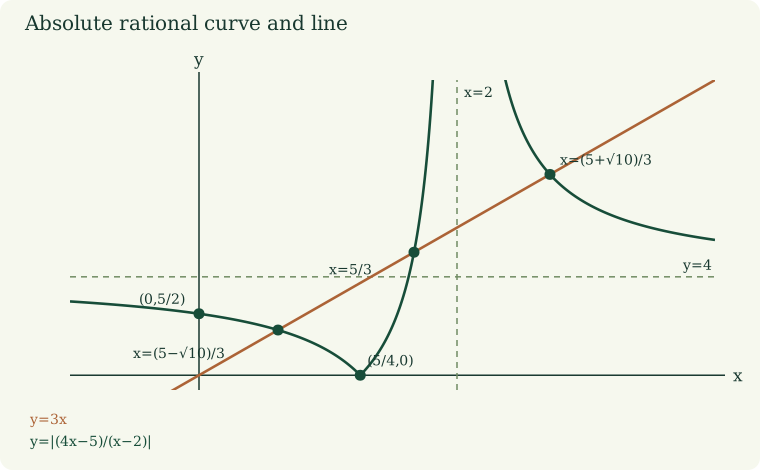
The underlying rational curve is 4x−5x−2=4+3x−2\dfrac{4x-5}{x-2}=4+\dfrac3{x-2}. Reflect its negative-y portion in the x-axis to obtain y=∣(4x−5)/(x−2)∣y=\left|(4x-5)/(x-2)\right|.

The source sketch labels y=4y=4, x=2x=2, (0,5/2)(0,5/2), (5/4,0)(5/4,0), the three intersections x=5/3−10/3x=5/3-\sqrt{10}/3, 5/35/3, 5/3+10/35/3+\sqrt{10}/3, and y=3xy=3x.

∣5−4x3x−6∣>x∣(−1)(4x−5)3(x−2)∣>x∣4x−5x−2∣>3x.\begin{aligned} \left|\frac{5-4x}{3x-6}\right|&>x\\ \left|\frac{(-1)(4x-5)}{3(x-2)}\right|&>x\\ \left|\frac{4x-5}{x-2}\right|&>3x. \end{aligned}

From the graphs, x<5/3−10/3x<5/3-\sqrt{10}/3 or 5/3<x<25/3<x<2 or 2<x<5/3+10/32<x<5/3+\sqrt{10}/3.

Teacher margin notes

Note: x≥0x\ge0, as ∣(4x−5)/(x−2)∣≥0\left|(4x-5)/(x-2)\right|\ge0.

To sketch the graph of y=∣f(x)∣y=|f(x)|: obtain it by reflecting the part of the curve y=f(x)y=f(x) where y<0y<0 above the x-axis, while the part where y≥0y\ge0 remains unchanged.

Source diagrams

Complete source absolute-rational and line graph, with asymptotes x=2,y=4, intercepts(0,5/2),(5/4,0) and three exact intersection abscissae.

Provenance

Question page references: 2. Solution page references: 13, 14. The original compilation header and printed page numbers are preserved in the edition notes. Original PDFs and page images remain only in the private QA archive.