Original question & working
Restrict the domain to choose an inverse · source reference
[2011/IJC/Prelim/I/9] · Question pp. 1, 2 · Working pp. 5, 6, 7
Open the interactive lessonThe working and teaching notes are included in the interactive lesson.
The general claim that f and its inverse intersect only on y=x is false for decreasing functions. The working here includes the extra admissibility check.
Full original question, working & notes
Complete question
For all real x, . (i) Find its range. [2] (ii) Explain why it has no inverse. [1] (iii) Restrict its domain to : find the least k that gives an inverse, and find that inverse. [3] (iv) Sketch the restricted f and its inverse together, clearly showing their relationship. [2] (v) Show algebraically that a solution of satisfies . [2]
[2011/IJC/Prelim/I/9]
Printed working
Part (i)
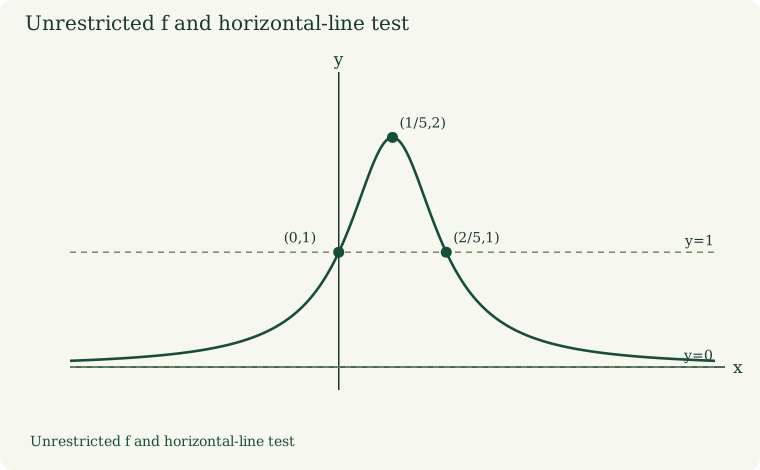
The graph is symmetric about , with maximum and horizontal asymptote . The marked line intersects the unrestricted graph twice. .
Part (ii): graphical method
The horizontal line cuts the graph of at two points (), hence is not one-one and does not have an inverse.
Part (ii): counter-example — non-graphical
Since but and both inputs lie in , is not one-one and does not have an inverse.
Part (iii)
Least . Let , :
Since , . Hence
Part (iv)
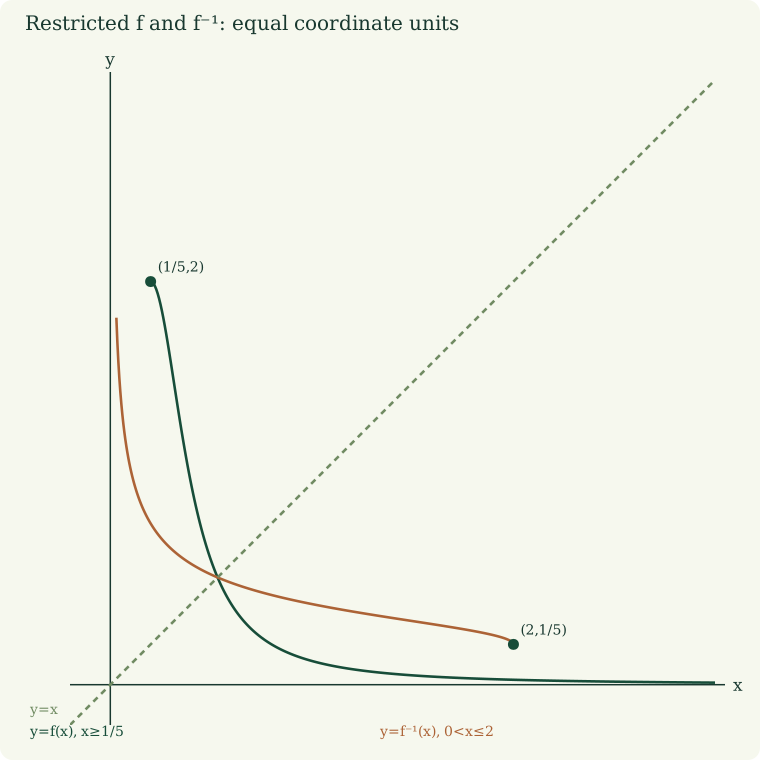
The restricted graph and its inverse are reflected about , with endpoints and respectively. Both axes use the same scale. The inverse has vertical asymptote , while the restricted function tends to .
Part (v): printed derivation
Therefore , giving (shown).
The implication to the fixed-point equation is justified for this restricted curve; the authored article supplies the stronger domain check that excludes extra unrestricted two-cycle roots.
Teacher margin notes
The range of is the set of y-values that can take. Sketch the graph of according to the given domain before determining the range.
Graphical method: use the graph of sketched in (i). To show is not1–1, give a counter-example of one particular horizontal line that cuts the graph of more than once.
Counter-example: give two different values of x that result in the same image y.
Deduce the least from the graph of . State the domain of . To find : (1) let ; (2) make the subject, and if there are two possible expressions, choose the one corresponding to values can take in the domain of ; (3) replace with . Note: .
When sketching and together, use the same scale for x- and y-axes; their graphs must be symmetrical about . Always include endpoints. In this case the two curves intersect only on , so the two curves and the line meet at the same point.
To solve , it may be easier to solve or .
Source diagrams
Review qualification
The full printed solution sketch labels a horizontal asymptote , whereas the question short key and the formula imply . The native graph uses the mathematically correct asymptote ; is the separate horizontal-line test level. This preserves the printed discrepancy explicitly.
The general claim that f and its inverse intersect only on y=x is false for decreasing functions. The working here includes the extra admissibility check.
The corrected or qualified authored derivation is retained in the question article.
Provenance
Question page references: 1, 2. Solution page references: 5, 6, 7. The original compilation header and printed page numbers are preserved in the edition notes. Original PDFs and page images remain only in the private QA archive.