Original question & working
Map the whole interval, not only its endpoints · source reference
[modified 2011/HCI/Prelim/II/2] · Question pp. 2 · Working pp. 8, 9
Open the interactive lessonThe working and teaching notes are included in the interactive lesson.
View source review notesFull original question, working & notes
Complete question
(a) for real , with constant lambda. (i) Find the values of lambda for which an inverse exists. [2] (ii) With , define the inverse, including its domain. [3] (b) for all real x, and for real . (i) Show hg exists. [2] (ii) Find its range. [2]
[modified 2011/HCI/Prelim/II/2]
Printed working
Part (a)(i)
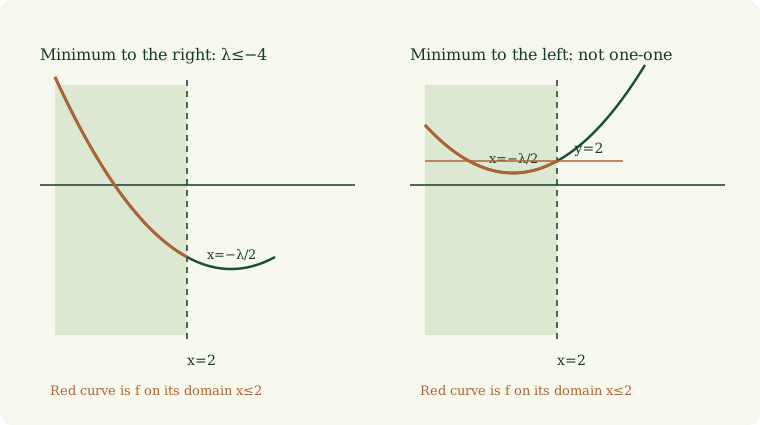
For , gives , the x-coordinate of the minimum.
For to exist, must be one-one. Thus .
Alternative method to find the turning-point abscissa:
Thus is again the minimum abscissa. The two source diagrams compare a minimum to the right of 2 (injective restricted branch) and a minimum to the left of 2 (horizontal line cuts the restricted graph twice). Their shaded domain is .
Part (a)(ii)
Let , . Then , giving .
Since , reject and take . .
Therefore , .
Part (b)(i)
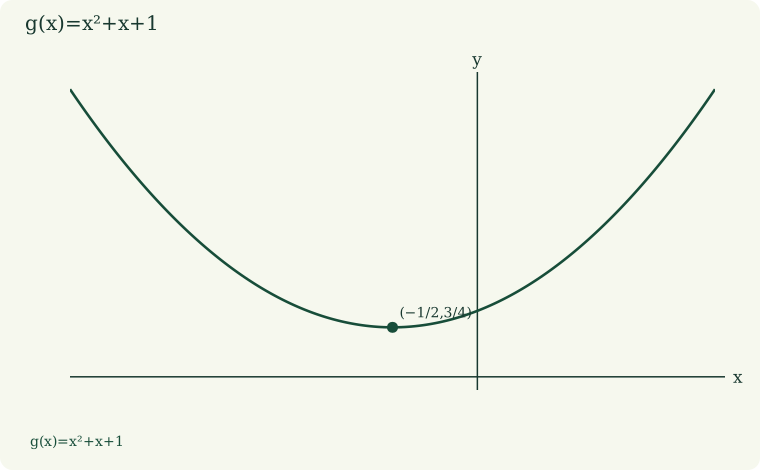
The graph labels minimum . Since , exists (shown).
Part (b)(ii)
Use as the new domain of . The source graph labels its minimum , vertical asymptote , oblique asymptote , the domain ray beginning at and a vertical range ray beginning at 4.
Thus .
Teacher margin notes
For to be1–1, the minimum at must be to the right of , i.e. . If it is to the left of , as in the second diagram, is not1–1 because horizontal line cuts its graph at two points.
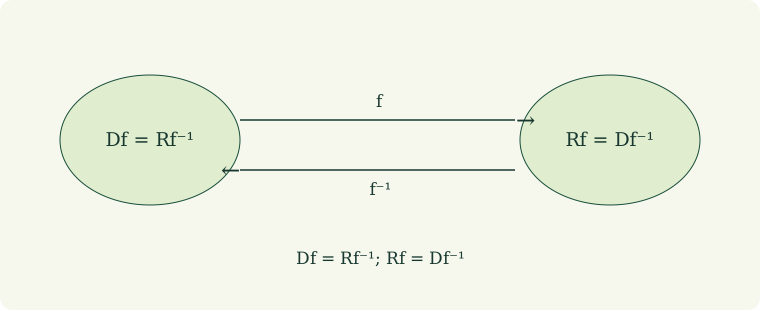
To find : (1) let so ; (2) make the subject and choose the expression corresponding to the domain of ; (3) replace with ; (4) define — both rule and domain. Note .
Given two functions , is (first function) followed by (second function). For to exist, range of domain of .
To find : (1) find using the graph of ; (2) sketch the graph of the second function ; (3) range of the first function becomes the restricted domain of ; (4) use that new domain and the graph of to find its range, which is .
Source diagrams
![Source h=x+4/x plot: x=0 andy=x asymptotes, minimum(2,4), restricted domain[3/4,∞) and range[4,∞).](/diagrams/native-04-04-h.svg)
Provenance
Question page references: 2. Solution page references: 8, 9. The original compilation header and printed page numbers are preserved in the edition notes. Original PDFs and page images remain only in the private QA archive.