Porisma

Original question & working

Three compositions return the input · source reference

[2014/JJC/Promo/8] · Question pp. 2 · Working pp. 11

Open the interactive lesson

The working and teaching notes are included in the interactive lesson.

View source review notes
Full original question, working & notes

Complete question

Define f(x)=(x−1)/xf(x)=(x-1)/x for real x≠0,1x\ne0,1. (i) Define its inverse. [3] (ii) Show the composite f2f^2 exists and equals the inverse. [3] (iii) State f3(x)f^3(x). [1] (iv) Given f2014g(x)=1−e−xf^{2014}g(x)=1-e^{-x} for x>0x>0, find g(x). [3]

[2014/JJC/Promo/8]

Printed working

Part (i)

Let y=(x−1)/xy=(x-1)/x, x∈Rx\in\mathbb R, x≠0,1x\ne0,1. Then

xy=x−1⇒1=x−xy⇒1=x(1−y)⇒11−y=x.xy=x-1\Rightarrow1=x-xy\Rightarrow1=x(1-y)\Rightarrow\frac1{1-y}=x.

Thus f−1(x)=1/(1−x)f^{-1}(x)=1/(1-x) and Df−1=Rf=R∖{0,1}D_{f^{-1}}=R_f=\mathbb R\setminus\{0,1\}.

Alternatively write the domain as (−∞,0)∪(0,1)∪(1,∞)(-\infty,0)\cup(0,1)\cup(1,\infty).

Define f−1:x↦1/(1−x)f^{-1}:x\mapsto1/(1-x), x∈Rx\in\mathbb R, x≠0,1x\ne0,1.

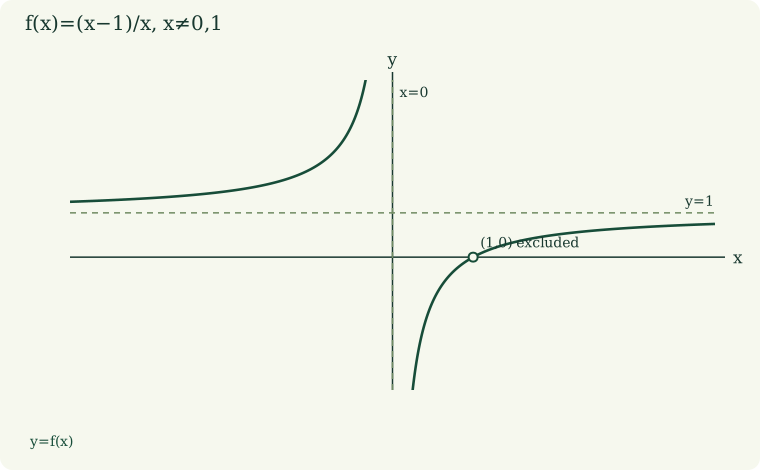
The source sketch of y=f(x)y=f(x) labels vertical asymptote x=0x=0, horizontal asymptote y=1y=1 and an open point (1,0)(1,0).

Part (ii)

Since Rf=R∖{0,1}⊆R∖{0,1}=DfR_f=\mathbb R\setminus\{0,1\}\subseteq\mathbb R\setminus\{0,1\}=D_f, f2f^2 exists (shown).

f2(x)=f(f(x))=x−1x−1x−1x=−1x−1=11−x=f−1(x).(Shown.)f^2(x)=f(f(x))=\frac{\frac{x-1}{x}-1}{\frac{x-1}{x}} =-\frac1{x-1}=\frac1{1-x}=f^{-1}(x).\quad\text{(Shown.)}

Part (iii)

f2(x)=f−1(x)f^2(x)=f^{-1}(x) gives f(f2(x))=f(f−1(x))f(f^2(x))=f(f^{-1}(x)), so f3(x)=xf^3(x)=x on the original punctured domain.

Part (iv)

f2014(g(x))=1−e−xf^{2014}(g(x))=1-e^{-x}. Note 2014=671×3+12014=671\times3+1:

ff3⋯f3⏟671 blocks(g(x))=1−e−x.f\underbrace{f^3\cdots f^3}_{671\text{ blocks}}(g(x))=1-e^{-x}.

Replace the innermost f3(g(x))f^3(g(x)) by g(x)g(x), leaving670 such blocks, and use the earlier result repeatedly. This reduces to f(g(x))=1−e−xf(g(x))=1-e^{-x}, hence

g(x)=f−1(1−e−x)=11−(1−e−x)=ex.g(x)=f^{-1}(1-e^{-x})=\frac1{1-(1-e^{-x})}=e^x.

Teacher margin notes

From (iii), f3(x)=x⇒f3(g(x))=g(x)f^3(x)=x\Rightarrow f^3(g(x))=g(x). Example: f10(g(x))=ff3f3f3⏟3 blocks(g(x))=ff3f3⏟2 blocks(g(x))=ff3⏟1 block(g(x))=f(g(x))f^{10}(g(x))=f\underbrace{f^3f^3f^3}_{3\text{ blocks}}(g(x))=f\underbrace{f^3f^3}_{2\text{ blocks}}(g(x))=f\underbrace{f^3}_{1\text{ block}}(g(x))=f(g(x)).

Source diagrams

Source punctured rational graph y=(x−1)/x with x=0,y=1 asymptotes and open deleted point(1,0).

Provenance

Question page references: 2. Solution page references: 11. The original compilation header and printed page numbers are preserved in the edition notes. Original PDFs and page images remain only in the private QA archive.