Original question & working
Absolute values and the correct inverse branch · source reference
[2011/AJC/Promo/8] · Question pp. 3 · Working pp. 12, 13
Open the interactive lessonThe working and teaching notes are included in the interactive lesson.
View source review notesFull original question, working & notes
Complete question
For real , ; for all real x, . (i) Show f is not one-one. Find the least k such that restricting the domain to makes it one-one. [2] On this restricted domain, (ii) define the inverse of f. [3] (iii) Find the exact range of . [2]
[2011/AJC/Promo/8]
Printed working
Part (i)
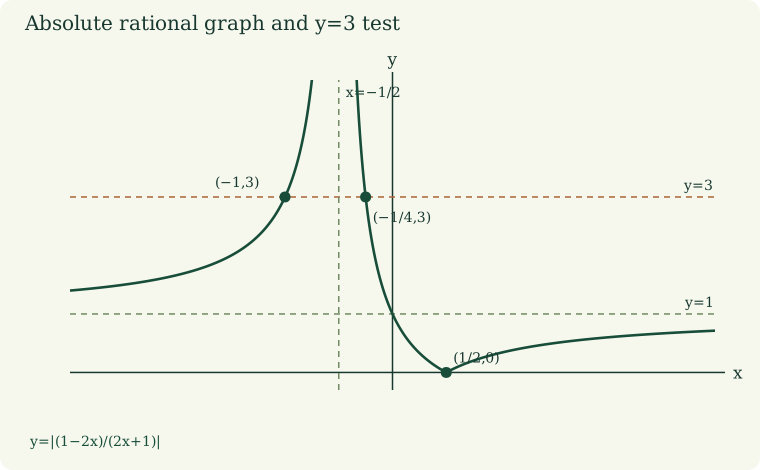
The horizontal line cuts the graph of at more than one point (two points), so is not one-one. Least .
The graph labels vertical asymptote , horizontal asymptote , cusp and the counter-example line . Its two intersections are at and , both giving3.
Part (ii)
Let , :
Therefore , .
Thus , .
Part (iii)
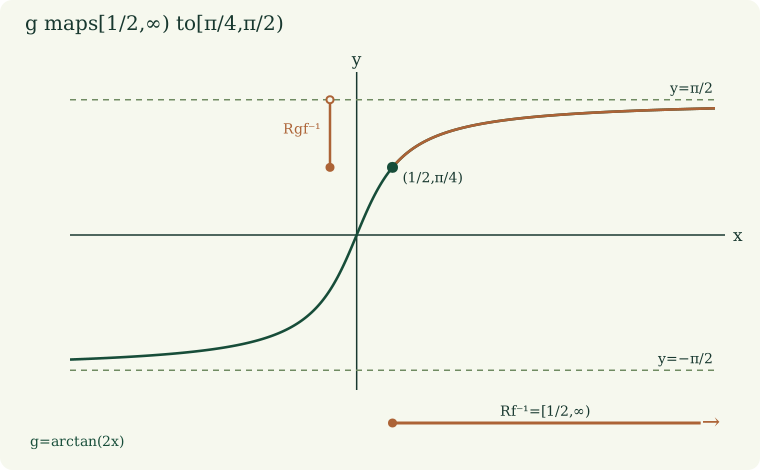
Thus . The source arctangent graph labels both horizontal asymptotes , point , restricted domain ray beginning at and range with closed lower and open upper endpoints.
Teacher margin notes
For the graphical method, draw horizontal line on the same diagram as the graph of , showing it cuts that graph at two points.
Note: (1) To show is not1–1, only give an example of one particular horizontal line cutting its graph more than once. (2) Either write “graph of f”, “graph of y=f(x)”, or “the curve y=f(x)”.
The source says for , , , so and , hence . At the included endpoint , the first strict sign should be ; the displayed absolute-value identity and inverse remain valid there.
Source diagrams
Provenance
Question page references: 3. Solution page references: 12, 13. The original compilation header and printed page numbers are preserved in the edition notes. Original PDFs and page images remain only in the private QA archive.