Porisma

Original question & working

Invert a special point separately · source reference

[2010/MJC/Prelim/I/10] · Question pp. 3 · Working pp. 13, 14

Open the interactive lesson

The working and teaching notes are included in the interactive lesson.

View source review notes
Full original question, working & notes

Complete question

For all real x, f(x)=cos⁡xf(x)=\cos x. For −1<x≤1-1<x\le1, g(x)=ln⁡(1/(1+x))g(x)=\ln(1/(1+x)). Define h by the same logarithmic rule for −1<x<1-1<x<1, but set h(1)=−1. (i) Show fg exists. [2] (ii) Expand fg through the cubic term. [4] (iii) State h−1(−1)h^{-1}(-1), then define the piecewise inverse as p(x) for x>a and c for x=−1, finding a,c and p. [4]

[2010/MJC/Prelim/I/10]

Printed working

Part (i)

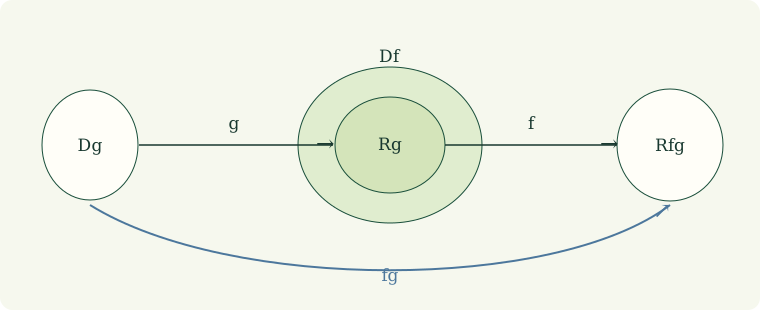
Rg=[−ln⁡2,∞)R_g=[-\ln2,\infty) and Df=RD_f=\mathbb R. Since Rg⊆DfR_g\subseteq D_f, fgfg exists.

The source graph of g(x)=−ln⁡(1+x)g(x)=-\ln(1+x) labels vertical asymptote x=−1x=-1 and the closed endpoint (1,−ln⁡2)(1,-\ln2). A composition diagram shows RgR_g inside DfD_f and the arrows gg, ff and fgfg.

Part (ii)

fg(x)=cos⁡(ln⁡11+x)=cos⁡(−ln⁡(1+x))≈cos⁡(−x+x22−x33)=1−(−x+x2/2−x3/3)22!+(−x+x2/2−x3/3)44!−⋯=1−12(−x+x22)2+⋯=1−12(x2−x3)+⋯=1−12x2+12x3+⋯ .\begin{aligned} fg(x)&=\cos\left(\ln\frac1{1+x}\right)=\cos(-\ln(1+x))\\ &\approx\cos\left(-x+\frac{x^2}2-\frac{x^3}3\right)\\ &=1-\frac{(-x+x^2/2-x^3/3)^2}{2!}+\frac{(-x+x^2/2-x^3/3)^4}{4!}-\cdots\\ &=1-\frac12\left(-x+\frac{x^2}2\right)^2+\cdots\\ &=1-\frac12(x^2-x^3)+\cdots\\ &=1-\frac12x^2+\frac12x^3+\cdots. \end{aligned}

Part (iii)

h(1)=−1⇒h−1(−1)=1h(1)=-1\Rightarrow h^{-1}(-1)=1.

For the continuous branch, let y=ln⁡(1/(1+x))=−ln⁡(1+x)y=\ln(1/(1+x))=-\ln(1+x), −1<x<1-1<x<1:

1+x=e−y⇒x=e−y−1.1+x=e^{-y}\Rightarrow x=e^{-y}-1.

Thus

h−1(x)={e−x−1,x>−ln⁡2,1,x=−1.h^{-1}(x)=\begin{cases}e^{-x}-1,&x>-\ln2,\\1,&x=-1.\end{cases}

Teacher margin notes

For fgfg to exist, the range of the first function gg must be a subset of the domain of the second function ff.

Use the standard Maclaurin series: ln⁡(1+x)=x−x2/2+x3/3−⋯+(−1)r+1xr/r+⋯\ln(1+x)=x-x^2/2+x^3/3-\cdots+(-1)^{r+1}x^r/r+\cdots and cos⁡x=1−x2/2!+x4/4!−⋯+(−1)rx2r/(2r)!+⋯\cos x=1-x^2/2!+x^4/4!-\cdots+(-1)^rx^{2r}/(2r)!+\cdots.

To find h−1(x)h^{-1}(x): (1) let y=h(x)⇒x=h−1(y)y=h(x)\Rightarrow x=h^{-1}(y); (2) make xx the subject; (3) replace yy with xx; (4) define h−1h^{-1} — both rule and domain. For the branch −1<x<1-1<x<1, Dh−1=Rh=Rg∖{−ln⁡2}D_{h^{-1}}=R_h=R_g\setminus\{-\ln2\}; the isolated inverse input −1 is handled by the separate case.

Source diagrams
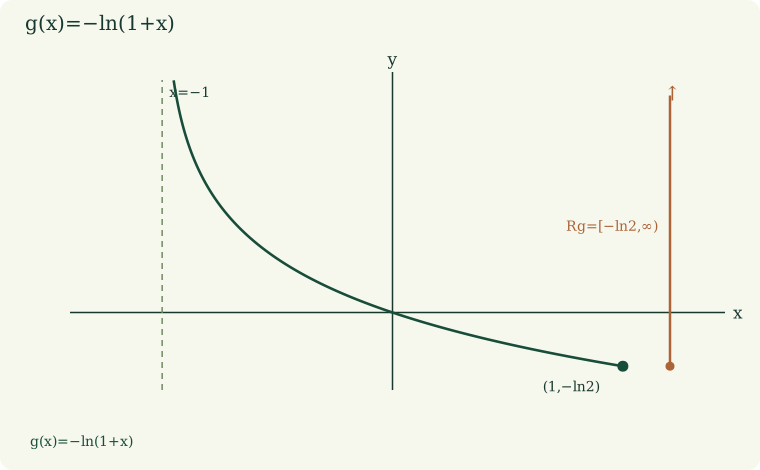
Source g=−ln(1+x) graph with x=−1 asymptote and closed endpoint(1,−ln2), plus range ray. Source g then f composition diagram, with Rg inside Df.

Provenance

Question page references: 3. Solution page references: 13, 14. The original compilation header and printed page numbers are preserved in the edition notes. Original PDFs and page images remain only in the private QA archive.