Original question & working
The decreasing sine branch · source reference
[2016/NYJC/Prelim/I/10a] · Question pp. 3 · Working pp. 15
Open the interactive lessonThe working and teaching notes are included in the interactive lesson.
Source discrepancy: solution PDF p.15 prints arcsin(x/2)−π/3. This maps 2 to π/6 but maps −2 to −5π/6, outside the required domain. Porisma shows the corrected branch and retains the original source.
Full original question, working & notes
Complete question
(i) Express as with exact positive R and alpha. [1] (ii) Define f by that expression on . Find the largest exact k for which f has an inverse, define the inverse including its domain, and state the inputs where . [5]
[2016/NYJC/Prelim/I/10a]
Printed working
Part (i)
and .
Thus .
Part (ii): printed working
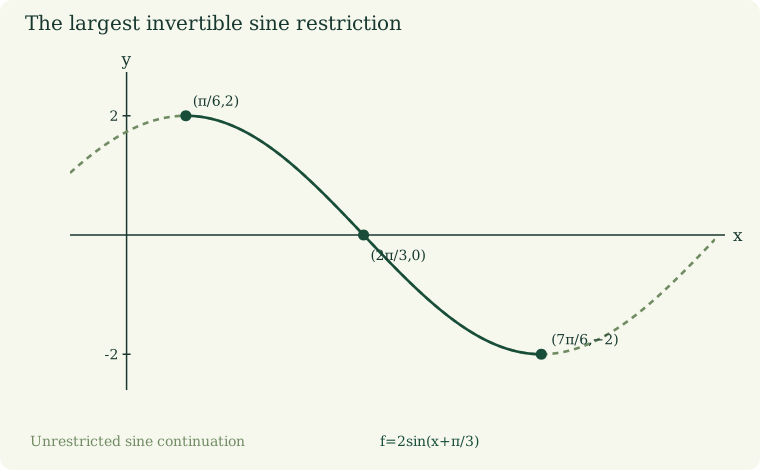
, . For an inverse, must be one-one. The largest .
The source plot shows the closed endpoints , , the x-intercept and dotted continuations of the unrestricted sine curve.
Let , . The source prints
The printed inverse domain is correct, but the printed inverse rule is the wrong sine branch.
Corrected inverse branch
On the decreasing half-wave, . Thus
Composite domain comparison
Both identity composites equal where defined. The printed working gives
Alternatively . This composite-domain answer is unchanged after correcting the branch.
Teacher margin notes
and . To compare them, intersect their domains: .
Source diagrams
Review qualification
Source discrepancy: solution PDF p.15 prints arcsin(x/2)−π/3. This maps 2 to π/6 but maps −2 to −5π/6, outside the required domain. Porisma shows the corrected branch and retains the original source.
The corrected or qualified authored derivation is retained in the question article.
Provenance
Question page references: 3. Solution page references: 15. The original compilation header and printed page numbers are preserved in the edition notes. Original PDFs and page images remain only in the private QA archive.