Original question & working
Matching rules are not equal without matching domains · source reference
[2021/EJC/Promo/8] · Question pp. 4 · Working pp. 16, 17
Open the interactive lessonThe working and teaching notes are included in the interactive lesson.
View source review notesFull original question, working & notes
Printed question
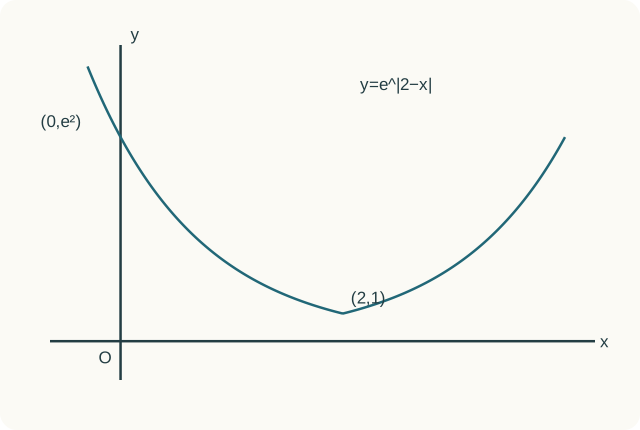
The function is defined by , , , where is a constant. It is given that is the least possible value such that exists.
(i) State the value of . [1]
(ii) Hence find and state the domain of . [4]
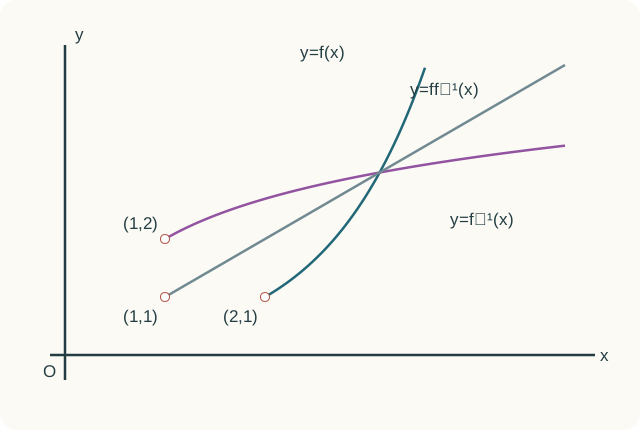
(iii) Sketch on the same diagram the graphs of , and , giving the coordinates of all end points. [3]
It is now given that is replaced by a constant such that the functions and are equal.
(iv) Explain why the new value of satisfies the equation , and find . [2]
(v) The function is defined by , . Explain why composite does not exist. [1]
[2021/EJC/Promo/8]
Printed working
(i) . The unrestricted exponential absolute-value graph has minimum and intercept .
(ii) Let . , i. e. . Thus , , . Therefore , .
(iii) Native graphs have open endpoints , and ; for . All three meet at the fixed point.
(iv) The source writes “As exists, ”; existence alone allows as well, but the new equal-domain solution is indeed greater than .
(same rule). To be equal, also need (same domain) ⇒ ⇒ ⇒ ⇒ . Here denotes the formula’s limiting endpoint value although is excluded from the domain. GC gives (3 s. f.).
(v) If exists, . But , and is not an integer, so . Hence , and does not exist.
Teacher notes
For to exist, has to be one-one.
; . The three graphs intersect at the same point.
Answer key
(i) 2. (ii) , . (iii) Native three-curve sketch. (iv) (3 s. f.). (v) .
Native diagrams