Porisma

Original question & working

Self-inverse functions alternate by parity · source reference

[2020/CJC/Promo/10] · Question pp. 4 · Working pp. 17, 18

Open the interactive lesson

The working and teaching notes are included in the interactive lesson.

View source review notes
Full original question, working & notes

Printed question

A function ff is said to be a self-inverse function if f(x)=f−1(x) f(x)=f^{-1}(x). The function ff is defined by f(x)=ax+bcx−2 f(x)=\frac{ax+b}{cx-2}, x∈Rx\in\mathbb R, x≠2/cx\ne2/c, where a,b,c,da, b, c, d are non-zero constants.

(i) By finding f−1(x) f^{-1}(x), show that a=2 a=2 for ff to be self-inverse. [2]

For the rest use a=2,b=3,c=5 a=2, b=3, c=5. (ii) Find f2(x) f^2(x). [1] (iii) Evaluate f71(4) f^{71}(4). [2]

The function gg is defined by g(x)=2x2−3 g(x)=2x^2-3, x∈Rx\in\mathbb R. (iv) Explain why composite fgfg does not exist. [2] (v) Find exact solutions of gf(x)=5 gf(x)=5. [3]

[2020/CJC/Promo/10]

Printed working

(i) y=(ax+b)/(cx−2) y=(ax+b)/(cx-2) ⇒ cxy−2y=ax+bcxy-2y=ax+b ⇒ x(cy−a)=b+2yx(cy-a)=b+2y ⇒ x=(b+2y)/(cy−a)=(2y+b)/(cy−a) x=(b+2y)/(cy-a)=(2y+b)/(cy-a).

Hence f−1(x)=(2x+b)/(cx−a) f^{-1}(x)=(2x+b)/(cx-a). Comparing gives a=2 a=2 (under the inverse-existence/nonconstant premise: the determinant −2a−bc-2a-bc must be nonzero).

(ii) f=f−1 f=f^{-1} ⇒ ff=ff−1 ff=ff^{-1} ⇒ f2(x)=ff−1(x)=xf^2(x)=ff^{-1}(x)=x, for x≠2/5 x\ne2/5.

(iii) f71(x)=f35×2+1(x)=f(x) f^{71}(x)=f^{35\times2+1}(x)=f(x); f71(4)=f(4)=[2(4)+3]/[5(4)−2]=11/18 f^{71}(4)=f(4)=[2(4)+3]/[5(4)-2]=11/18.

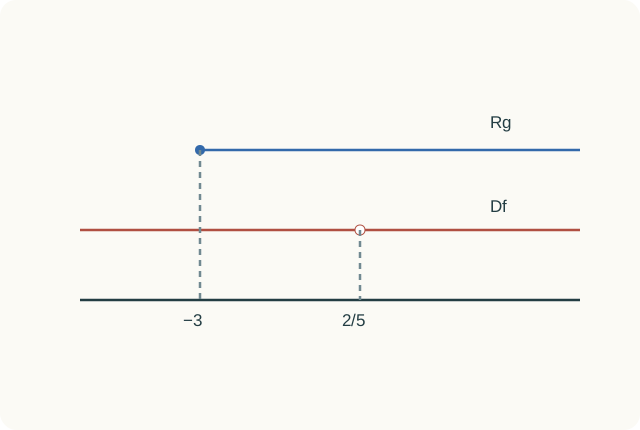
(iv) For fgfg to exist, Rg⊆DfR_g\subseteq D_f. Rg=[−3,∞) R_g=[-3, \infty), Df=(−∞,2/5)∪(2/5,∞) D_f=(-\infty, 2/5)\cup(2/5, \infty). Since Rg⊈DfR_g\nsubseteq D_f, fgfg does not exist.

(v) gf(x)=5 gf(x)=5 ⇒ g((2x+3)/(5x−2))=5 g((2x+3)/(5x-2))=5 ⇒ 2((2x+3)/(5x−2))2−3=52((2x+3)/(5x-2))^2-3=5 ⇒ ((2x+3)/(5x−2))2=4((2x+3)/(5x-2))^2=4.

Method 1: 2x+3=±2(5x−2)2x+3=\pm2(5x-2). Positive sign gives 2x+3=2(5x−2)⇒8x=7⇒x=7/82x+3=2(5x-2)\Rightarrow8x=7\Rightarrow x=7/8. Negative gives 2x+3=−2(5x−2)⇒12x=1⇒x=1/122x+3=-2(5x-2)\Rightarrow12x=1\Rightarrow x=1/12.

Method 2: square relation gives 4x2+12x+9=4(25x2−20x+4)4x^2+12x+9=4(25x^2-20x+4) ⇒ 96x2−92x+7=096x^2-92x+7=0.

x=92±8464−4(96)(7)2(96)=92±76192=78 or 112.x=\frac{92\pm\sqrt{8464-4(96)(7)}}{2(96)}=\frac{92\pm76}{192}=\frac78\text{ or }\frac1{12}.

Both avoid the excluded 2/52/5. The printed unused constant dd in the statement is retained; no dd is present in the formula.

Teacher notes

Compare f(x)=f−1(x) f(x)=f^{-1}(x): ax+bcx−2=2x+bcx−a⇒a=2\frac{ax+b}{cx-2}=\frac{2x+b}{cx-a}\Rightarrow a=2.

Iterate in pairs: f71=f(f2)(f2)⋯(f2) f^{71}=f(f^2)(f^2)\cdots(f^2) with 35 pairs; removing one identity pair leaves 34 pairs, and continuing gives ff.

The range/domain number-line diagram has RgR_g starting at closed −3-3, while DfD_f excludes the open hole 2/52/5.

Answer key

(i) f−1(x)=(2x+b)/(cx−a) f^{-1}(x)=(2x+b)/(cx-a). (ii) f2(x)=xf^2(x)=x. (iii) 11/1811/18. (iv) Rg⊈DfR_g\nsubseteq D_f. (v) 7/87/8 or 1/121/12.

Native diagrams

Source Rg and Df number lines, closed −3 and open2/5.