Porisma

Original question & working

A quarter ellipse becomes a self-inverse circle · source reference

[2011/ACJC/Prelim/I/9] · Question pp. 5 · Working pp. 20, 21

Open the interactive lesson

The working and teaching notes are included in the interactive lesson.

View source review notes
Full original question, working & notes

Printed question

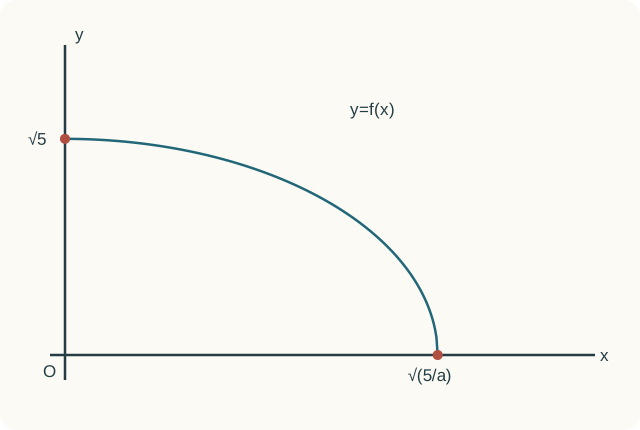
Sketch the curve y2+ax2=5 y^2+ax^2=5 for x≥0 x\ge0, y≥0 y\ge0, where aa is positive. [1]

f:x↦5−ax2 f:x\mapsto\sqrt{5-ax^2}, x∈Rx\in\mathbb R, 0≤x≤5/a0\le x\le\sqrt{5/a}; g:x↦1+e−x g:x\mapsto1+e^{-x}, x∈Rx\in\mathbb R, x≥0 x\ge0.

Show that f−1 f^{-1} exists and define f−1 f^{-1} in a similar form. [4]

Given f2(x)=xf^2(x)=x for all x∈Rx\in\mathbb R, 0≤x≤5/a0\le x\le\sqrt{5/a},

(i) show a=1 a=1 without evaluating f2(x) f^2(x), [2]

(ii) using (i), show fgfg exists and find its corresponding range. [3]

[2011/ACJC/Prelim/I/9]

Printed working

y2+ax2=5⇒y2(5)2+x2(5/a)2=1 y^2+ax^2=5\Rightarrow\frac{y^2}{(\sqrt5)^2}+\frac{x^2}{(\sqrt{5/a})^2}=1. Native first-quadrant ellipse has intercepts 5\sqrt5 and 5/a\sqrt{5/a}.

Any horizontal line y=ky=k, k∈Rk\in\mathbb R, cuts ff at most once ⇒ ff one-one ⇒ f−1 f^{-1} exists (shown).

Let y=5−ax2 y=\sqrt{5-ax^2}, 0≤x≤5/a0\le x\le\sqrt{5/a}. Then y2=5−ax2 y^2=5-ax^2 ⇒ x2=(5−y2)/ax^2=(5-y^2)/a ⇒ x=(5−y2)/a x=\sqrt{(5-y^2)/a} since x≥0 x\ge0.

f−1:x↦(5−x2)/a f^{-1}:x\mapsto\sqrt{(5-x^2)/a}, x∈Rx\in\mathbb R, 0≤x≤50\le x\le\sqrt5.

(i) f2(x)=x⇒f(x)=f−1(x) f^2(x)=x\Rightarrow f(x)=f^{-1}(x) ⇒ 5−ax2=5/a−x2/a\sqrt{5-ax^2}=\sqrt{5/a-x^2/a} ⇒ 5=5/a5=5/a and a=1/aa=1/a ⇒ a=1 a=1 (shown).

Alternative method: f=f−1 f=f^{-1} ⇒ graph symmetric about y=xy=x ⇒ ff is part of a circle centered (0,0)(0, 0) ⇒ 5/a=5\sqrt{5/a}=\sqrt5 ⇒ a=1 a=1.

(ii) Rg=(1,2] R_g=(1, 2], Df=[0,5] D_f=[0, \sqrt5]. Since Rg⊆DfR_g\subseteq D_f, fgfg exists. Domain/range flow: Dg=[0,∞)→gRg=(1,2]→fRfg=[1,2) D_g=[0, \infty)\xrightarrow{g}R_g=(1, 2]\xrightarrow{f}R_{fg}=[1, 2). Thus Rfg=[1,2) R_{fg}=[1, 2).

Teacher notes

Why the self-inverse inference works: f2(x)=x⇒f−1f2(x)=f−1(x)⇒f−1f(f(x))=f−1(x)⇒f(x)=f−1(x) f^2(x)=x\Rightarrow f^{-1}f^2(x)=f^{-1}(x)\Rightarrow f^{-1}f(f(x))=f^{-1}(x)\Rightarrow f(x)=f^{-1}(x) since f−1f(x)=xf^{-1}f(x)=x.

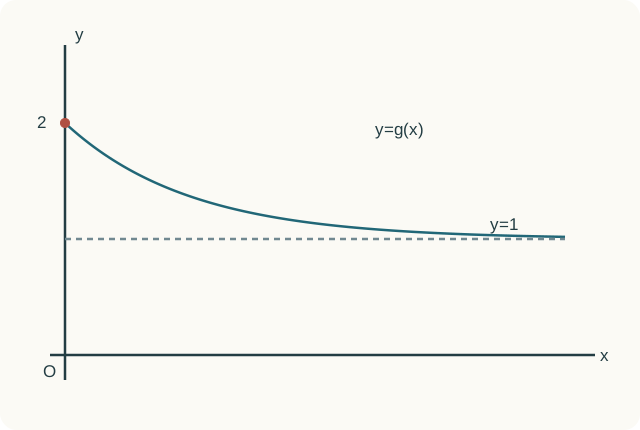
The graph of gg starts at closed (0,2)(0, 2), tends to the excluded asymptote y=1 y=1; the highlighted ellipse arc maps open input 1 to open output 2 and closed input 2 to closed output 1.

Answer key

Inverse as above, 0≤x≤50\le x\le\sqrt5; native ellipse sketch. (ii) Rfg=[1,2) R_{fg}=[1, 2).

Native diagrams

First-quadrant ellipse, closed intercepts √5 and√(5/a). g exponential with (0, 2) and y=1. Quarter-circle f highlighting Rg=(1, 2] and Rfg=[1, 2).